




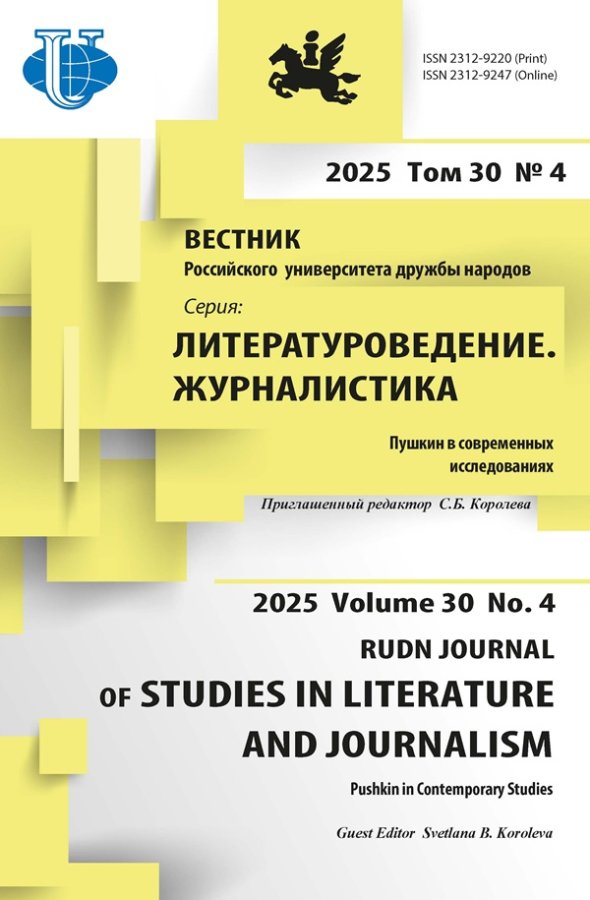
Volume 30, Nº 4 (2025): PUSHKIN IN CONTEMPORARY STUDIES
- Ano: 2025
- Artigos: 21
- URL: https://journals.rcsi.science/2312-9220/issue/view/24846
- DOI: https://doi.org/10.22363/2312-9220-2025-30-4
Edição completa

LITERARY CRITICISM
Pushkin and the Pushkin Myth in Contemporary Russian Literary Studies
Resumo
The aim of the article is to present an analytical review of research conducted in the mainstream of modern Russian Pushkin studies. The author analyzes the material of reports presented at the international Pushkin conferences of recent years; summarizes the content of articles published in this issue of the RUDN Journal of Studies in Literature and Journalism ; and identifies perspective areas of Pushkin research. Focusing on different aspects of the main areas that have emerged in modern Russian Pushkin studies, it describes the latter ones as follows: poetics and problems of Pushkin’s work in the context of tradition and era; poetics of Russian literature in the context of perception of Pushkin’s personality and work; the Pushkin myth (including its cretive interpretation and deconstruction) as a way of identification and selfidentification in popular culture and the individual author’s picture of the world; the ‘other’ Pushkin: his perception in other national cultures, with an emphasis on the distinctive features of foreign images of Pushkin. The relevance of comparative and receptive issues included in the problematic fi of modern Pushkin studies is accentuated; and the problems of correlation between the ‘Petersburg theme’ in Pushkin’s poem The Bronze Horseman and Byron’s Venetian text, of Pushkin’s way of developing the European myth of Don Juan in Russian literature, of reception of Dostoevsky’s “Pushkin Speech” abroad, and of penetration of the imagological myth about Russia into foreign Pushkin studies are commented on as examples. The following conclusions were made in this research: the contemporary fi of Russian Pushkin studies is distinguished by a diversity of issues and continuity with respect to the methodological tradition and the achieved results of research in this area; the comparativereceptive aspect is one of the most relevant in contemporary Pushkin studies; the depth and originality of the research perspective of the articles presented in this issue of the RUDN Journal of Studies in Literature and Journalism testify to the inexhaustible responses of Russian and world cultures to the poet, as well as to the endless prospects for discoveries along the paths of Pushkin studies.
 675-695


“Verse and Prose” in an Epistle to A.N. Wolf: on the Nature of Pushkin’s Poetic “Litter”
Resumo
The aim of this study is to analyze Pushkin’s epistle < Iz pis’ma k A. N. Vul’fu > (, 1824), with a focus on identifying the strategies that allow everyday language to penetrate poetic discourse. The text reveals a clear tendency toward prose, made possible both owing to genre specificity of a “friendly epistle” and in spite of it. On the one hand, this genre in Golden Age lyric poetry occupies a borderline position between art and everyday life, which makes it easily saturated with mundane details. On the other hand, the prosaic quality of the poem clearly violates the laws of high poetry (it is no coincidence that the poem was part of a letter to Wulf and not intended for print). However, the analysis of the work also reveals the opposite tendency, showing that Pushkin’s text is built on subtle literary play. The analysis leads to the following conclusions: The everyday imagery of the poem grows out of traditional motifs of a “friendly epistle”, which undergo a deep transformation; the artistic structure of the work incorporates an implicit reception of the poetic techniques of N.M. Yazykov, who was among its intended readers; as a result of combining opposite strategies, “prose” enters the lyrical discourse, expanding the sphere of high poetry. A vivid example of such a combination is the toponym Troegorskoe : by adapting the name of the estate to the metrical norm of the text, Pushkin subject everyday language to the laws of poetic speech. These tendencies can be traced in a number of Pushkin’s poems not intended for publication. Here, on the periphery of the lyrical system, is the precise locus of development of the poetics, which Pushkin in Eugene Onegin refers to as Flamandskoy Shkoly Pestryy Sor (The Flemish School’s Variegated Dross). This very designation is based on the artistic principles outlined above: the “prosaic” word “dross” simultaneously becomes a poetic metaphor, where everyday life is interpreted through the aesthetics of the Minor Dutch masters.
696-706
Alexander Pushkin’s Sources of the Meaning of the People’s War in L. Tolstoy’s novel War and Peace
Resumo
The aim of the study is to characterize the relationship between the image of the people’s war in L. Tolstoy’s novel War and Peace and the image of the Pugachev rebellion, as depicted in A.S. Pushkin’s The Captain’s Daughter . The character of Fyodor Dolokhov uniquely embodies the symbolic polyvalence of the notion of “war” in Tolstoy’s War and Peace . On one hand, he epitomizes its negative aspect - aristocratic pride and egoism, the central maladies of Russian life. On the other, Dolokhov’s predatory “ferocity” and “savagery” make him a key agent of the 1812 Patriotic War, which affirms the idea of “peace” as a universal, “communalswarm” existence. In this, Dolokhov channels the primal, “elemental-hunting” spirit of popular war, personified by Tikhon Shcherbaty. The prototype for such war, as an uprising of primitive hunting instincts, appears in Pushkin’s The Captain’s Daughter through Pugachev’s rebellion. Its leader reveals the rebellion’s essence to Grinyov via a Kalmyk tale of an eagle and raven: Better to drink living blood once than feed on carrion for three hundred years. Meanwhile, the turncoat Shvabrin exposes the logic behind Dolokhov’s amoral noble “self-will” - first adopting the “elemental-hunting” ethos as a mark of distinction, then dissolving into it completely. Like Shvabrin as Grinyov’s “useful saboteur” , Dolokhov plays an analogous role for Tolstoy’s protagonists (Pierre Bezukhov, Nikolai and Natasha Rostov). Both antagonists compel the heroes to harness that same primal vitality and will, rooted in nature yet guided by reason, measure, and morality. The following conclusions have been made in this research: within the literary universes of Pushkin and Tolstoy, a dialectical interaction between raw nature and human nature is revealed; by threatening to plunge the ordered world into primordial chaos, the elemental force of war, uprising, distraction ultimately reinforces its very structure.
707-716
A Pushkin Quotation in Ivan Karamazov’s Poem
Resumo
The aim of the study is to determine the functions of a quotation from Alexander Pushkin’s tragedy The Stone Guest in Ivan Karamazov’s poem The Grand Inquisitor . The author argues with previously expressed versions regarding the semantic potential of this quotation. Methodologically, the approach of the article is rooted in the idea that the quotation from Pushkin in the poem about the Grand Inquisitor is not only a form of expression of the author’s position (Dostoevsky’s), but also the position of the literary character, portrayed as the author and subject of the quotation (Ivan Karamazov’s). A hypothesis is put forward that the quotation from The Stone Guest can be regarded as a polemical argument against the inquisitorial concept of man, which Ivan Karamazov insists on. In light of the quotation from Pushkin, Ivan’s position is revealed as characterised by a profound duality and contradictions, which he himself directly denies. This hermeneutic hypothesis is based on an analysis of the genre specificity of the tragedy, which formed as a result of Pushkin’s reconceptualization of the comedic version of the Don Juan story; an analysis of the image of Don Juan as a tragic hero; an analysis of the philosophical integrity of The Little Tragedies cycle; and, finally, an analysis of the receptive structure of the tragedy The Stone Guest . The specificity of the latter is regarded as a task implicitly present in the text for the reader to overcome the inertia of the comedic stereotype in reading Pushkin’s version of the “eternal” plot. As a result of the study, the following conclusions have been made: the involvement (by the hero - Ivan and the author - Dostoevsky) of Pushkin’s quotation from The Stone Guest into the poem The Grand Inquisitor is significant for its meaning in the novel; its main function is to exacerbate the philosophical contradictions of the poem, the clash of opposing ideas about man; the quotation can be defined as an interpretant of Ivan’s position: in its light, that deep duality, which the hero denies, becomes obvious.
717-727
“Alexander Sergeyich, I Miss You”: Pushkin - a Personage of Georgy Ivanov’s Lyrics
Resumo
The purpose of the study is to identify the stylistic means of creating the image of Pushkin, as well as its aesthetic function in Georgy Ivanov’s works. It is argued that the intertext of G. Ivanov, references to the works of A. Pushkin occupy a significant place. However, Pushkin is present in the poetic world of G. Ivanov not only at the level of words and images, he is a living character in lyric poems, appearing in five texts from different periods of creativity. G. Ivanov focuses on important episodes of Pushkin’s fate: The Lyceum, the Decembrist uprising, marriage, duel, death. The major focus is G. Ivanov’s various techniques to introduce Pushkin as a character into the text: metrical allusion to Pushkin’s hexameter poems; conceptual integration of mental spaces; symbolization (Pushkin is one of the symbols of abandoned Russia); stylistic transformation of conversational genres. The following conclusions were made as the major result of the research: The figure of Pushkin embodies various facets of artistic meaning, relevant for the lyrical hero of G. Ivanov - the dream of poetic glory; personal involvement in tragic historical events; touching the world harmony, the music of the spheres; courage in the face of death; Guided by Pushkin’s antinomy of the “humble” and the “divine,” G. Ivanov constructs the image of Pushkin at the intersection of high pathos and low conversational elements
728-737
Pushkin in the Literary Manifestos of the 1920s
Resumo
The aim of study is to reveal the uniqueness of reception of the Pushkin myth in the context of post-revolutionary cultural transformation, when the poet’s legacy was subjected to both simplified interpretations and deep creative rethinking. Analyzing the critical works of V.F. Khodasevich, B.V. Tomashevsky, O.E. Mandelstam, and others, we point out the warnings of these authors against the canonization of Pushkin, turning him into an “aesthetic barrier” obscuring the living tradition. The central place in the study is occupied by the analysis of the aesthetics of “The Pass (Pereval),” where Pushkin’s principles - freedom of creativity, organicity, humanism - were rethought through the prism of a turning point in the era. Perevaltsy (The Pass’ Members) contrasted inspired creativity with the utilitarianism of Proletkult, developing the traditions of meditative lyrics (poems by D. Semenovsky, N. Zarudin, M. Golodny). Their works contain allusions to Pushkin’s motifs (“The Prophet,” “The Village”), but taking into account the tragedy of modern times. The philosophical and aesthetic term “tragedijnost`” introduced by the Perevaltsy was, in their opinion, the basis of true art. It is concluded that Perevaltsy (The Pass’ Members) saw in the classics not the “ashes” of the past, but living “seeds” for the future, preserving the continuity of culture. Prospects for further study of the reception of Pushkin in the literature of the “big twenties,” emphasizing the relevance of his legacy for understanding the dynamics of the literary process of the era.
738-749
Peculiarities of Responses to Pushkin in Works by the Satyriconists
Resumo
The aim of the study is describing the character of responses to A. S. Pushkin’s personality and works by Satyrikon writers (A. Averchenko, Sasha Cherny, N. Teffi, DonAminado, A. Bukhov, V. Knyazev, O. Dymov) - participants of the famous journals Satyrikon (1908-1914) and Noviy Satyrikon (1913-1918). It is argued that the character of allusions to Pushkin by Satyriconists is primarily comic, due to the demands of humorous discourse. Mentioning the name of the Russian classic, the authors use the techniques of farcical comedy and “nonsense comedy”, escalating numerous absurdities; sometimes they use the means of black humor. At the same time, the personality of the creator of Eugene Onegin and The Captain’s Daughter turns out to be a secondary fact for these authors. Pushkin for them is rather a symbol manifesting high achievements of Russian culture and literature. In this regard, an appeal to Pushkin can introduce serious meanings into the text, and their major function is to highlight the vulgarity of everyday routine, the stupidity and mediocrity of the modern “every” man. The following conclusions were made as a result of the study: the reception of the figure of Pushkin and Pushkin’s literary legacy by satirical writers was multifaceted; pursuing humorous goals, representatives of the famous journal include Pushkin’s name in the circle of “the comic nonsense”; at the same time, references to Pushkin help them to highlight the mediocrity and wretchedness of modern life and man; a special function of allusions to Pushkin’s work is revealed in these writers’ political satire.
750-759
The Bulgakovian Code of Alexander Galich’s Pushkiniana
Resumo
The objective is to describe the ways in which Bulgakov’s meanings are transformed, as implied in A. Galich’s references to the personality and works of A.S. Pushkin. The Bulgakov code of works, in one way or another correlated with Pushkin in Galich’s work, has not yet become the subject of a special research. The study traces forms of actualization of Bulgakovian impressions at different stages of Galich’s life as they are reflected in his mature works - the autobiographical novel Dress Rehearsal (“General’naya repetitsiya”) and the poems The Fires Have Broken Out (“Zanyalis’ pozhary”), Experience of Despair (“Opyt otchayaniya”), and Experience of Nostalgia (“Opyt nostal’gii”). Analyzing the conceptual significance of reminiscences from Bulgakov’s play about Pushkin and from The Master and Margarita , it focuses on the encoding function of a quotation from Anna Akhmatova’s epitaph for Bulgakov. Particular attention is paid to Galich’s response to the collision embodied in the figure of the Master: Bulgakov endowed his fictional Doppelganger with his own creative maximalism and human frailty, whereas Galich shifted the emphasis from circumstances of irresistible force to personal imperfection. The poet perceives Pushkin’s ideal fate as a reproach.The conclusions of the research suggest that: actualization of the Pushkin myth of in Galich’s work is based on the conviction of the uniqueness of the poet’s ideal path, with the Pushkin invariant functioning as an imperative; by interpreting his own destiny through the Bulgakovian code of the Pushkin myth, Galich was able to transcend empirical experience and, by universalizing his personal trials, repeatedly re-establish a connection with the ideal, embodied in Pushkin; in Galich’s reception, Bulgakov’s principle of the “indivisible yet unmerged” relationship between the Pushkinian and the Gospel myths emerged as a productively creative contradiction.
760-770
The Poems of A. Pushkin in the Antologia della Poesia Russa Edited by S. Garzonio e G. Carpi (2004): The Choice of Textes, the Choice of Translators
Resumo
The goal is translation strategies used in authoritative translations of A.S. Pushkin’s works into Italian. Using three translations of Pushkin’s works - the poems The Prophet , I Loved you ..., and an excerpt from The Bronze Horseman - included in the bilingual Anthology of Russian Poetry (Antologia della Poesia Russa) edited by S. Garzonio and G. Carpi (2004), three translation strategies are analyzed. It is argued that while Pushkin’s contemporary and his first Italian translator M. Ricci strives for precision and stylistic fidelity to the original, his younger contemporary A. Canini significantly reworks the text, bringing it closer to the song tradition and, in fact, creating a variation on the theme; M. Colucci’s translation reflects an approach based on a philological study of the text and illustrates the principles adhered to by most modern Italian translators from Slavic languages. The article touches upon the problems of conveying poetic form, language and style, the appropriateness of archaization and its methods, taking into account the potential readership and the need to provide the text with commentary. A comparison of the three translations allows us to conclude that this anthology is a valuable source of information not only about the history of Russian poetry, but also about the history of its translation in Italy, about the practice of poetic translation in general and about the most talented translators; it can be used within the framework of a course in the history and theory of literary translation.
771-778
Me and Alien: Confrontation and Convergence of Images in the Character System of Modern German and Czech Childrens Literature
Resumo
The development to the analysis of the development of conflict situations in children’s literary works, provided that unusual “alien” characters appear in them. Special attention is paid to the problem of transformation of the characters’ images and their worldview. The works of modern German and Czech writers were chosen as the research material: Eine Woche voller Samstage (1973), Am Samstag kam das Sams zurück (1980) by Paul Maar, Der Bärbeiß (2013) by Annette Pehnt, Bertík a chmuchadlo (2014) by Petra Soukupova. The study sets several tasks: to understand the essence of conflict situations, to analyze the process and results of changing the worldview of “heroes-wards” under the influence of “heroes-guides”, to demonstrate the importance of the appearance of “aliens” for conflict resolution. The article proves the following theses: in the system of characters of the work, the appearance of an “alien” is necessary, since it is he who is able to resolve the conflict by changing the internal attitude of other characters, as a result of which the transition of the “alien” into the category of “one’s own” is carried out. Using the example of the material under consideration, the following conclusions and observations are formulated: the fear, rejection and curiosity of the central characters in relation to the “alien” characters are gradually replaced by trust and sympathy. The main factor stimulating this process is the opportunity for the main characters to listen to themselves and look at themselves from a “foreign” position.
779-790
Adil Yakubov’s Poetological Construction: Aesthetic Criteria and Basis of Expression
Resumo
The dialectical unity of character and the human psyche, expressed artistically through the poetics of Adil Yakubov’s prose, is analyzed. This unity is based on the concept of character as an imaginary hero with a clearly defined will and psychological experiences, distinguished by individual characteristics. The problem of interpreting this colorful world is embodied in the formation of character. In fiction, particularly novels, the study of the world of images emphasizes aspects such as the elevation of heroes to the level of personae and their role in the development of events. It follows that the mastery of character creation is linked to the process of artistic discovery by the creator. The novels analyzed of Adil Yakubov place particular emphasis on reality, which serves as the basis for interpretation, the world of images, psychological experiences, and the processes of character development.
791-801
Mukhtar Auezov and Ivan Turgenev
Resumo
The aim continues the research on the creative legacy of M.O. Auezov, presenting new and relevant insights. It is the first study to examine the influence of I.S. Turgenev’s works on the Kazakh literary classic. The article analyzes previously unknown materials from Auezov’s scholarly and critical heritage, which reflect the history of Kazakh literature and its connections with the literary traditions of other nations. The study explores a previously unexamined area: the spiritual sources that nourished, inspired, and energized Auezov creatively. Alongside national literature, world literature - particularly Russian classical literature - played a crucial role. The article emphasizes that Auezov regarded Turgenev as a mentor who broadened his worldview and influenced his writing style. The authors investigate Turgenev’s impact on Auezov’s works, opening avenues for further research. Additionally, Auezov’s experience as a translator and his scholarly contributions in this field are examined. By introducing Kazakh readers to masterpieces of world literature, his translations of Russian classics elevated the standards of literary translation in Kazakhstan. This study contributes to the further exploration of literary connections, deepening the understanding of Russian classics’ influence on Auezov and his role in the cultural process.
802-812
JOURNALISM
Artificial Intelligence and Human-Machine Communication: A Challenge for Mediatization Studies
Resumo
The development of artificial intelligence technologies, including communicative AI, has become a serious challenge for mediatization studies. The article explores the limits of applicability of the mediatization research program and Andreas Hepp’s figurational approach to automated (human-machine) communication. The author poses and consistently develops three questions: how do mediatization studies consider AI as a subject of theoretical and empirical analysis; what are the potential and limitations of the figurational approach to humanmachine communication; what are the possible directions for reassembling this approach (and the mediatization program as a whole) in the era of communicative AI. Critical understanding of mediatization theory, and in particular, Andreas Hepp’s figurational approach, focuses on five key concepts: figurations, hybrid agency, media logics, quasi-communication and communicative AI. Assessing the heuristic potential of figurational optics in AI research, the author formulates a number of directions for its revision and further development. Given the cross-cutting and multifunctional nature of AI technologies that permeate multiple social worlds and practices, the analysis should not be limited to individual figurations; polyand interfigurative contexts are also important. In addition, it is necessary to study how figurations (social knowledge, values, and behavioral norms of different communities and institutions) are incorporated into artificial agents acting as a (multi)figurative Other. Finally, there are reasons to rethink the concepts of “hybrid figurations” and “hybrid agency” in the context of the growing influence of AI and “artificial humans”.
813-823
The Problem of Media Eco-Standardization: Scholarly Foundations and Institutional Challenges
Resumo
Examined the feasibility of establishing an independent media expertise system based on ecological principles. Through a multidisciplinary lens (media ecology, communication studies, digital sociology), it analyzes: key research trends in media ecosystems, criteria for media environment “sustainability”, and existing practices of content evaluation. The study aims to identify prerequisites for developing media eco-standards and systemic barriers to their implementation. The author argues for alternative media regulation mechanisms beyond state control or commercial interests, highlighting the tension between free speech and user protection from toxic content. The scholarly contribution includes a framework for assessing technological (filtering algorithms), institutional (NPOs’ role), and socio-cultural (media literacy) factors affecting standardization. The analysis demonstrates that current advancements in media ecology provide sufficient groundwork for collaborative research. A promising avenue is integrating expert assessments into media rankings using AI tools.
824-837
Code of Ethics for Modern Media Communications: Regulation Media Cultural Principles
Resumo
The subject of this research is the concept of a future Code of Ethics for Modern Media Communications - a set of normative rules. The goal is to articulate the problem of regulating media-cultural principles based on a new paradigm. The theoretical and methodological framework draws on media culture theory, the concept of professional journalistic ethics, and a critical approach to the ethics of artificial intelligence. A complex of methods is employed: historical-cultural analysis, systematization, structural analysis, case study, modeling, and secondary analysis of sociological data. An assessment of the new mediacommunication paradigm reveals that it unifies the media-cultural principles for all actors in the media space, leading to an equalization of status between professional media producers and ordinary social media users. Therefore, it is methodologically sound to focus not only on professional ethics but also on branch-specific ethics, with this category being specified as industrial ethics. Based on the research findings, the thesis on the necessity of developing a normative Code of Ethics for Modern Media Communications is put forward. Ideally, it will be founded on the norms of universal human ethics, acquire a supra-professional status, and extend to all types of media and differentiated groups of media-producing agents. The main idea of the Code is substantiated: the equivalence of media-cultural and media-ethical principles, and introduces the provisions of the future code into the agenda for discussion by both representatives of the media industry and the expert community.
838-847
Media Ambivalence of Organ Donation: Between Solidarity and Fear
Resumo
Focuses on how organ donation and transplantation are represented in Russian media in 2022-2024 (based on the online-publications in the seven leading periodicals: Komsomolskaya Pravda , TASS , RIA Novosti , Izvestia , Gazeta.ru , Interfax and Kommersant ). This content-analysis study aims to identify the specifics of how this type of donation is covered in media as well as at explicating the social factors that influence the development of transplant care in Russia nowadays. In total, from January 2022 to December 2024, there were identified 303 online publications on various types of donation (blood, organs and tissues, stem cells, germ cells etc.). The author selected 37 texts (12.2%) focused on organ donation and transplantation. The comparative analysis of genres and thematic accents highlighted some differences in the approaches of how these media cover the issues of organ donation and transplantation. As a result, some relatively contradictory trends were observed. On the one hand, some media resources, primarily Komsomolskaya Pravda , tend to promote this topic in order to create a positive image of organ donation. On the other hand, this and other news agencies mention the cases of illegal organ harvesting that might reinforce negative stereotypes and fears existing in Russian society related to “black” transplantation. Hence, an attempt has been made to explicate the issues and prejudices mentioned in the media through the concept of mortal transplant fears.
848-858
Cognitive and Emotional Impact of Environmental Media Texts on Youth: A Neuromarketing Study
Resumo
The results of a neuromarketing study of the mental states of the media audience are presented. The aim is to identify the basic emotions of young people in the process of consuming media texts on ecology. The study applied the main principles of cognitive and constructivist approaches, which made it possible to record and compare both conscious and unconscious (cognitive and emotional) reactions. The authors worked with texts on ecology (122 units) from 25 mass media and 14 social media outlets in the cities of the Chelyabinsk and Sverdlovsk regions. The respondents (300 people) were representatives of the age groups from 18 to 30 years old. The analysis showed that the subjects’ greatest attention was focused on the effects of environmental pollution on fl and fauna, and the negative impact of waste on the environment. The results of the theoretical and empirical study of the topic in accordance with the developed eye tracking methodology are presented for the fi time, data on the concentration of respondents’ attention on media content on environmental issues (cognitive aspect), as well as on the predominance of negative basic emotions (fear - 60%, sadness - 37%) after contact with information are systematized. The data obtained is in demand in media practice to improve the mechanisms of social interaction, increase the effectiveness of communications and develop eco content.
859-873
Narrating the Natural Catastrophe: Radio and Television Coverage of the Turkey-Syria Earthquake
Resumo
The media strategies used by leading Russian radio and television channels in covering the earthquake in Turkey and Syria in February 2023 were examined. The features of media discourse construction in news reports, and identified specific narrative and parainformational techniques used to interpret the events and exert a systemic influence on the audience are noted. A quantitative and qualitative content analysis of 100 news materials was conducted (Vesti FM, Channel One, Rossiya 1, NTV). It was found that the presentation of information was determined not only by the scale of the tragedy, but also by the broadcasting policy of the channels, which manifested itself in the layout of the releases, the use of emotionally colored vocabulary, visual images and intonation patterns. The scientific novelty lies in the comparative analysis of radio and television content, which allowed for the systematization of format-specific features and representation techniques of a natural disaster. The authors conclude that the strategy of emotional engagement of the audience and the political instrumentalization of events are dominant. A key finding was the identification of a hybrid narrative, where the tragedy served as material for addressing the conceptual tasks of the media.
874-886
Vertical Turn of Chinese Series: Impact of Mobile Viewing Practices on Industry and Narrative
Resumo
The aim is to identify the impact of mobile viewing practices on narrative strategies and economics of the web series industry. The relevance of the work is due to the rapid growth of the vertical video market and its growing influence on the global media industry, while this format remains insufficiently studied in academic discourse in Russian. The research methodology includes an overview-analytical method, formal narrative and discursive analysis, as well as analysis of industrial data. Based on the study of more than 20 specific series and reports from analytical agencies, the specific features of the format are revealed. A detailed definition of vertical microseries is given as a modular audiovisual form optimized for mobile platforms. The key narrative features are revealed: plot-driven orientation rather than character development; the use of “hooks” and cliffhangers; compensation for the predictability of the plot due to visual entertainment. The ambivalent role of the format is revealed: on the one hand, thematic freedom and the use of the current Internet language, on the other - dependence on adaptations (IP) and the risk of creative homogeneity. The transformation of the industry’s business models towards algorithmic distribution and detailed monetization schemes integrated into the ecosystem of short videos is analyzed. It is concluded that the vertical microseries is a promising universal format, whose success is based on a unique combination of relevant media forms, interactive consumption practices and commercial efficiency, which provides it with the potential for deep integration into the global media space.
887-901
The Impact of AI Attitudes on Detecting AI-Generated Political Content
Resumo
The rise of generative artificial intelligence (AI) raises critical questions about users’ ability to distinguish AI-generated content from human-generated content, particularly in the political domain. This study investigates the relationship between subjective attitudes towards AI and the accuracy of detecting AI-generated political content. In an experiment involving political science students (n = 60), participants were asked to identify definitions of “political values” generated by the ChatGPT model and to assess their degree of ideological bias. The results revealed that, on average, only about half of the participants correctly identified the artificial origin of the definitions. However, the group of “optimists”, who hold a positive view of AI development, demonstrated significantly higher detection accuracy compared to the “neutral” group. Paradoxically, it was the “neutral” respondents who were significantly more likely to rate AI-generated content as completely objective and devoid of ideological bias. This suggests that a neutral, rather than a skeptical, stance towards AI may create a blind spot for potential ideological influence, as such content does not undergo sufficient critical reflection. The study contributes to understanding how user attitudes mediate the perception of political content in the age of generative AI.
902-915
REVIEWS
Russian National Branding: Between Cultural Archetypes and Marketing Strategies
Resumo
The communicative landscape in contemporary Russia demonstrates a marked turn towards national cultural traditions, folklore, and classical art. Unlike the often opportunistic campaigns in popular culture, branding and marketing communications, due to their commercial nature and drive for monetization, signal a new level of identity processes that are permeating everyday life precisely because of their resonance with the public consciousness. The goal is to identify the deep, archetypal foundations of the phenomenon of the national brand, which, in its hybrid form, serves both as a tool for creating a “unique cultural proposition” for the world and for affirming ethico-semantic constants within society that influence internal communication as a tool for identificatory reflection. The methodological framework is based on qualitative casestudy analysis, supplemented by the dialectical principle of historicity, tracing the transformation of cultural patterns from classical exemplars (e.g., the Ballets Russes, Russian ballet) to contemporary hybrid forms (e.g., the Khokhloma brand, the Sigma Boy media phenomenon). The analysis proves that the resilience and success of a national brand are directly correlated with its embeddedness in the specific patterns of the national consciousness, with its orientation towards integrity and a spiritual tonality. In conclusion, the article substantiates the crucial distinction between authentic cultural archetypes and imposed ideological simulacra in the context of Russia’s contemporary branding strategy.
916-927