





RUDN Journal of Political Science
Editor-in-Chief: Yuriy M. Pochta, PhD, Professor
ISSN: 2313-1438 (Print) ISSN: 2313-1446 (Online)
Founded in 1999. Publication frequency: quarterly.
Open Access: Open Access  APC: no article processing charge.
Peer-Review: double blind. Publication language: Russian, English
PUBLISHER: Peoples’ Friendship University of Russia named after Patrice Lumumba (RUDN University)
Journal History
Indexation: White List, Russian Index of Science Citation, RSCI, Google Scholar, Ulrich's Periodicals Directory, IPSA, WorldCat, Cyberleninka, DOAJ, Dimensions, ResearchBib, Lens, Research4Life, JournalTOCs, British Library, Bodleian Libraries (University of Oxford), Ghent University Library
Media registration certificate: ПИ № ФС 77 - 61179 от 30.03.2015
Official website: https://journals.rudn.ru/political-science
The mission of the Journal is a broad exchange of scientific information and results of theoretical and empirical studies by researchers from different fields of Russia's Political science: Comparative Politics, Russian Political History, Political Sociology, as well as Political Philosophy and Political Psychology.
The purpose of the Journal is enhancement of research efficiency in the field of political science on the basis of the development of scientific, editorial and publishing activities as well as dissemination and approbation of modern techniques and the latest achievements of political science in order to realize the mission of a modern classical university. Principal objectives of the journal:
- conceptualization of political problems, goals, trends and tasks and further development of political self-consciousness and political culture;
- providing the researchers with an opportunity of free expression and exposition of their vision of political processes and institutions within the framework of scientific discourse while allowing critical review of political problems through the prism of certain concepts, aspects and approaches;
- cooperation with Russian academic and educational institutions in order to expand the information field and promote exchange of scientific knowledge;
- in publications, materials should be selected according to the specificity of RUDN University in general and topics of selected countries in particular;
- expanding the authors’ cooperation network;
- promoting the image and helping to further recognition of the journal by expanding its international activity and visibility;
- advancing the journal in the market of scientific periodical reviewed works;
- using the published materials in research and educational process at Political Science departments of Russian higher educational establishments as well as within the Human Sciences framework.
The journal is designed for publishing the results of independent and original research works by researchers, professors of RUDN University and scientific centers in the form of research articles, review materials, scientific reports, and bibliographical reviews on certain subjects and within selected scientific areas. The journal provides an overall coverage of political processes in Russia and the contemporary world. At the same time, following the scientific trends of the University, special attention is paid to Russia-related studies: Political history of Russia; Religion and state politics; Contemporary political process; Russia in the system of international relations; Foreign policy of Russia; political thought and methods of Political Science research. Particular attention is paid to the problems of political and state development of contemporary Russia. Research is based on the principles of methodological pluralism and the interdisciplinary approach, as well as studies of international relations and dialogue of civilizations in the context of ongoing changes in the global landscape. Concurrently, traditional methodological tools of Political Science are being reconsidered.
Submit a manuscript: https://journals.rudn.ru/political-science/author/submit/1
最新一期
卷 27, 编号 4 (2025): Politics in Africa and Africa in Politics
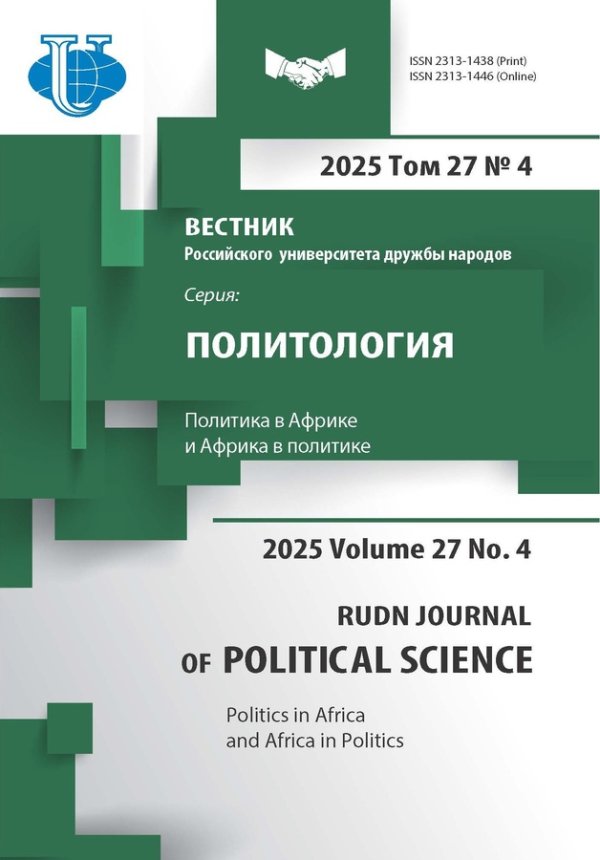
- 年: 2025
- 文章: 19
- URL: https://journals.rcsi.science/2313-1438/issue/view/25004
- DOI: https://doi.org/10.22363/2313-1438-2025-27-4
完整期次

Editorial
The Crisis of the Western Model of Globalization and the Socio-Political Development of Africa: Lessons from the Aggravation of International Relations
摘要
In the editorial article, the editor-in-chief of the journal, Yu.M. Pochta, presents the materials of the issue, interpreting their cross-cutting themes as issues of the development of the states of the African continent in the context of the crisis of the Western model of globalization. This crisis has become most evident in the context of the aggravation of international relations in connection with the Russian Special Military Operation in Ukraine. Russia’s conflict with the collective West is not only evidence of its aggressiveness. Western society itself is in crisis, involving all of humanity, including the societies of Africa, complicating the processes of socio-political development and liberation from neocolonialism for them. The articles presented in the issue cover a wide range of political science topics related to Africa, from the colonial legacy and postcolonial politics to modern development challenges, conflicts and foreign relations. Many works analyze the impact of historical colonialism on modern African states, including reparations for the slave trade through the African Union, the change of the neocolonial paradigms of France and the impact on the politics of West African countries, emphasizing the need to conceptualize social states and classify political regimes (one-party, multiparty and dominant). The articles also explore the evolution of sub-Saharan foreign policy orientations, the global consequences of local conflicts in the Horn of Africa, and the economic effects of COVID-19 on food security in West Africa. Country analyses focus on traditional institutions such as chieftainship in Ghana, resource risks in the Democratic Republic of Congo, and party systems in Tunisia, Mozambique, and South Africa, including the role of Islamist movements and military coups in Burkina Faso. Finally, external aspects include Russian network diplomacy in Africa and the transformation of narratives about Russia among West African youth, as well as comparative studies of military movements in Egypt, illustrating the intersections of African and Middle Eastern politics. These themes highlight the dynamics between history, development, and global connections, offering a critical look at the sustainability of African political systems.
 701-712


POSTCOLONIAL DEVELOPMENT
Reparations for the Transatlantic Slave Trade and the Crimes of Colonialism: The Current Agenda of the UN and the African Union
摘要
In recent years, the agenda of reparations to Africa by Western countries for the crimes of the transatlantic slave trade and colonialism has been gaining increasing popularity in both academic and political discourse. The study analyzes contemporary discourse in both political, legal and economic terms, as well as the representation of this issue in Russian and Soviet academic literature. Particular attention is paid to the formation of political discourse, including in the context of the work of the Group of Eminent Persons established in 1992 in West Africa in order to draw attention to this topic and a number of conferences held on private initiative in the 1990s. The researshers show how the issue of reparations justice has reached the level of the UN and the African Union, practical steps taken in this regard and their consequences. The article examines the political and legal aspects of paying reparations to Africa in Western discourse, including the problem of retroactivity of legal norms, repeatedly raised by Western experts, and its political deconstruction. Particular attention is paid to the strategy of Western countries related to responding to the problem of reparative justice. The structures sponsored by Western funds are quite closely integrated into the reparative agenda of the African Union. In this context, the practical implementation of the UN and African Union decisions in this area will largely depend on the level of demonstrated African agency. If the outcome is favorable, the reparations received can be an important source of financing for the sovereign development of the African continent.
713-733
Postcolonial Policy of France in Africa: Change of Neo-Colonial Paradigms
摘要
The relevance of the study of the problems of France’s postcolonial policy in Africa is determined by global geopolitical changes that have increased the importance of the “Global South” in the world. The Republic of Mali is a clear example of the rapid transformation of relations with France, its former metropolis. The purpose of the study is to identify the neocolonial nature of two foreign policy strategies of “Françafrique” and “Afrique-France” in France’s postcolonial policy. The theoretical basis for achieving this goal is the theory of postcolonial discourse, which belongs to the scientific direction of postcolonial studies (E. Said, H. Baba, G. Spivak). To solve the research problems, the concept of “deconstruction” of the theory of postcolonial discourse was used, which describes the way to identify and criticize colonial stereotypes. The preservation of colonial stereotypes in the strategies of France’s African policy, which are reflected in the public consciousness of French society, is proven. The result of the study is to establish the causes and methods of reproducing colonial stereotypes in the postcolonial policy of France, to identify the principles of formation of discursive technologies for promoting “Western” neocolonial strategies in political practices.
734-745
The Impact of Colonial Legacy on Contemporary Politics in Africa: A Case Study of West African Countries
摘要
The colonial legacy still impacts the formation and functioning of political systems in West African countries. The study addresses institutional, ethnopolitical, cultural, and economic aspects of the region’s postcolonial development. The analysis demonstrates that artificial borders created during the colonial era, ethnic fragmentation, institutional weakness, and persistent economic dependence on former colonial powers remain key factors shaping both domestic and foreign policy dynamics. Special attention is given to the dual nature of political culture, which combines elements of traditional power structures with Western governance models, as well as to the phenomenon of “decolonization of consciousness” as a cultural and ideological process aimed at rethinking identity and development trajectories. Drawing on historical and contemporary evidence, the study explores mechanisms for reproducing neocolonial relations, the role of the military in politics, challenges to national integration, and the influence of colonial policy on migration processes. The conclusion emphasizes the need for comprehensive institutional and cultural reforms aimed at strengthening sovereignty and building an inclusive political system that takes into account historical experience, ethnic diversity, and the challenges of globalization.
746-758
MACRO-REGIONAL ISSUES
Evolution of Foreign Policy Guidelines of the States in Sub-Saharan Africa
摘要
The relevance of the study lies in the fact that African countries are becoming an integral part of political and economic processes in the world. African leaders build their cooperation strategy on the basis of national interests and mutual benefit, focusing on strengthening sovereign states. African leaders pay great attention to the military-political aspect of international cooperation, since a number of countries on the continent are experiencing a high intensity of local and interstate conflicts. This is evidenced by the aggravation of the situation in the Sahara-Sahel region in 2023-2025. That is why regional military-political alliances are being established and agreements with traditional defense partners are being revised. The research focuses on the maturation of the political elites of African states, their pragmatism and disassociation from the former metropolises, which in turn seek to keep them in the orbit of their influence. Neo-colonialist mechanisms such as Fransafrique are criticized and protested by the majority of Africans. The independent choice of partners is emphasized, not only from among Western countries, but also from non-Western countries. Interaction with Russia is emphasized in light of the decisions of the 2019 Sochi and 2023 summits in St. Petersburg and the Russia - Africa Inter-Ministerial Meeting in Sochi in November 2024. The emergence of such a platform as the Russia - Africa Forum has significantly increased the opportunities for African countries to implement national projects and strengthen their positions in international affairs. The aspiration of African countries to participate in the BRICS inter-civilizational association is seen as a good prospect for political growth and international prestige of African countries. It has been proved that the political activity of African countries is steadily growing, which contributes to the consolidation of their authority in the world, improvement of economic performance, and helps to combat illegal armed groups. The work applied a comprehensive approach to the processes under consideration, used event-analysis with critical evaluation of information.
759-774
Developmental Welfare States in Africa: Conceptualisation and Classification
摘要
The concept of welfare state based on the criteria that G. Esping-Andersen elaborated for developed capitalist economies - OECD member-states. The problem of the possibility of implementation of this concept in African states forms the key research question of the paper. We study various theoretical and empirical classifications of approaches adapting and transferring the methodology of welfare states towards developing countries and Africa, in particular, including the ones introducing the notions of developing welfare state and meta-welfare regimes. The limitations of the implementation of this concept in Africa are connected to the absence of democratic regimes, low level of economic development and certain weakness of state as a political actor. Precommodification happening in Africa in the late 20th century while commodification was giving way to decommodification in the developed economies is in fact the main peculiarity of Africa from the viewpoint of welfare state criteria. The adapted criteria enable the usage of new terms within the academic discourse like productive, protective and dual regimes; informal security regimes and insecurity regimes; labour reserve economies and cash crop economies; Middle African and Southern African models of social protection, etc. Comparing these theoretical approaches to an empirical classification of states according to the level of Human Development Index, and taking into consideration the known worldwide rise of the index for the last decades together with the presence of state social protection programmes in Africa, we can argue that an original developing welfare state exists on the African continent which we suggest to name ‘welfare state with adjectives’. The diversity of its representations under the conditions of the absence of any unite African model of welfare state depends on the heritage of the colonial past and postcolonial transition, religion, the level of economic development, differentiated dependence on the international community and capacity of state to fulfil social functions on its own.
775-792
Impacts of COVID-19 on the Economic and Humanitarian Situation of Food Security in West Africa
摘要
There has been a noticeable spike in food insecurity during the aftermath of the COVID-19 which has been on the increase in both Nigeria and Burkina Faso. This study made use of mixed methods research design to explore how COVID-19 affected the economic and humanitarian aspects of food security in West Africa. The purpose of this document is to provide clear highlight on the actions and responses of Nigeria and Burkina Faso to the emergence of COVID-19 concerning its implications on the food sector. Findings revealed that agriculture has made a significant contribution to the GDP of both Nigeria and Burkina Faso but witnessed a change during the outburst of COVID-19. We concluded that the government rolled out a series of policies both cash-based and food-based through subsidies and palliatives that ensure prices of food are monitored and that the vulnerable are provided with food. This paper therefore recommended that more work be done on how to integrate the use of technology to improve food security in both Nigeria and Burkina Faso and the rest of West Africa.
793-804
From Local Conflicts to Global Implications: The Ripple Effects of Political Violence in the Horn of Africa
摘要
Political violence in the Horn of Africa has significant implications that resonate beyond local borders, impacting global security and international relations. This study aims to investigate the historical and socioeconomic factors contributing to regional political violence and to assess how these local conflicts cascade into global security dynamics. A historical-analytical approach was applied, drawing on various data sources, including conflict statistics and security analysis reports, to trace the pathways through which local violence escalates into broader geopolitical concerns. The findings reveal that local conflicts in the Horn of Africa contribute to transnational security threats such as terrorism, piracy, and illegal arms trade, while also influencing migration patterns and humanitarian crises that affect multiple regions worldwide. The analysis shows a strong linkage between regional instability and shifts in international relations, with increased intervention efforts by neighboring countries and international organizations. The study further identifies the impact of these conflicts on economic stability and the strategic re-calibration of foreign policies. In conclusion, understanding the ripple effects of political violence in the Horn of Africa is essential for developing effective policy strategies aimed at conflict resolution and global stability. Addressing these conflicts requires a comprehensive approach that considers both the regional and global dimensions of security.
805-815
СOUNTRY-SPECIFIC CASE STUDIES
The Evolution of Chieftaincy Power in Ghana’s Political Governance: From Historical Legacy to Contemporary Role
摘要
The presented research provides an up-to-date view of the institution of traditional authority - the power of chiefs, in modern Ghana. Despite the fact that their political influence has changed over the course of history, Chiefs in Ghana are still politically authoritative figures, influence the electoral process, manage tribal lands and implement local, normatively unregulated forms of community governance and legal proceedings in the role of a «justice of the peace». This role of chiefs in society raises the problem of their political inclusion in the system of governance at different levels and their status as influencers in election campaigns. In this regard, the aim of the work is to study the modern political role of chiefs in the system of socio-political relations in Ghana with an emphasis on the historical transformation of this role in the postcolonial period. To this end, the author applies a structural-functional approach to the analysis of the role of chiefs in the system of political power in Ghana, a normative-legal analysis to present the legal dimension of their activities and a retrospective analysis to present the evolution of their powers, functions, and, as a consequence, political influence. The example of the Republic of Ghana, considered in this article, clearly demonstrates that even one of the most developed democratic systems in Africa has a pronounced traditionalist political dimension. Despite the fact that the country’s constitution does not allow chiefs to participate in elections at all levels as candidates, the political reality demonstrates their deep involvement in the political process on an informal basis. Authority in tribal communities and the right to dispose of the historical land of the tribe makes them priority agents of political influence in the national electoral system. As the study shows, it is their support that largely determines the victory of not only members of parliament, but also presidents of the country. In this regard, the political process in Ghana appears as quasi-democratic and based on traditional forms of power, which act as an informal platform for the political struggle of parties and elites.
816-832
Natural Resources, Ethnopolitical Conflicts and Risk Factors for Sustainable Development in the Democratic Republic of the Congo
摘要
The issue of natural resources as a driver of political destabilization in the Democratic Republic of the Congo (DRC) is a critical focus of scholarly analysis. However, the complex interplay of resources with weak institutions, demographic pressures, ethnic fragmentation, and external intervention requires deeper systematic examination. Studying these mechanisms, determining their specific causal pathways and combined destabilizing effects, is paramount for political science and development studies, as it allows for assessing for multifaceted challenges to sustainable peace and governance in resource-rich, fragile states. A systemic interdisciplinary approach, combining political science, demographic, economic and ecological analysis, was employed to understand the destabilizing dynamics. Case study and content analysis of specific conflicts (Bateke Plateau, Eastern Kivu) enabled the identification of causal links and the role of resource control. It has been found that resources catalyze ethnopolitical conflicts through four interconnected mechanisms: the institutional, the socio-demographic, the ethnic, and the external. Environmental degradation and climate change impacts further exacerbate these dynamics by intensifying competition over land, water, and livelihoods, provoking displacement and new conflict lines. Unlike simplistic notions of the “resource curse”, this study demonstrates that sustainable development in the DRC is contingent upon fundamentally strengthening state and political institutions to manage resources, mitigate interconnected socio-economic and environmental threats, and counter fragmentation, as the primary prerequisite for stability.
833-847
Resources and Power Dynamics in the Democratic Republic of the Congo: Interplay Between Formal Institutions and Informal Networks of Governance
摘要
The aim of the study is to analyze the interrelation between natural resources and power in the Democratic Republic of Congo through the lens of formal and informal governance regimes. The methodology is based on an interdisciplinary approach, drawing on the concept of legal pluralism, research on the “resource curse” phenomenon, and analysis of the interaction between formal and informal actors as well as external players. The study identifies the mechanisms through which the DRC’s natural wealth becomes a driver of socio-economic vulnerability and political instability. The results show that in the DRC, the resource curse manifests in a complex manner, encompassing mineral, land, and water resources, as well as ecological systems, and transforms into a structural factor of internal instability. Control over resource extraction serves as a source of both revenue and power, which reinforces institutional weakness, provokes conflicts, and exacerbates poverty. The conclusion is drawn that without institutional reform and the establishment of mechanisms for accountable and inclusive resource governance, the DRC will remain in a state of chronic instability, where natural wealth reproduces crisis rather than development.
848-866
The Expansion of the Influence of Political Islam in South Africa, as Exemplified by the Activities of Transnational Organizations
摘要
This research provides a political science analysis of the mechanisms and channels of influence of transnational movements within the ideological spectrum of political Islam on political processes in host countries. Using the case of South Africa, the adaptation of global Islamist ideas to the conditions of a secular democratic state with an ethno-confessional minority is explored. The research methodology includes a comparative analysis of sources, critical discourse analysis, and an examination of the activities of non-governmental organizations. The scientific novelty of the work lies in its comprehensive examination of the South African case through the prism of theoretical concepts of political Islam and the introduction of relevant and modern data, as well as local expert assessments, into scholarly discourse. It is concluded that in South Africa, socio-political and human rights forms of activism, integrated into the country’s legal framework, rather than revolutionary ones, predominate.
867-880
The Peculiarities of the Modern Tunisian Party System
摘要
Tunisia is one of the most developed countries in the Arab world with an active party and political life. This research analyses the development of political parties and the current state of the party system in Tunisia. It examines the main features of the political system, the history of the formation of the party system, the relationships between the parties and the current alignment of the country’s political forces. The author concludes that Tunisian parties have repeatedly faced crisis situations, one of which is evident at the present time. This crisis can be attributed to a combination of external circumstances, such as the political reforms of president K. Said and the adoption of new legislation that significantly limited the influence of political parties, as well as internal instability within the parties themselves. Following the events of the ‘Arab Spring’, new elements were introduced to Tunisia’s political system and serious changes were made; however, the factors of continuity from the previous regime still retained their influence. Democratic reforms have not been sufficient to improve the standard of living of the country’s citizens or to resolve its difficult economic situation. Currently, several parties are attempting to unite their efforts to advance their demands and protect their interests, while several political forces and movements are declaring their support for the presidential course. The ability to overcome the crisis largely depends on whether the various parties and socio-political movements can reach an agreement. Conversely, the president will need to develop a new, sustainable political model to maintain his position and ensure the stability of the existing state system.
881-895
Dynamics of the Electoral Processes in Mozambique in 2014-2024: At the Junction of Global Influences and Local Specifics
摘要
One of the key problems in many sub-Saharan African countries in the 21st century is the irremovability of ruling parties while formally recognizing the freedom of choice of the population. The purpose of this study is to characterize the main transformations of electoral preferences of citizens of the Republic of Mozambique, taking into account the key factors influencing the spatial distribution of votes in 2014-2024. The scientific novelty of the work lies in the fact that changes in the socio-political situation in Mozambique are considered in connection with the results of electoral cycles, expressed in the number of votes in each of the 11 provinces of the country. It was established that after the last three cycles of the presidential elections in 2014, 2019 and 2024, the electoral monochromacy in the state has significantly increased: the disproportions in the spatial and territorial distribution of the electorate’s votes are significantly leveled. The main scenario for the development of the socio-political situation in Mozambique was determined at the end of the current electoral cycle in 2024. It presupposes further territorial consolidation under the rule of FRELIMO, the weakening of the historically most active opposition in the person of the RENAMO national democrats due to a conflict in the leadership of the organization and the transition of PODEMOS activists to the number of moderate parliamentary oppositionists.
896-908
Military Coups in West Africa: The Case of Burkina Faso
摘要
There were eight military coups in Burkina Faso since 2020, including two in 2022. Author examines the key aspects and sequence of military coups in Burkina Faso in 2022, as well as their main causes and consequences. It identifies the causes of instability, including internal socio-economic problems, terrorist threats from groups, and the impact of the crisis in neighboring countries - Mali and Guinea. The study highlights the parallels and impact of the military coup of January 2022, as well as the process of the military coup of September 2022 and the reactions to the coup. The first coup in January 2022 was a consequence of serious threats to national security associated with the actions of terrorist groups, which caused mass protests and public disappointment in the work of the ruling structures. The military seized the moment and took over, citing the need to restore order and combat terrorism. Against this backdrop, a second military coup was carried out in September 2022, which was caused by growing internal destabilization, popular discontent, and divisions within the armed forces. During this event, the military again seized power, replacing the leader, and emphasized its role in ensuring the country’s stability. This paper also provides a comprehensive overview of the current situation and prospects for further development of the situation in the country. It examines the government’s efforts to restore stability, develop infrastructure, and combat corruption, as well as new political steps, including the abandonment of elections and the expansion of the powers of President Ibrahim Traore. The article also examines the international reaction, including the condemnation of the military coups by the European Union and regional structures, primarily ECOWAS.
909-919
The Role of Military Backgrounds in the Liberation Movements of Middle Eastern Leaders: A Case Study of the Free Officers Movement in Egypt
摘要
The military backgrounds allowed strategic discipline and command structures and elite networks to lead decolonization through the study of Egypt’s Free Officers Movement. The research shows that military officers who initiated uprisings such as Gamal Abdel Nasser employed their battlefield experience to rapidly achieve revolutionary objectives, while creating enduring authoritarian systems of control. The research uses content analysis along with historical-comparative analysis of primary documents to present new insights about how military origins influenced both liberation movements and permanent government systems in the region. The research demonstrates that military leadership functioned as a fundamental power force which molded revolutionary movements and state development in post-colonial nations.
920-930
RUSSIA AND AFRICA
Formats of Russia’s Network Diplomacy in Africa
摘要
The relevance of the study is due to the need to rethink the role of new formats of diplomatic interaction considering the deepening cooperation between Russia and Africa, new trends in international relations (such as increased involvement in cooperation of representatives of multilateral associations and non-governmental actors, securitization of new sectors of world politics). The purpose of this article is to show how the tools of Russia’s network diplomacy can be used to strengthen partnerships between the Russian Federation and African states in various areas - political, economic and humanitarian. At the same time, the author emphasizes that the formats of network diplomacy at both the global (BRICS, G20) and regional (Russia - Africa Economic and Humanitarian Forum, thematic working groups and, in the future, formats for the settlement of military-political conflicts) levels can act only as auxiliary tracks, without replacing traditional channels of diplomacy (summits, ministerial meetings and working diplomatic contacts). The works of Russian and foreign experts revealing the theoretical foundations of network diplomacy (Morozov, Lebedeva, Burganova, Metzl, Slaughter, etc.) as well as those devoted to the analysis of Africa’s positions in the system of international relations (Harberson, Rothschild, Kortunov, etc.) were useful for the current study. It was carried out based on structural-systemic and historical-comparative research methods. The uniqueness of the article lies in the fact that the author assesses the prospects for the development of existing formats of network diplomacy taking into account Russia’s strategic foreign policy priorities in Africa and suggests ways to develop new formats of network interaction that would contribute to the resolution of key military-political and socio-economic problems of the region.
931-944
Relations Between Russia and Africa: Dynamics and Challenges
摘要
The growing relevance of this topic stems from Russia’s deepening engagement with Africa amid ongoing global geopolitical transformations. In recent years, Russia has expanded its political, economic, and humanitarian presence on the continent through diplomatic initiatives, trade and investment, military-technical cooperation, and cultural exchanges. These developments have reshaped African perceptions of Russia and influenced regional and global power dynamics. The research examines how Russia’s image has evolved across African countries, taking into account historical legacies, political and economic factors, and socio-cultural dimensions. It identifies the main drivers behind the transformation of Russian - African relations and assesses their implications for Africa’s development and the emergence of a multipolar world order. The study employs historical, comparative, and content analysis methods, drawing on official documents, policy reports, and statistical data. It investigates how Africa’s growing integration into the global economy affects competition over its natural resources and attracts greater interest from external powers, including Russia. Among them, Russia seeks to strengthen its influence in the region amid shifting geopolitical dynamics. Despite progress in political and cultural cooperation, economic interaction remains limited, reflecting persistent challenges in trade diversification and institutional cooperation.
945-956
Transformation of Narrative Representation of Russia among Youth in West Africa
摘要
Western mainstream media narratives about Russia affect the perception of youth in West Africa regarding Russia as a global role player. The research is based on a synthesis and integration of scholarly studies, as well as newspapers and reports from selected Western media outlets. A broad literature review was first conducted to understand the body of knowledge on Western media narratives and their effects on people’s perceptions of Russia. A narrative matrix was used as the main approach to map out the narratives about Russia, and thematic analysis was finally employed to identify the themes and sub-themes from the media narratives to examine how these narratives affect youth perceptions of Russia as a global player. The study identifies three competing narratives: the first is the dominant narrative in Western media, which describes Russia negatively in terms of its imperial interests. The second is the counter-narrative from several scholars, global South media outlets, dissenting politicians, and individuals who assert that NATO’s expansion to the east threatens Russia’s security and is the cause of the recent geopolitical crisis. The last is the alternative narrative, which assumes that Africans see Russia as a potential ally for mutually beneficial cooperation, despite the recent geopolitical crisis. The article concludes that the counter and alternative narratives have been marginalized and overshadowed by the dominant narratives propagated by Western media, which tend to shape youth perceptions of Russia as a negative global player, especially regarding narratives about the crisis in Ukraine.
957-970