




 Acesso aberto
 Acesso está concedido
 Somente assinantes
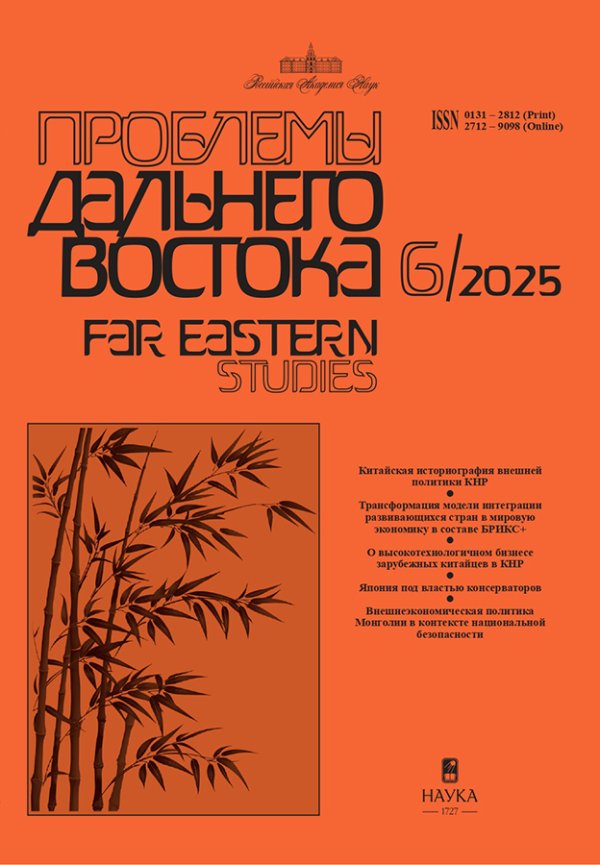
Nº 6 (2025)

Politics
Japan under Conservative Rule. On the 70th Anniversary of the Liberal Democratic Party of Japan
Resumo
This article analyzes the long and, in many ways, unique reign of the Liberal Democratic Party of Japan (LDP), which has held power, with only a few interruptions, for nearly seven decades since its founding in 1955. It examines the institutional, social, and economic mechanisms that have enabled the party to maintain its leading position in the country's political system. These include the LDP's ability to adapt to changing conditions, skillfully combining traditional values with pragmatic approaches to governance, as well as its effective interaction with the bureaucracy, big business, and regional elites. It examines how the party's internal organization, the presence of stable factions, and the distribution of resources within it ensure stability and controllability of political processes. It also emphasizes that such dominance does not guarantee perpetual power: demographic changes, an aging society, declining trust among young people in traditional parties, and intensifying political competition create new risks. The article concludes that the LDP's future development will largely depend on its readiness for internal transformation and openness to new ideas. Rethinking traditional governance approaches, implementing structural reforms, and strengthening government transparency measures can not only renew the political system but also strengthen public trust. Amid growing international instability and technological change, the LDP must find a balance between maintaining continuity and adapting. The success of these efforts will determine whether the party can maintain its leading position, ensuring sustainable development and political modernization in Japan in the 21st century.
 5–19
5–19


The Cybersecurity Policy of the Republic of Korea 2017–2025
Resumo
The present article examines the evolution of the Republic of Korea's cybersecurity policy between 2017 and 2025 under the influence of foreign policy factors. In recent decades, the issue of cybersecurity has assumed a pivotal role in the formulation of national policies. Despite its considerable economic and technical development, the South Korean government has historically neglected to allocate sufficient resources to the protection of its national cyber borders. This oversight has resulted in a series of significant cyberattacks on critical infrastructure during the 2010s. In 2019, Moon Jae-in's government published its inaugural national cybersecurity strategy, which was of a defensive nature. This decision was made within the context of a stabilizing international political environment, characterized by intensified diplomatic negotiations between the United States and North Korea. However, following another crisis on the Korean peninsula, South Korea shifted its focus towards cyber cooperation with Western countries. The final transition to an offensive doctrine in the cyber sphere took place in 2024, when the conservative government of Yoon Suk-yeol adopted an updated national cybersecurity strategy, significantly expanding cooperation with military alliances aimed at Russia, China, and North Korea. One of primary motivations for the revision of policy in the cyber sphere was the escalation of the Ukrainian crisis and the subsequent confrontation between Russia and the collective West. The Republic of Korea is compelled to adopt proactive measures to ensure national cybersecurity due to a combination of factors, including the influence of the US-South Korea alliance, its geographical location in the center of a conflict-prone region, the traditional perception of an existential threat from North Korea, and the inability to independently protect its national cyberspace. At present, the Republic of Korea's efforts are predominantly concentrated on participating in the militarization of cyberspace through partnerships with intergovernmental organizations centered on the United States of America.
20-33
Foreign Economic Policy of Mongolia in the Context of National Security
Resumo
Mongolia is a landlocked country in the center of Asia, sandwiched between Russia and China. Its geographical location makes it dependent on its neighbors in many ways. Therefore, Mongolia faces a particularly acute challenge, compared to other small states, of maintaining a balance in relations with neighboring powers and third countries without compromising its sovereignty or limiting its economic development. The paper presents the results of an analysis of the practical implementation of Mongolia's multi-vector foreign economic policy. It is emphasized that in the early 1990s, Mongolia was forced to seek assistance from Western countries, which became its key development partners. The mining boom of the 2000s, along with rapid economic growth, led to dependence on mineral exports to China and the strengthening of foreign companies as major investors. Mongolia's decision to maintain control over key sectors of the economy caused a collapse in the inflow of foreign investment. Together with the attraction of loans on the international debt market in the context of falling world prices for minerals, this led to the 2016 crisis. Nevertheless, key partners helped Mongolia avoid default on its sovereign debt. Moreover, the recession during the COVID-19 pandemic and the subsequent economic recovery confirmed that Mongolia has no alternative to a policy of multi-vector foreign economic cooperation, in which China remains the main sales market, and Western partners are key creditors. In relations with Russia, Mongolia seeks to eliminate dependence on imported Russian oil products, conclude a free trade agreement and participate in plans to build transit infrastructure to China.
34-43
Economics
Transforming the Model of Emerging Economies’ Integration into the World Economy Via the BRICS+
Resumo
The relevance of the article is connected with growing significance of the BRICS+ in the world economy and a need to study directions which show ways to integrating into the global system based on a new model of manufacturing and cooperation. Main suggestions of the article rely on fundamental works by Russian and foreign researchers as well as time-relevant statistics. The article introduces a notion of symbiosis of individual competitive advantages of the BRICS+ making up a full set of unique resources, cadres, technology and competence to produce finished products based on the strategy of cost minimization and common good maximization. Theoretical significance of the paper is about deepening knowledge in the emerging direction of research of a new paradigm of globalization under the leadership of the BRICS+. Practical significance of the research’s results lies in the proposed approaches to use the strengths of the new paradigm of globalization under BRICS+ leadership which before could be gained during active globalization of the world America-centered economy. Due to the obsolescence of widely accepted rules of international exchange, the article puts a stress on looking for compromising solutions in conditions of hostile protectionism and deglobalization. The article concludes by saying that the universal direction of development in the modern world economy is in the field of a new paradigm and a model of business which help any country of the world irrespective of the level of wellbeing contribute an individual competence in the common set of tools of the BRICS+ and make use of equally approachable collective advantage thanks to their harmonic symbiosis to maximize the positive effect of solving national problem.
44-55
On the Overseas Chinese High-Tech Business in the PRC
Resumo
The article is devoted to the current scientific problem of determining the place of overseas Chinese (Chinese diaspora, in Chinese: huagiao-huaren — Chinese emigrants with PRC citizenship and ethnic Chinese with foreign citizenship) companies in high-tech business in the PRC. The work is based on the factual data collected by the author in 2023–2024 on 290 operating companies created by the winners of the “Key Business Teams of Overseas Chinese (2009–2017)” competition, as well as the results of a study conducted by the author in 2010–2011 on innovative companies of Chinese specialists with degrees from foreign universities who returned to China. The article presents the author’s methodology for the quantitative assessment of high-tech companies of overseas Chinese in the PRC, which showed that the total number of high-tech companies of overseas Chinese increased from 1.9 thousand to 201.5 thousand, and their share in the total number of companies carrying out high-tech activities in the PRC increased from 8% to 63.5% over 2000–2023. The main hypothesis of the study is that overseas Chinese companies occupy a leading position in high-tech business in China at present. This hypothesis is supported by the quality characteristics of 181 high-tech enterprises (including 130 innovative companies) out of the 290 overseas Chinese companies mentioned above. Most of the founders of these enterprises studied and worked in technologically advanced countries: the USA, Canada, EU countries, Japan, where they gained advanced experience in doing business in the field of new and high technologies – a key advantage in the domestic Chinese market. The companies they have created generally occupy strong positions in most sectors of the manufacturing industry and the tertiary sector of the economy; in several sectors, their positions are assessed as leading. These companies have a high level of scientific and technical capabilities and development potential. Geographically, they are concentrated in key economic regions on the southern and eastern coasts, and the adjacent developing central and western regions of the PRC. Overseas Chinese are at the forefront of scientific and technological progress in China’s manufacturing industry. They are a reliable resource for ensuring the high-tech development of China’s economy, especially in the context of Western sanc-tions.
56–77
Domestic and Inbound Tourism of the DPRK under International Sanctions
Resumo
78-92
EAEU and Mongolia: Opportunities of the Temporary Free Trade Agreement
Resumo
93-103
Growth Factors in Cambodia's Agricultural Sector
Resumo
104–117
Integration of South Korean Ports into Arctic Maritime Trade: Opportunities & Prospects
Resumo
118-132
State and society
Lottery Industry in the PRC
Resumo
133-144
History
Chinese Historiography of the PRC's Foreign Policy
Resumo
145-164
Culture
Foreign Languages in the Contacts of China with the Outside World
Resumo
165-174
Book reviews
Book Review: The Role and Place of Political Banks in the Economic System of China / E.M. Serbina. Moscow: IKS ARAS, 2025. 364 p.
175-176
Ad Memoriam
Mikheev Vasily Vasilievich 16.04.1954–29.10.2025
177-178
Contents of the Journal “Far Eastern Studies” 2025
179-182