




 Open Access
 Access granted
 Subscription Access
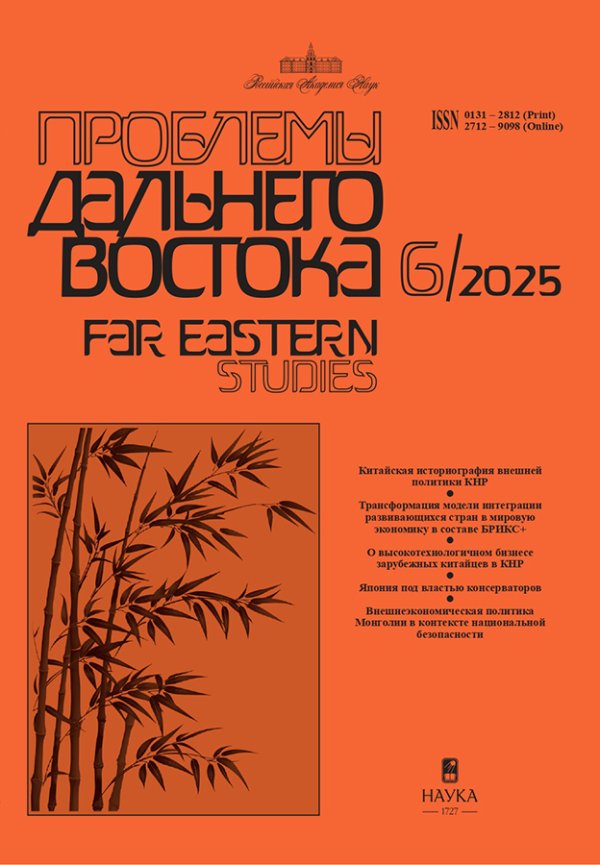
No 6 (2025)

Politics
Japan under Conservative Rule. On the 70th Anniversary of the Liberal Democratic Party of Japan
Abstract
This article analyzes the long and, in many ways, unique reign of the Liberal Democratic Party of Japan (LDP), which has held power, with only a few interruptions, for nearly seven decades since its founding in 1955. It examines the institutional, social, and economic mechanisms that have enabled the party to maintain its leading position in the country's political system. These include the LDP's ability to adapt to changing conditions, skillfully combining traditional values with pragmatic approaches to governance, as well as its effective interaction with the bureaucracy, big business, and regional elites. It examines how the party's internal organization, the presence of stable factions, and the distribution of resources within it ensure stability and controllability of political processes. It also emphasizes that such dominance does not guarantee perpetual power: demographic changes, an aging society, declining trust among young people in traditional parties, and intensifying political competition create new risks. The article concludes that the LDP's future development will largely depend on its readiness for internal transformation and openness to new ideas. Rethinking traditional governance approaches, implementing structural reforms, and strengthening government transparency measures can not only renew the political system but also strengthen public trust. Amid growing international instability and technological change, the LDP must find a balance between maintaining continuity and adapting. The success of these efforts will determine whether the party can maintain its leading position, ensuring sustainable development and political modernization in Japan in the 21st century.
 5–19
5–19


The Cybersecurity Policy of the Republic of Korea 2017–2025
Abstract
The present article examines the evolution of the Republic of Korea's cybersecurity policy between 2017 and 2025 under the influence of foreign policy factors. In recent decades, the issue of cybersecurity has assumed a pivotal role in the formulation of national policies. Despite its considerable economic and technical development, the South Korean government has historically neglected to allocate sufficient resources to the protection of its national cyber borders. This oversight has resulted in a series of significant cyberattacks on critical infrastructure during the 2010s. In 2019, Moon Jae-in's government published its inaugural national cybersecurity strategy, which was of a defensive nature. This decision was made within the context of a stabilizing international political environment, characterized by intensified diplomatic negotiations between the United States and North Korea. However, following another crisis on the Korean peninsula, South Korea shifted its focus towards cyber cooperation with Western countries. The final transition to an offensive doctrine in the cyber sphere took place in 2024, when the conservative government of Yoon Suk-yeol adopted an updated national cybersecurity strategy, significantly expanding cooperation with military alliances aimed at Russia, China, and North Korea. One of primary motivations for the revision of policy in the cyber sphere was the escalation of the Ukrainian crisis and the subsequent confrontation between Russia and the collective West. The Republic of Korea is compelled to adopt proactive measures to ensure national cybersecurity due to a combination of factors, including the influence of the US-South Korea alliance, its geographical location in the center of a conflict-prone region, the traditional perception of an existential threat from North Korea, and the inability to independently protect its national cyberspace. At present, the Republic of Korea's efforts are predominantly concentrated on participating in the militarization of cyberspace through partnerships with intergovernmental organizations centered on the United States of America.
20-33
Foreign Economic Policy of Mongolia in the Context of National Security
Abstract
Mongolia is a landlocked country in the center of Asia, sandwiched between Russia and China. Its geographical location makes it dependent on its neighbors in many ways. Therefore, Mongolia faces a particularly acute challenge, compared to other small states, of maintaining a balance in relations with neighboring powers and third countries without compromising its sovereignty or limiting its economic development. The paper presents the results of an analysis of the practical implementation of Mongolia's multi-vector foreign economic policy. It is emphasized that in the early 1990s, Mongolia was forced to seek assistance from Western countries, which became its key development partners. The mining boom of the 2000s, along with rapid economic growth, led to dependence on mineral exports to China and the strengthening of foreign companies as major investors. Mongolia's decision to maintain control over key sectors of the economy caused a collapse in the inflow of foreign investment. Together with the attraction of loans on the international debt market in the context of falling world prices for minerals, this led to the 2016 crisis. Nevertheless, key partners helped Mongolia avoid default on its sovereign debt. Moreover, the recession during the COVID-19 pandemic and the subsequent economic recovery confirmed that Mongolia has no alternative to a policy of multi-vector foreign economic cooperation, in which China remains the main sales market, and Western partners are key creditors. In relations with Russia, Mongolia seeks to eliminate dependence on imported Russian oil products, conclude a free trade agreement and participate in plans to build transit infrastructure to China.
34-43
Economics
Transforming the Model of Emerging Economies’ Integration into the World Economy Via the BRICS+
Abstract
The relevance of the article is connected with growing significance of the BRICS+ in the world economy and a need to study directions which show ways to integrating into the global system based on a new model of manufacturing and cooperation. Main suggestions of the article rely on fundamental works by Russian and foreign researchers as well as time-relevant statistics. The article introduces a notion of symbiosis of individual competitive advantages of the BRICS+ making up a full set of unique resources, cadres, technology and competence to produce finished products based on the strategy of cost minimization and common good maximization. Theoretical significance of the paper is about deepening knowledge in the emerging direction of research of a new paradigm of globalization under the leadership of the BRICS+. Practical significance of the research’s results lies in the proposed approaches to use the strengths of the new paradigm of globalization under BRICS+ leadership which before could be gained during active globalization of the world America-centered economy. Due to the obsolescence of widely accepted rules of international exchange, the article puts a stress on looking for compromising solutions in conditions of hostile protectionism and deglobalization. The article concludes by saying that the universal direction of development in the modern world economy is in the field of a new paradigm and a model of business which help any country of the world irrespective of the level of wellbeing contribute an individual competence in the common set of tools of the BRICS+ and make use of equally approachable collective advantage thanks to their harmonic symbiosis to maximize the positive effect of solving national problem.
44-55
On the Overseas Chinese High-Tech Business in the PRC
Abstract
The article is devoted to the current scientific problem of determining the place of overseas Chinese (Chinese diaspora, in Chinese: huagiao-huaren — Chinese emigrants with PRC citizenship and ethnic Chinese with foreign citizenship) companies in high-tech business in the PRC. The work is based on the factual data collected by the author in 2023–2024 on 290 operating companies created by the winners of the “Key Business Teams of Overseas Chinese (2009–2017)” competition, as well as the results of a study conducted by the author in 2010–2011 on innovative companies of Chinese specialists with degrees from foreign universities who returned to China. The article presents the author’s methodology for the quantitative assessment of high-tech companies of overseas Chinese in the PRC, which showed that the total number of high-tech companies of overseas Chinese increased from 1.9 thousand to 201.5 thousand, and their share in the total number of companies carrying out high-tech activities in the PRC increased from 8% to 63.5% over 2000–2023. The main hypothesis of the study is that overseas Chinese companies occupy a leading position in high-tech business in China at present. This hypothesis is supported by the quality characteristics of 181 high-tech enterprises (including 130 innovative companies) out of the 290 overseas Chinese companies mentioned above. Most of the founders of these enterprises studied and worked in technologically advanced countries: the USA, Canada, EU countries, Japan, where they gained advanced experience in doing business in the field of new and high technologies – a key advantage in the domestic Chinese market. The companies they have created generally occupy strong positions in most sectors of the manufacturing industry and the tertiary sector of the economy; in several sectors, their positions are assessed as leading. These companies have a high level of scientific and technical capabilities and development potential. Geographically, they are concentrated in key economic regions on the southern and eastern coasts, and the adjacent developing central and western regions of the PRC. Overseas Chinese are at the forefront of scientific and technological progress in China’s manufacturing industry. They are a reliable resource for ensuring the high-tech development of China’s economy, especially in the context of Western sanc-tions.
56–77
Domestic and Inbound Tourism of the DPRK under International Sanctions
Abstract
The DPRK was one of the first countries to close its borders before the WHO declared the COVID-19 pandemic on March 11, 2020/ After five years the North Korean leadership still hesitate to make a decision on the full resumption of air and rail transport links with the outside world. Acting primarily for reasons of security, preserving the lives and health of the population in a country where there is no possibility of providing high-tech medical care, the authorities were forced to accept financial losses in the field of inbound tourism, which was an important source of income for the state budget. A new era in Russian-North Korean relations was marked by the conclusion of the Comprehensive Strategic Partnership Treaty on June 19, 2024 (ratified by Federal Law No. 374-FZ of November 9, 2024, entered into force on December 4, 2024). This allowed Russian-North Korean relations to strengthen significantly after a long period of decreased activity in contacts against the backdrop of tightening anti-North Korean sanctions since 2016. The DPRK opened its borders for Russian tourists on February 12, 2024. There have been trends towards intensifying tourist contacts between the DPRK and China and Western countries. At the same time, there is an active development of domestic tourism in the DPRK. The article analyzes the state, problems and prospects of the North Korean tourism industry.
78-92
EAEU and Mongolia: Opportunities of the Temporary Free Trade Agreement
Abstract
This article examines the conditions for preparing the interim trade agreement between the Eurasian Economic Union and Mongolia, which was signed in the summer of 2025. It provides a chronological overview of the draft agreement's preparation and public discussions in Ulaanbaatar. The relatively short timeframe in which the draft was approved demonstrates the parties' strong interest in implementing the agreements and their desire to test trade preferences. The final document includes 367 product categories eligible for a three-year preferential regime: zero or significantly reduced custom duties. Mongolia received preferences for a wide range of export-oriented goods, including meat products, cashmere, and wool products. An overview of the dynamics of Russian-Mongolian trade relations is provided, which is important for understanding the initial conditions and expectations for the implementation of the preferences. Establishing zero tariffs on a limited range of goods allows Mongolia and Russia to comfortably resolve pressing trade and economic cooperation issues, while the integration association can continue to expand its network of free trade agreements. For Kazakhstan, Belarus, Kyrgyzstan, and Armenia, signing a trade agreement with Mongolia poses few economic risks and represents a significant step against the backdrop of the intensification of political contacts in recent years. Further expansion of the range of goods eligible for preferential trade, an extension of the agreement, and the conclusion of a full-fledged free trade agreement are possible. It is concluded that the key effect of the signed interim trade agreement is that the dialogue between the Eurasian integration association and Mongolia is started.
93-103
Growth Factors in Cambodia's Agricultural Sector
Abstract
In recent years, Cambodia's agricultural sector has not only met the needs of the population but has also positioned the country among the leading exporters of various products. Despite a decline in its contribution to gross production and the share of employed individuals, it still holds significant positions in the economy and exerts substantial influence on socio-economic development. This article analyzes the architecture of economic growth in the agricultural sector, assessing the impact of factors that act as driving forces determining the level of development and dynamics, while highlighting the determinants. Land resources play a key role in the development of the agricultural sector, serving as the primary means of production. Cambodia retains a classic land-saving technological production method, characterized by low labor productivity, which can be attributed to the small size of farms, low capital intensity, and, most importantly, a historically driven motivation for land conservation rather than labor conservation. Although labor productivity indicators in the agricultural sector have increased, they remain low. Overall, significant progress has been made in Cambodia's agricultural sector, but problems persist that hinder the development of rural Cambodia and slow the growth of agricultural production, affecting both land productivity and labor productivity. For example, the introduction of irrigation systems and fertilizers has increased land productivity, but their use remains limited. Agricultural mechanization is growing but faces challenges such as a lack of qualified specialists to service the equipment. It is concluded that, despite tremendous achievements and impressive growth, Cambodia's agricultural model operates at the limits of its capabilities. For further growth, investments in technology, improvements in infrastructure, and a more balanced policy aimed at enhancing efficiency and inclusivity are necessary.
104–117
Integration of South Korean Ports into Arctic Maritime Trade: Opportunities & Prospects
Abstract
In the Republic of Korea, the election campaign for one of the most important positions in the country ended in early June 2025. This election took place amidst a prolonged political crisis caused by a controversial decision by former President Yoon Suk Yeol to impose martial law on the country in December 2024. After nearly six months of political uncertainty and tension, Lee Jae Myung, a candidate from the Democratic Party, was chosen as the new president. On the eve of his inauguration, Mr. Lee spoke about the significance of including several of the country's ports in Arctic maritime trade. Earlier, in November 2021, as part of the second pillar of the «expanding the horizons of Arctic diplomacy» in the Polar Strategy-2050, approved by the Korean government, Russia was identified as one of the three «most significant» Arctic countries. The main priority for joint activities is the development of the Northern Sea Route. As both countries are maritime nations, Russia plays a significant role in operating the Northern Sea Route. Trade between our two countries has decreased from $29.9 billion in 2021 to only $11.3 billion in 2024. This shift in South Korea's Arctic policy offers hope for a positive transformation in our relationship.
118-132
State and society
Lottery Industry in the PRC
Abstract
From ancient times to the present day, one of the common tools for collecting the necessary financial resources to solve socio-economic problems in various countries of the world is holding lotteries. Recently, there have even been separate publications about the fact that the lottery was used in ancient China to raise funds for the construction of the Great Wall of China. In the PRC, funds received from lotteries go to the Public Welfare Fund and are included in the state budget in accordance with the rules for managing state funds. The fund's resources are used exclusively for the development of social security and sports. Surpluses are carried over to the next year for further use and are not used to balance the general consolidated budget of the PRC. In the PRC, most of the funds (80–90%) are returned to players in the form of winnings and social assistance, ensuring the attractiveness of bets. At the same time, the efficiency of spending funds from the Public Welfare Fund and the Social Fund, which are formed through deductions from the lottery, currently raises certain questions among the country's control bodies. This article analyzes the regulatory framework for holding lotteries in China, types of lotteries, examines the institutions that control the holding and distribution of financial resources, analyzes the standards for distributing funds collected between the center and the provinces from holding lotteries, and examines the efficiency of managing funds collected from lotteries.
133-144
History
Chinese Historiography of the PRC's Foreign Policy
Abstract
The article attempts to consistently trace the historiography of works published in China on the country's foreign policy from 1949 to the present. Special attention is paid to works on Sino-Russian relations. The chronology of publications is linked to the periods of government of the top officials of the party and the state, respectively, Mao Zedong, Deng Xiaoping, Jiang Zemin, Hu Jintao and Xi Jinping. Mao Zedong's formula of "sticking to one side" and the theories of "intermediate zones" and "three worlds" defined the main features of China's foreign policy during the first three decades. At the turn of the 1980s and 1990s, Deng Xiaoping's main foreign policy precepts were formulated, summarized in the formula of 28 hieroglyphs: "observe coolly, strengthen shaky positions, show self-control, cope with difficulties, keep in the shadows and try not to show yourself in any way, be able to defend, albeit clumsy, but your own views, in no case do not climb forward, to the first place, and at the same time do something real." Jiang Zemin successfully completed the multi-year marathon of China's accession to the World Trade Organization (December 2001). The "Zouchuqu" strategy (the entry of national enterprises "outside", i.e. into the world market) and the closely related program for the rise of the "western territories" were proclaimed. Hu Jintao supported the development of the concept of China's "rise", which was later replaced by the doctrine of "China's development", designed to enhance the country's foreign policy. On April 22, 2005, at the Afro-Asian Summit in Jakarta, Hu Jintao put forward his concept of a "harmonious world". At the end of 2012 Xi Jinping for the first time had raised the issue of the need for a "great renaissance" of the Chinese nation. In 2013, he proclaimed the Belt and Road Initiative, that is, a project for the large-scale development of international economic ties "by land", conditionally along the route of the ancient Silk Road, and by sea. Later, he came up with the idea of creating a "community of the common destiny of humanity" in the world, designed to achieve universal, "inclusive" security. At the 20th CPC National Congress in 2022 the idea of the "community of the common destiny of mankind" and the "Belt and Road Initiative" (as one of the main tools for its implementation) were included in the CPC Charter.
145-164
Culture
Foreign Languages in the Contacts of China with the Outside World
Abstract
In modern China, any language problems — both inside the country or in contacts with the outside world in the process of implementing the so-called “discursive force” — are solved with the help of the latest technologies. The need to intensively apply these technologies and in particular the GenAI in the language sphere is discussed in a special document recently published by the Ministry of Education, the State Language Commission, as well as the Office of the Central Cyberspace Affairs Commission. In the same document, there is used a new term “digital Chinese”. Artificial intelligence has significantly transformed communication in a globalized world. Native speakers of different languages are able to communicate verbally or translate texts without resorting to the services of translators. Nevertheless, despite the widespread use of the latest technologies in various fields, it is known that modern translation systems can make serious mistakes, and the knowledge of foreign languages both by the high-level translators and, to a certain extent, by the residents as a whole is still in demand in different countries. In China’s official and unofficial contacts, English remains the main means of communication, though other languages are also used at different levels, in particular, in the light of the “Community with a Shared Future for Mankind” concept and the “One Belt and One Road” initiative. As for the Russian language, it is in demand in China’s contacts not only with Russia, but also with the post-Soviet countries of Central Asia, where it still serves as a means of interethnic communication.
165-174
Book reviews
Book Review: The Role and Place of Political Banks in the Economic System of China / E.M. Serbina. Moscow: IKS ARAS, 2025. 364 p.
175-176
Ad Memoriam
Mikheev Vasily Vasilievich 16.04.1954–29.10.2025
177-178
Contents of the Journal “Far Eastern Studies” 2025
179-182