
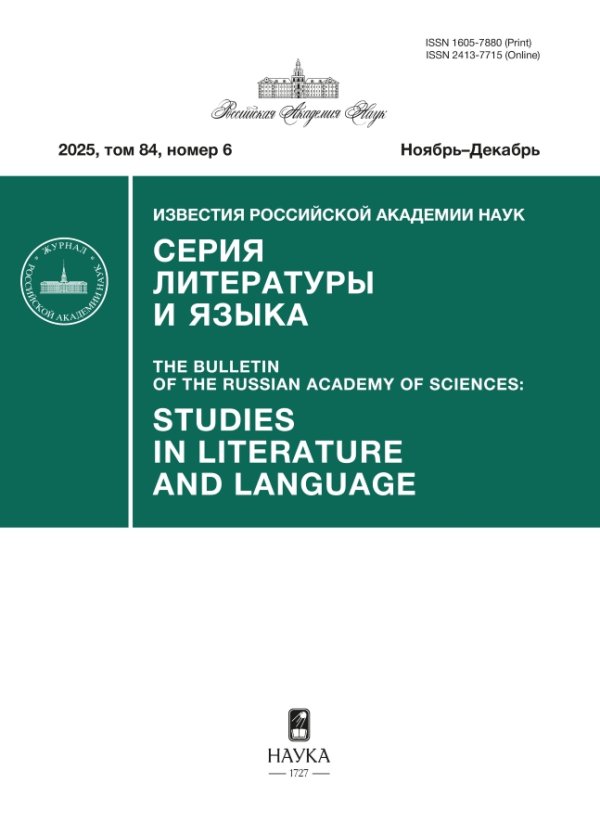
The Bulletin of the Russian Academy of Sciences: Studies in Literature and Language

Izvestiya RAN. Seriya literatury i yazyka (The Bulletin of the Russian Academy of Sciences: Studies in Literature and Language), founded in 1852 by Academician Izmail I. Sreznevsky, is the oldest academic journal in Russia for scholars of philology.

Publication history: from 1852 to present.

Founders

  • Russian Academy of Sciences

Publisher

  • Russian Academy of Sciences

The journal is published under the supervision of the RAS Department of Historical and Philological Sciences (OIFN RAS).

About the journal

As the official journal of the Division of Historical and Philological Studies of the Russian Academy of Sciences (in Russian, ОИФН РАН), Izvestiya RAN. Seriya literatury i yazyka (The Bulletin of the Russian Academy of Sciences: Studies in Literature and Language) is committed to carrying on the Russian philological traditions while seeking to publish innovative research.

The journal offers papers on aspects of literary and linguistic studies, including discussions of fundamental philological works, review articles and chronicles, and transactions of the Division of Historical and Philological Studies of the RAS. One of the journal’s main sections is devoted to resurrection of undeservedly disregarded events from the history of philological scholarship in our country.

Among The Bulletin of the Russian Academy of Sciences: Studies in Literature and Language’s contributors there are Academicians and correspondent members of the Russian Academy of Sciences, researches from academic institutes, many internationally recognized scholars from Moscow, Saint Petersburg, different Russian regions, as well as eminent scholars from other countries.

Editor-in-Chief

  • Vadim Polonsky, Corresponding Member of the RAS, Dr. Sci. (Philology), Prof., A.M. Gorky Institute of World Literature of the Russian Academy of Sciences (Moscow, Russia)

Editorial Staff

  • Deputy Editor-In-Chief – Leonid Krysin, Dr. Sci. (Philology), Prof., V.V. Vinogradov Russian Language Institute of the Russian Academy of Sciences (Moscow, Russia)
  • Executive Editor – Alexander Piperski, Cand. Sci. (Philology), Higher School of Economics (Moscow, Russia)
  • Scholarly Editor – Vladimir Korovin, Dr. Sci. (Philology), Assoc. Prof., Lomonosov Moscow State University (Moscow, Russia)
  • Editorial Manager – Olga Lukashenko

Subjects

Literature and Language, Linguistics, History of Russian and World Literature, Literary Theory, Folklore Studies, Aspects of History of Art.

Main Headings

  • Original Papers
  • From the History of Philology
  • Reviews
  • Chronicles

Frequency

The journal is published bi-monthly (6 issues per year).

Indexing

The journal is included in the Russian Higher Attestation Commission List of peer-reviewed scientific publications.


Edição corrente

Acesso aberto Acesso aberto  Acesso é fechado Acesso está concedido  Acesso é fechado Somente assinantes

Volume 84, Nº 6 (2025)

Capa

Edição completa

Acesso aberto Acesso aberto
Acesso é fechado Acesso está concedido
Acesso é fechado Somente assinantes

Articles

Pushkin Digital: Institutional Experience of the Digital Transformation of the Academic Edition of the Classics
Golovin V., Belyak G.
Resumo
The article is dedicated to the Pushkin Digital project of the Institute of Russian Literature (Pushkin House) of the Russian Academy of Sciences and the accompanying institutional shift it entails in the preparation of scholarly editions of the classics. The focus is on the new functions of the research institute as an operator of a digital research environment: the transition from a traditional corpus of documents to a multi-layered extensible database, the creation of a digital manuscript repository, the integration of editions and variants in an interactive form, and a hypertextual scholarly commentary. This shift requires new forms of interdisciplinary collaboration between philologists and computer scientists, changes in organizational roles and formats of scholarly interaction, which collectively lead to supplementing traditional forms with a new type of institutional activity in the humanities in the era of digital transformation.
The Bulletin of the Russian Academy of Sciences: Studies in Literature and Language. 2025;84(6):5-11
pages 5-11 views
Count Nulin, W. K. Küchelbecker, and Prince P. A. Vyazemsky
Ivinskiy D.
Resumo
This paper discusses the reception of Alexander Pushkinʼs poem “Count Nulin” by W.K. Küchelbecker in his book The Russian Decameron and by Prince Pyotr Vyazemsky in his notebook, where he reflects on Boccaccio’s Decameron. The analysis demonstrates that the approaches of Küchelbecker and This paper discusses the reception of Alexander Pushkinʼs poem “Count Nulin” by W.K. Küchelbecker in his book The Russian Decameron and by Prince Pyotr Vyazemsky in his notebook, where he reflects on Boccaccio’s Decameron. The analysis demonstrates that the approaches of Küchelbecker and Vyazemsky, while largely convergent, are at the same time polemical in important respects when set against Pushkin’s narrative poem.
The Bulletin of the Russian Academy of Sciences: Studies in Literature and Language. 2025;84(6):12-20
pages 12-20 views
Nina Berberova’s Comedy Madame within the Field of Literary Traditions
Ledenev A., Korzhova I.
Resumo

The article explores the system of literary codes and their functions in Nina Berberova’s comedy Madame. Staged by the Russian Drama Theatre in Paris, the play reflected the theatre’s pursuit of contemporaneity and its effort to renew the language of drama. The work may be read both as a domestic comedy and as a melodrama. It reconstructs recognizable emigration realities and conventional plot motifs, yet the conspicuousness of these elements appears intentional. In her memoirs Berberova explicitly opposed her comedy to the tradition of realist theatre. The plot, along with the density of reminiscences, the use of grotesque, and the deliberate exposure of theatrical devices, brings Madame close to Vladimir Nabokov’s The Event, staged in the same theatre six months earlier. In both plays, the inauthenticity of life is revealed through the metaphor of the world as theatre. In Berberova’s play, the capacity to break free from the bonds of literary secondariness and from the tyranny of fate is asserted as a central value.

The Bulletin of the Russian Academy of Sciences: Studies in Literature and Language. 2025;84(6):21-28
pages 21-28 views
The “Depicted Word” in the Structure of Lyric Discourse in G. R. Derzhavin
Larkovich D.
Resumo
The article explores the artistic function of the “depicted word” (izobražennoje slovo) in the lyric discourse of G.R. Derzhavin. The frequent occurrence of poetic elements presented by the author as the direct speech of “secondary” voices indicates that the poet deliberately sought to overcome the subjectivity and unilinearity of the lyric utterance, endowing it with greater axiological depth and semantic variability. The study offers a typology of speakers of the depicted word – divine beings, deceased righteous men and heroes of the past, monarchs, mythological figures, relatives, acquaintances, and others – and provides a characterization of each category. The analysis demonstrates that the multiplicity of perspectives, articulated through these secondary voices, enables Derzhavin to transcend the monologic paradigm of lyric discourse. In so doing, he creates the conditions for a multi-perspectival vision of life and of the human being situated within an endlessly shifting and emergent reality.
The Bulletin of the Russian Academy of Sciences: Studies in Literature and Language. 2025;84(6):29-35
pages 29-35 views
Mythopoetic Aspects in the Plays of Elena Isaeva
Xing W., Mikhaylova M.
Resumo
This article analyzes the mythopoetic dimensions of the plays by Elena Isaeva (born 1966): “David and Bathsheba”, “Judith”, and “The Two Wives of Paris”. Additionally, the text of the play titled “Nonplay for Two” is used as auxiliary material. A step­by­step analysis reveals the trajectory of the playwright’s myth­ making strategy: from close reproduction of mythological plots, through the retention of a mythological framework enriched with original concepts, to a syncretic synthesis of heterogeneous mythological traditions. Notably, the play “The Two Wives of Paris” illustrates both the reception and transformation of the mythopoetics of Innokenty F. Annensky and Euripides. In Isaeva’s artistic treatment, the themes of love and ethics undergo a substantive conceptualization, articulating her perspective on pressing sociocultural issues of the present. The methodology combines hermeneutic analysis with historical­literary, intertextual, and cross­cultural approaches, thereby enabling the reconstruction of the playwright’s ethical­aesthetic program. The study concludes that Isaeva’s model of mythologization may be described as a neoromantic attempt to overcome social alienation through the re­interpretation of archetypal meanings.
The Bulletin of the Russian Academy of Sciences: Studies in Literature and Language. 2025;84(6):36-48
pages 36-48 views
Exotic Kinship Vocabulary (Based on the Arkhangelsk Dialects)
Kachinskaya I.
Resumo
A comparison of Old Russian sources with the present-day inventory of kinship terms shows that a number of lexical items have been lost, and their decline continues. With the transition from the “extended” family to the “nuclear” family, many terms began to be confused or forgotten, especially those referring to relations by marriage (affinal kinship). Today, few urban speakers, particularly among the younger generation, can identify words such as zolovka, svojačenica, šurin, or dever'; confusion often arises even with tyošča (‘mother-in-law’) and svekrov' (‘mother-in-law’). There is a strong tendency to replace single-word kinship terms with descriptive phrases. At the same time, evidence from regional dialects reveals that the kinship lexicon is much richer than what is preserved in Old Russian monuments. This article presents kinship terms that are unusual or unexpected for speakers of the standard language, recorded in Arkhangelsk dialects during the compilation of the Arkhangelsk Regional Dictionary. Some have transparent inner form, while in others the original motivation is obscured. In certain cases, northern dialects even preserve lexemes characteristic of other Slavic areas. These “exotic” kinship terms are examined in their morphological, grammatical, lexical, and semantic aspects.
The Bulletin of the Russian Academy of Sciences: Studies in Literature and Language. 2025;84(6):49-56
pages 49-56 views
“Katerina, ty prichina, chto lishen muzhchina china” (“Katerina, You’re the Reason That a Man Has Lost His Rank”): On the Features of Nikolai L’vov’s Rhyme
Pasternak E.
Resumo
This article investigates the distinctive features of rhyme in the lyric and lyric-epic works of Nikolai L’vov. His corpus is divided into four groups: completed poems and verse narratives included in the 1994 volume–the only published collection of his poetry to date; long poems; anacreontic verse; the poetic impromptues; poetic works that entered scholarly circulation after 1994 and remain in manuscript form. This division reveals both continuity and variation in L’vov’s versification: while many aspects of his rhyme remain consistent, he employed more elaborate and playful rhyme schemes in long poems; in the anacreontics he produced unusually half-rhymed odes, atypical for him; and in the last group he occasionally allowed looser rhyme patterns. Corpus analysis highlights several common features across these groups: extensive use of rhyme chains; incorporation of internal and contact rhymes; lexical inventiveness in many rhymes; relatively few open-iotated rhyme pairings; and occasional experiments such as dactylic and macaronic rhymes. Taken together, these features identify L’vov as a striking innovator in eighteenth-century Russian versification.
The Bulletin of the Russian Academy of Sciences: Studies in Literature and Language. 2025;84(6):57-66
pages 57-66 views
The History of the Relationship between I. S. Shmelev and G. D. Grebenshchikov: New Materials
Surovova L.
Resumo
The article examines the intersections of the life and creative paths of two émigré writers, Ivan Shmelev and Georgy Grebenshchikov, a topic that has not previously been the focus of scholarly inquiry. Their acquaintance began in Crimea, shortly before the peninsula came under Soviet control, and was later resumed in Paris within the milieu of Russian émigré life. Literary existence abroad imposed its own demands: writers had to cultivate useful contacts, secure foreign publishers and translators, and seek access to the European book market. Initially, Grebenshchikov achieved notable success in promoting his works in France, a fact that aroused some resentment among his more established contemporaries, including Shmelev. Yet Grebenshchikov consistently expressed respect for Shmelev, and he authored the only substantial article devoted to Shmelev’s novella It Was. After World War II, in a devastated France struggling with shortages of food and goods, Shmelev’s circumstances were further burdened by accusations of collaboration due to his association with the pro-fascist newspaper Paris Herald. Grebenshchikov, who had settled in the United States in 1924, was among the first to offer support, sending encouraging letters and much-needed dietary provisions. The newly collected and chronologically arranged evidence–including unpublished correspondence and émigré periodicals – sheds new light on the destinies of both writers and on the cultural environment of the Russian diaspora.
The Bulletin of the Russian Academy of Sciences: Studies in Literature and Language. 2025;84(6):67-78
pages 67-78 views
Intonational Means of Expressing Modality in Interrogative Sentences (with Reference to Why-Questions)
Efremova M.
Resumo
The article examines intonational strategies for conveying modal meanings in interrogative sentences formed with the pronominal adverb počemu (“why”). The research material consists of extended text fragments taken from audio recordings by different readers, which reveal the features of individual interpretive performance, using as examples works by Evgeny Grishkovets. The fragments are analyzed through a combination of syntactic, auditory, and acoustic methods. Particular attention is given to the intonational patterns (intonation constructions, ICs) employed in shaping interrogative sentences and to the placement of their prosodic center. A comparison of different readings highlights the intonational potential of both dialogic and monologic texts, demonstrating how the choice of IC type depends on sentence length and question semantics. The linguistic analysis of why-questions integrates the intonational-communicative dimension with textual factors, taking into account their relation to adjacent sentences, text genre, and the presence or absence of an addressee. The analysis shows that the intonational organization of modal questions is highly variable, as it conveys additional shades of meaning.
The Bulletin of the Russian Academy of Sciences: Studies in Literature and Language. 2025;84(6):79-87
pages 79-87 views
The Use of Ordinal Numerals in Various Semantic Contexts (Based on Parallel Translations of the New Testament)
Nasledskova P.
Resumo
This study compares the use of ordinal constructions in different semantic contexts across five languages: Russian, English, Spanish, Indonesian, and Rutul. The analysis is based on parallel translations of the New Testament. The data include verses containing at least one ordinal numeral in any of the sampled languages, taken from six books of the New Testament (the canonical Gospels, the Acts of the Apostles, and the Book of Revelation). Special attention is paid to contexts in which ordinal numerals are not consistently rendered across all languages. Semantic contexts are defined according to the semantic class of the nouns modified by the ordinal numerals. The analysis covers four classes of nouns: animate beings, inanimate objects, temporal intervals, and events, as well as the construction “the X-th time.” The initial hypothesis posited that the frequency of ordinal numerals in different contexts would correlate with the animacy hierarchy. This hypothesis was not supported by the data: in all languages examined, ordinal constructions were used less frequently with nouns denoting animate beings than with those denoting inanimate objects or events. Furthermore, the study shows that ordinal constructions are more commonly used for non-extreme elements of a set than for its first or last members. The article also describes non-ordinal constructions found in the data, which employ other types of numerals (most often cardinals) or alternative linguistic means.
The Bulletin of the Russian Academy of Sciences: Studies in Literature and Language. 2025;84(6):88-102
pages 88-102 views
Fairy-Tale Elements in Virginia Woolf’s Short Story “Lappin and Lapinova”
Liseev G.
Resumo
The article analyzes Virginia Woolf’s short story Lappin and Lapinova through the lens of fairy-tale elements. A close reading demonstrates the particular significance of fairy-tale forms and traditions for the story’s plot and composition. The presence of these elements produces what may be described as a “double plot,” in which the domains of fairy tale and reality intersect. Such an approach broadens the interpretative possibilities of Woolf’s text, offering a fresh perspective on its meaning. In addition, the article identifies a significant inaccuracy in the only existing Russian translation of the story and proposes an alternative rendering of the title and the protagonists’ names.
The Bulletin of the Russian Academy of Sciences: Studies in Literature and Language. 2025;84(6):103-111
pages 103-111 views
On the Problems and Prospects of Transcriptional Textology
Galai V.
Resumo
The article addresses the theoretical foundations and editorial practices involved in publishing Dostoevsky’s draft manuscripts. In light of the distinctive features of Fyodor Dostoevsky’s creative process, the search for an editorial methodology capable of preserving all semantic layers of his manuscripts becomes especially pressing. The study traces the history of publishing the writer’s notebooks from the early Soviet period onwards. The dilemma between facsimile and transcription-based editions gives rise to a range of challenges situated at the intersection of reception aesthetics and the poetics of polycoded texts. The method of “diplomatic transcription” is shown to safeguard the graphic and semantic integrity of Dostoevsky’s autographs. The advantages and potential of this approach are analyzed within the broader context of the development of the Digital Humanities.
The Bulletin of the Russian Academy of Sciences: Studies in Literature and Language. 2025;84(6):112-123
pages 112-123 views

Chronicles

International Scientific Conference “The Chekhov Phenomenon: The Silver Age Between Classics and Modernism (Dedicated to the 165th Anniversary of the Writer’s Birth)”
Bogdanova O.
The Bulletin of the Russian Academy of Sciences: Studies in Literature and Language. 2025;84(6):124-141
pages 124-141 views

*****

Index of Authors, Volume 84, 2025
The Bulletin of the Russian Academy of Sciences: Studies in Literature and Language. 2025;84(6):142-144
pages 142-144 views

Согласие на обработку персональных данных с помощью сервиса «Яндекс.Метрика»

1. Я (далее – «Пользователь» или «Субъект персональных данных»), осуществляя использование сайта https://journals.rcsi.science/ (далее – «Сайт»), подтверждая свою полную дееспособность даю согласие на обработку персональных данных с использованием средств автоматизации Оператору - федеральному государственному бюджетному учреждению «Российский центр научной информации» (РЦНИ), далее – «Оператор», расположенному по адресу: 119991, г. Москва, Ленинский просп., д.32А, со следующими условиями.

2. Категории обрабатываемых данных: файлы «cookies» (куки-файлы). Файлы «cookie» – это небольшой текстовый файл, который веб-сервер может хранить в браузере Пользователя. Данные файлы веб-сервер загружает на устройство Пользователя при посещении им Сайта. При каждом следующем посещении Пользователем Сайта «cookie» файлы отправляются на Сайт Оператора. Данные файлы позволяют Сайту распознавать устройство Пользователя. Содержимое такого файла может как относиться, так и не относиться к персональным данным, в зависимости от того, содержит ли такой файл персональные данные или содержит обезличенные технические данные.

3. Цель обработки персональных данных: анализ пользовательской активности с помощью сервиса «Яндекс.Метрика».

4. Категории субъектов персональных данных: все Пользователи Сайта, которые дали согласие на обработку файлов «cookie».

5. Способы обработки: сбор, запись, систематизация, накопление, хранение, уточнение (обновление, изменение), извлечение, использование, передача (доступ, предоставление), блокирование, удаление, уничтожение персональных данных.

6. Срок обработки и хранения: до получения от Субъекта персональных данных требования о прекращении обработки/отзыва согласия.

7. Способ отзыва: заявление об отзыве в письменном виде путём его направления на адрес электронной почты Оператора: info@rcsi.science или путем письменного обращения по юридическому адресу: 119991, г. Москва, Ленинский просп., д.32А

8. Субъект персональных данных вправе запретить своему оборудованию прием этих данных или ограничить прием этих данных. При отказе от получения таких данных или при ограничении приема данных некоторые функции Сайта могут работать некорректно. Субъект персональных данных обязуется сам настроить свое оборудование таким способом, чтобы оно обеспечивало адекватный его желаниям режим работы и уровень защиты данных файлов «cookie», Оператор не предоставляет технологических и правовых консультаций на темы подобного характера.

9. Порядок уничтожения персональных данных при достижении цели их обработки или при наступлении иных законных оснований определяется Оператором в соответствии с законодательством Российской Федерации.

10. Я согласен/согласна квалифицировать в качестве своей простой электронной подписи под настоящим Согласием и под Политикой обработки персональных данных выполнение мною следующего действия на сайте: https://journals.rcsi.science/ нажатие мною на интерфейсе с текстом: «Сайт использует сервис «Яндекс.Метрика» (который использует файлы «cookie») на элемент с текстом «Принять и продолжить».