

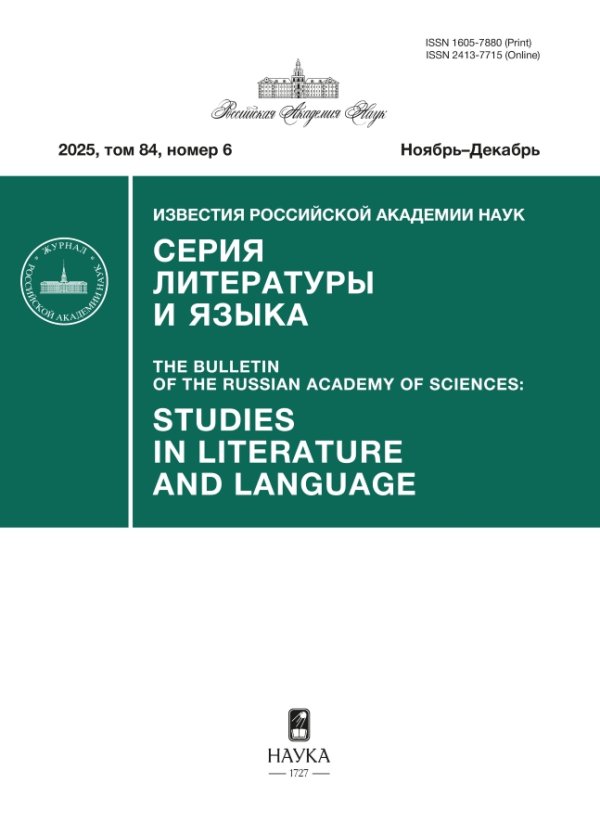
The Bulletin of the Russian Academy of Sciences: Studies in Literature and Language

Izvestiya RAN. Seriya literatury i yazyka (The Bulletin of the Russian Academy of Sciences: Studies in Literature and Language), founded in 1852 by Academician Izmail I. Sreznevsky, is the oldest academic journal in Russia for scholars of philology.

Publication history: from 1852 to present.

Founders

  • Russian Academy of Sciences

Publisher

  • Russian Academy of Sciences

The journal is published under the supervision of the RAS Department of Historical and Philological Sciences (OIFN RAS).

About the journal

As the official journal of the Division of Historical and Philological Studies of the Russian Academy of Sciences (in Russian, ОИФН РАН), Izvestiya RAN. Seriya literatury i yazyka (The Bulletin of the Russian Academy of Sciences: Studies in Literature and Language) is committed to carrying on the Russian philological traditions while seeking to publish innovative research.

The journal offers papers on aspects of literary and linguistic studies, including discussions of fundamental philological works, review articles and chronicles, and transactions of the Division of Historical and Philological Studies of the RAS. One of the journal’s main sections is devoted to resurrection of undeservedly disregarded events from the history of philological scholarship in our country.

Among The Bulletin of the Russian Academy of Sciences: Studies in Literature and Language’s contributors there are Academicians and correspondent members of the Russian Academy of Sciences, researches from academic institutes, many internationally recognized scholars from Moscow, Saint Petersburg, different Russian regions, as well as eminent scholars from other countries.

Editor-in-Chief

  • Vadim Polonsky, Corresponding Member of the RAS, Dr. Sci. (Philology), Prof., A.M. Gorky Institute of World Literature of the Russian Academy of Sciences (Moscow, Russia)

Editorial Staff

  • Deputy Editor-In-Chief – Leonid Krysin, Dr. Sci. (Philology), Prof., V.V. Vinogradov Russian Language Institute of the Russian Academy of Sciences (Moscow, Russia)
  • Executive Editor – Alexander Piperski, Cand. Sci. (Philology), Higher School of Economics (Moscow, Russia)
  • Scholarly Editor – Vladimir Korovin, Dr. Sci. (Philology), Assoc. Prof., Lomonosov Moscow State University (Moscow, Russia)
  • Editorial Manager – Olga Lukashenko

Subjects

Literature and Language, Linguistics, History of Russian and World Literature, Literary Theory, Folklore Studies, Aspects of History of Art.

Main Headings

  • Original Papers
  • From the History of Philology
  • Reviews
  • Chronicles

Frequency

The journal is published bi-monthly (6 issues per year).

Indexing

The journal is included in the Russian Higher Attestation Commission List of peer-reviewed scientific publications.


Current Issue

Open Access Open Access  Restricted Access Access granted  Restricted Access Subscription Access

Vol 85, No 1 (2026)

Cover Page

Full Issue

Open Access Open Access
Restricted Access Access granted
Restricted Access Subscription Access

Articles

About the Project “German Prose of the 21st century”: The Main Trends and Guidelines
Kudryavtseva T.V.
Abstract
The article introduces new research by Russian Germanists in the field of German-language fiction of the 21st century. The first results of the work on the stated topic are summarized within the framework of a project initiated by the Center for German Studies of the Gorky Institute of World Literature of the Russian Academy of Sciences, prospects for the implementation of the set goals and objectives are outlined, the necessity of limiting the research object at this stage to the analysis of German literature proper is substantiated. It is noted that the latest German prose has been studied unevenly and a closer examination of this literary kind is required. The purpose of the study is to create a comprehensive picture of the narrative fiction existence in Germany in the first quarter of the 21st century. It is emphasized that a systematic and integrated approach to the study of the material will make it possible to systematize existing knowledge and close existing gaps in the study of this literary space segment by academic science, to identify the main trends in the development of prose genres, the degree of German fiction involvement in the world literary process. Attention is drawn to the fact that the analysis will be carried out taking into account the relevance, connection with tradition, aesthetic and social significance and relevance of the considered artistic phenomena, in close connection with the historical, cultural and social contexts in which the literary process takes place. It is taken into account that the relevance of the topic is conditioned, in addition to its scientific component, by the specifics of the current geopolitical situation. Its reflection in German literature is of undoubted interest in the context of the changed nature of relations between Germany and Russia. The study of new political and social trends in German narrative prose and the reception nature of such trends in Russia is important for building an intercultural dialogue. It is envisaged that the study will fully take into account the results of the domestic and foreign German studies development in the first decades of the 21st century. The material presented in the article gives an idea of the main scientific and methodological approaches of researchers to the study of the modern literary process and can be useful for literature researchers, linguists, translators and culture researchers.
The Bulletin of the Russian Academy of Sciences: Studies in Literature and Language. 2026;85(1):5–11
pages 5–11 views
Eddic Designations of Valley, Meadow in Axiological Aspect
Toporova T.V.
Abstract
The primary objective is to demonstrate the interaction of meanings not only at various levels of language, but primarily within the text, specifically the Old Icelandic poetic epic, the Elder Edda, using the example of the designations for valley and meadow. The epic word, functioning in the mythological and heroic Eddic poems, is unique in its nature and requires a special approach, as it possesses an axiological status and reflects the concepts of the archaic mythopoetic model of the world, which is oriented toward the ultimate cosmologization of existence, correlating each object of the cosmized universe with the precedent of creation. Such a universal evaluation criterion allows one to determine with a significant degree of probability the significance of a particular element of the Eddic tradition, operating with the ratio of quantitative indicators. A concept receives a negative assessment if it is used to depict non-existence (chaos); is used to describe eschatological catastrophe (“the death of the gods”); is accompanied by explicitly expressed negative connotations. A positive assessment is realized if the concept is a theonym; mentioned in a cosmogonic myth — in a demiurgic act; attested in the context of the renewal of the universe after an eschatological crisis, which reproduces the precedent of the first creation; accompanied by positive connotations. Based on the analysis of Eddic linguistic facts, we can state the presence of two poles on the axiological scale — Old Norse auðn ‘desert’, eyði-mƍrc ‘land of desolation’, heiðr ‘wasteland’ and Old Norse vangr ‘meadow’, acr ‘arable land’, opposed to each other within the framework of the opposition ‘foreign’ – ‘one’s own’, ‘untapped space resembling chaos’ – ‘developed, cultivated space; ‘sacred locus, likened to an ordered cosmos’, around which the remaining nominations are grouped: meadows, valleys, in which the positive assessment somewhat exceeds the negative (cf. O.-Icel. dalr ‘valley’; vƍllr ‘plain’).
The Bulletin of the Russian Academy of Sciences: Studies in Literature and Language. 2026;85(1):12–20
pages 12–20 views
“How Fares Our Loving Mother?”: On the Trail of the Invisible Heroine of Richard III
Mikeladze N.E.
Abstract
The article examines the role of the absent-on-stage but actively discussed heroine in organizing the action of Shakespeareʼs play Richard III, the reasons for her concealment and the resulting discrepancies in the versions of the playʼs text. This is the mother of the Earl of Richmond, a full co-author of his triumph over the king Richard III. Margaret Beaufort, Countess of Richmond is an invisible, but ultimately influential participant in the female resistance described by Shakespeare, leading to the defeat of the tyrant and the change of the dynasty. 16 lines in three episodes are directly dedicated to her, although her image latently determines many of the plot movements (especially in storylines of her husband Lord Stanley and Queen Elizabeth with her offspring).The study of chroniclers’ data and comparison of the texts of the “theatrical” quarto of 1597 and the posthumous folio of 1623 showed a high probability of the playwrightʼs intention to bring Countess of Richmond onto the stage in a short meeting with her envoy Christopher Urswick (IV, 5) and allowed us to assume the original distribution of lines in this episode. The author connects the absence or disappearance from the stage of an important historical figure with the realities of Elizabethan England in the 1590s and the danger of multiplying of “Ladies Margarets” on the stage, declaring their own or their filial rights to the throne. The play was created at the time of disgrace of Margaret Clifford, Countess of Darby (first to the throne after the death of Elizabeth Tudor according to the Will of Henry VIII) and the discussions of the missionaries of Rome about the succession to the throne of England by her son Ferdinando, Lord Strange, patron of the Shakespeare’s troupe of actors (he died suddenly in the spring of 1594). English public theater was an influential medium of communication during in the age of Shakespeare, it discussed the important questions of general interest. Histories in the current context played the role of an explanatory parallel and could be perceived by the authorities both as a lesson and as a challenge. The article reveales the editing brought by the actual history to the stage story.
The Bulletin of the Russian Academy of Sciences: Studies in Literature and Language. 2026;85(1):21–29
pages 21–29 views
Philosophical Speculations аnd Portrait Features оf Archimandrite Theodore (A.M. Bukharev) in F.M. Dostoevsky s̓ Notebook for the Novel “The Possessed”
Barsht K.A.
Abstract
The article suggests that among the factors that influenced the refusal of the editorial board of the Russian Bulletin magazine (M.N. Katkov and N.A. Lyubimov) to publish chapter nine of the second part of the novel “The Possessed” (“At Tikhonʼs”) was the fear of the editorial board to receive a disapproving reaction from government supervisory authorities. By the end of the 1860s, a heavy impression remained in society caused by the brutal persecution of Archimandrite Theodore (A.M. Bukharev), who stood for the truth, who as a result renounced his dignity, giving rise to a wave of sympathetic indignation in secular and ecclesiastical circles alike. Tikhonʼs ideas and style of behavior, described by Dostoevsky in the chapter of “The Possessed”, have an obvious allusive address in the life path and books of Archimandrite Theodore, in particular, in “On Modern Spiritual Needs of Thought and Life” and “The Study of the Apocalypse”, which cost their author a monastic rank and a professorship. After about a year of fighting with the Russian Messenger, Dostoevsky was forced to change the plot of the work, which had lost its central plot event. However, among the notes to the novel “The Possessed” in the writerʼs notebook there are many allusions to the works of Archimandrite Theodore, there is also a small portrait, perhaps a drawing-the writerʼs reflection on the fate of the disgraced theologian.
The Bulletin of the Russian Academy of Sciences: Studies in Literature and Language. 2026;85(1):30–45
pages 30–45 views
On the Reasons for Alternation of 3rd and 1st Person Narrative Forms in A. Chudakovʼs Novel “Darkness Falls on the Old Steps”
Fedosyuk M.Y.
Abstract
The article analyzes the unusual form of Alexander Chudakovʼs novel “Darkness falls on the old steps”, in which the 3rd and 1st person narration forms alternate. It is shown that such alternation is due to the content of the novel, which combines memories of the life of the authorʼs family in one of the provincial cities of Northern Kazakhstan in 1940–1950s and elements of fantasy. The fantasy required the author of the novel to use the 3rd person narration, in the center of which stands a certain fictional character — a young man named Anton. However, the assessments of people and events that are discussed in the novel are presented exclusively in the form in which they can be conveyed most accurately, namely in the form of a narration from the first person.
The Bulletin of the Russian Academy of Sciences: Studies in Literature and Language. 2026;85(1):46–54
pages 46–54 views
On Reduplication in Grammars of Mongolian Languages (Brief Overview)
Chimitdorzhieva G.N.
Abstract
The paper presents an overview of the existing knowledge on Mongolian reduplication based on a number of grammars and common studies on Mongolian languages. Series of linguistic works by domestic and foreign Mongolists that contributed to the formation of the studied issues in the 19th–20th centuries has been also used as the material. The brief systematic overview demonstrates different views in explaining the nature of repetitions, which indicates the complexity of the research object. The article illustrates the main aspects of the study of reduplication (doubling, repetition), attempts to determine the place of reduplication in the language system through the traditional description of the structural, grammatical and functional-semantic features of reduplicated forms in the Mongolian languages. The novelty of the study lies in the generalization of the available data and the presentation of the research results on topical issues in the field of studying doubled forms. The results of the overview and analysis of scientific works show the state of knowledge of the problem at the present stage, confirm the relevance and necessity of studying reduplication in the Mongolian languages.
The Bulletin of the Russian Academy of Sciences: Studies in Literature and Language. 2026;85(1):55–66
pages 55–66 views
The Book by I.A. Bunin “The Temple of the Sun”: Possibilities of Digital Publication
Shchavlinskii M.S.
Abstract
The article explores the transformation of approaches to the study of literary heritage under the influence of digital technologies. The first part presents a conceptual analysis of modern digital platforms based on the trinity of key aspects: functional (intelligent navigation and analysis tools), textual (accurate transmission of the authorʼs text while preserving all editions) and interpretative (multi-level scientific commentary). Particular attention is paid to the promising project of the IWL RAS, in which researchers combine academic standards and innovative digital capabilities. The second part, using the material of I.A. Buninʼs book “Temple of the Sun”, demonstrates the practical application of digital methods. Four author’s editions of the work (1915, 1917, 1931, 1936) are considered in detail, innovative approaches to their comparative analysis through visualization of changes and statistical data processing are proposed. As the study shows, digital publications open up new prospects: from fundamentally different ways of presenting text dynamics to the creation of an interactive research space. Using Bunin’s text as an example, it is shown that electronic platforms make it possible to preserve the full range of textual information, while simultaneously making it accessible to different categories of users – from specialists to a wide range of readers.
The Bulletin of the Russian Academy of Sciences: Studies in Literature and Language. 2026;85(1):67–76
pages 67–76 views
The Problem of Part-Speech Classification and the Terminological Description of Non-Finite Forms in Forest Nenets
Starchenko A.M., Belov P.A., Kozlov A.A.
Abstract
The article examines the problem of part-speech classification and the terminological description of non-finite forms in Forest Nenets, drawing on new data from the Pur dialect. The study analyzes the system of Forest Nenets non-finite forms, which includes action nouns, participles, the gerund, the conditional form, and the supine. The analysis is carried out within a two-dimensional framework that considers non-finite forms both in terms of their syntactic functions and through the prism of their part-of-speech properties. The research provides a detailed description of the syntactic distribution of each form and characterizes their morphological properties. The findings reveal the complexity and diversity of usage in Forest Nenets non-finite forms. The study demonstrates that only the behavior of the action nominals fully corresponds to the syntax of a particular part of speech, although this behavior is more complex than that of nouns in the strict sense, since Forest Nenets nouns are regularly employed in attributive contexts. Based on syntactic functions, it is possible to classify the Forest Nenets supine, whereas the remaining non-finite forms display complex morphosyntactic behavior and features of mixed part-speech affiliation. The paper also analyzes the established terminology used to designate Forest Nenets forms in light of their internal properties and identifies the rationale underlying this system. Nonetheless, it concludes that moving toward a contrastive or typological description of grammar requires a revision of the classification of non-finite forms.
The Bulletin of the Russian Academy of Sciences: Studies in Literature and Language. 2026;85(1):77–97
pages 77–97 views
Semantics of Subjects as a Factor of Person-Number Agreement Variation in Constructions with ni … ni ‘neither … nor’
Davidyuk T.I.
Abstract
This article examines person-number agreement with subjects connected by the correlative conjunction ni … ni (‘neither … nor’) in Russian. Special attention is paid to the influence of the semantic properties of conjuncts, particularly their referentiality, on agreement patterns. To test this hypothesis, an acceptability judgment experiment was conducted. The results show that the referentiality of the closest conjunct affects the acceptability of agreement with it: constructions with an indefinite pronoun in the second conjunct position are more likely to allow 3rd person singular agreement than those in which the second conjunct is a referential noun phrase. Resolved agreement (1st person plural) and 3rd person plural agreement were also found to be acceptable. These findings clarify how semantic factors influence agreement with coordinated subjects.
The Bulletin of the Russian Academy of Sciences: Studies in Literature and Language. 2026;85(1):98–110
pages 98–110 views
“The Resurrected Gods (Leonardo da Vinci)” by D.S. Merezhkovsky through the Eyes оf Italian Researchers
Stinchelli A.
Abstract
This article introduces Italian studies of D.S. Merezhkovsky’s novel “The Resurrected Gods (Leonardo da Vinci)” from the time of its publication to the present day. Ten works are reviewed, summarizing their main conclusions and providing translations of key quotations into Russian. This review highlights the theoretical aspects of Italian Russian studies that underpin the reception and analysis of Merezhkovsky’s novel, the significant observations made by Italian critics and literary scholars, and the gaps that still need to be addressed. Italian research on “The Resurrected Gods” is limited and mainly focuses on the following issues: the biographical and historical sources of the novel, the accuracy of facts, the veracity of Leonardo’s portrayal and the ideological interpretation of his genius from the perspective of Merezhkovsky’s religious-philosophical views, the structure of the novel, the theme of teacher and pupil, comparisons between Italy and Russia, and Nietzschean ideas in Merezhkovsky’s philosophy. At the same time, the aesthetic and artistic aspects of the work of the Russian Symbolist writer remain underexplored.
The Bulletin of the Russian Academy of Sciences: Studies in Literature and Language. 2026;85(1):111–121
pages 111–121 views
Development and Decline of Non-Canonical Lability in Shughni-Rushani Languages
Chistiakova D.G.
Abstract
The paper focuses on the development and decline of secondary lability in the Shughni-Rushani languages (Iranian branch, Indo-European family). It provides an overview of the phenomena that fall under the definition of lability in these languages, particularly secondary P-lability, A-lability, and labile complex verbs. The study describes the pathways through which secondary P-lability arose in past tense forms and infinitives that historically go back to non-finite Proto-Iranian forms. It examines the synchronic distribution of labile forms and shows that, if one of the uses of a labile form disappears, it is most often the intransitive use that is lost first. The paper also reconstructs the development of a new morphological causative competing with the labile form in transitive contexts. It explores the distribution of causative and labile forms in the modern languages and demonstrates that, when both forms are available, the new morphological causative is more often retained. Finally, the results are compared with the mechanisms of the development and decline of lability described for Persian and Old Indo-Aryan.
The Bulletin of the Russian Academy of Sciences: Studies in Literature and Language. 2026;85(1):122–133
pages 122–133 views
War Diary of V.N. Muromtseva-Bunina
Sapunova I.P.
Abstract
The article analyzes the specifics of the narrative of the “war diary” of V.N. Muromtseva-Bunina. Previously unknown records stored in the Russian Archive in Leeds (Great Britain) are considered, describing the years 1939–1943 as one of the most important periods of the Buninsʼ life during the Second World War in Grasse. An appeal to the “war diary” of V.N. Muromtseva-Bunina of 1939–1943 allows us to conclude that on its basis it is possible, on the one hand, to characterize the features of the transfer of military events in France through the eyes of the “first wave” of Russian emigration and its attitude to the events taking place in Russia, as well as to determine the place and role of the war in the life of the Russian literary intelligentsia.
The Bulletin of the Russian Academy of Sciences: Studies in Literature and Language. 2026;85(1):134–139
pages 134–139 views

Chronicles

Workshop on Digital Lexicography and Its Applications in Linguistic Research
Kuleva A.S., Makarov Y.Y., Shestakova L.L.
The Bulletin of the Russian Academy of Sciences: Studies in Literature and Language. 2026;85(1):140–146
pages 140–146 views