




 Open Access
 Access granted
 Subscription Access
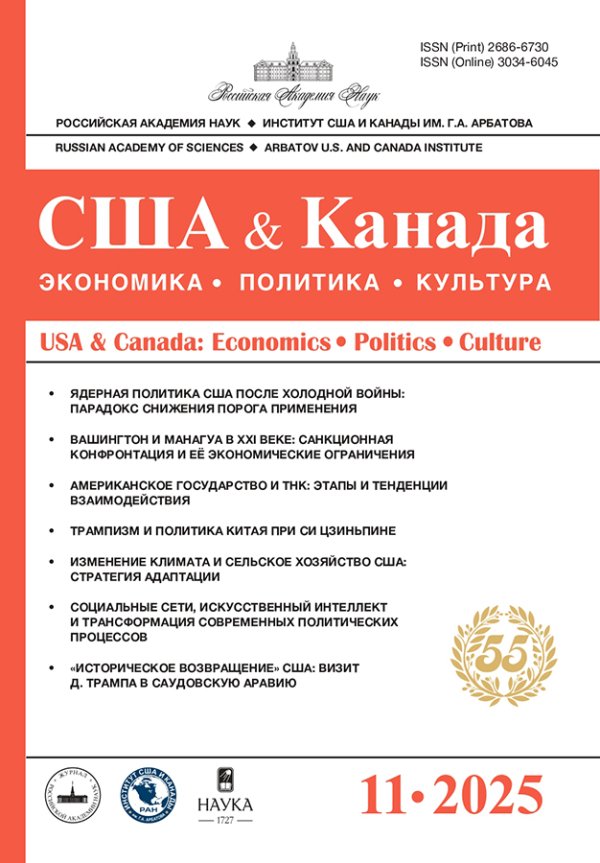
No 11 (2025)

Global Security
On the Particular Paradox of U.S. Post-Cold War Nuclear Policy
Abstract
The end of the Cold War significantly changed the strategic landscape. Under the powerful pressure of factors of military-political (changes of the world order and bloc policy), military-strategic (doctrinal views on warfare), and military-technical (the emergence of new types of weapons and military technologies) factors, U.S. nuclear policy underwent significant transformations. Against the backdrop of a drastic reduction in nuclear arsenals and a marked reduction in the role of nuclear weapons in strategic policy settings, the threshold for their use was paradoxically lowered due to the interaction of existing factors.
USA & Canada: Economics, Politics, Culture. 2025;(11):5-16
 5-16
5-16


Military Policy
The «historic» visit of D. Trump to Riyadh for the 80th anniversary of the US-Saudi alliance
Abstract
The article is devoted to D. Trump's visit to KSA, made during his first major international trip. The relevance of the topic is determined by the fact that the trip was called «historic return» of the USA to the Middle East. The first part examines the results of D. Trump's trip to Riyadh. D. Trump made trade and investment the key element of his trip, but artificial intelligence (hereinafter AI) was at the center of the agreements. In this regard the author discusses the prospects for AI-partnership and the US attempts to impose its technological standard on the KSA on monopolistic basis. The author concludes that KSA now holds central role in D. Trump's AI-policy and that the American-Arab technological alliance is formed.
USA & Canada: Economics, Politics, Culture. 2025;(11):17-28
17-28
U.S. and the World
China and Trumpism: Some Preliminary Thoughts
Abstract
Trumpism is a relatively new concept, but one that is already used in scientific and journalistic literature. It denotes a set of ideological attitudes aimed at changing approaches to foreign, domestic and economic policies of individual countries towards conservatism, nationalism and protectionism, by rejecting globalism. The emergence of Trumpism is associated with the personality of the U.S. President D. Trump, but is not limited to the views of Trump or the U.S. We can consider Trumpism as a transnational phenomenon, whose followers will participate in the political process both in the U.S. after the end of Trump's presidency and in other countries. Starting from D. Trump's first term (2017-2021), his political views and decisions have been negatively assessed in China. However, ideologically, Trumpism and the policies of the PRC during the reign of Xi Jinping seem to be very similar. Awareness of this similarity may lead to the normalization of relations between the countries in the future.
USA & Canada: Economics, Politics, Culture. 2025;(11):29-39
29-39
The USA and the Sandinista Government in Nicaragua in the 21st Century: New Rules for an Old Game
Abstract
The article deals with the features of U.S.–Nicaragua relations in the 21st century, since Sandinistas returning to power. The research outlines focal points in the evolution of bilateral engagement, with particular emphasis on the Joe Biden administration's tenure (2021–2025). A persistent political and ideological confrontation can be traced between the two countries, resulting in the U.S. sanctions targeting president Daniel Ortega's government. At the same time, the study highlights the economic dimension of this cooperation, noting that Washington’s ability to exert pressure on Managua is significantly constrained by the potential risks such measures pose to the United States itself.
USA & Canada: Economics, Politics, Culture. 2025;(11):40-52
40-52
Domestic Politics
The US National Security Council under Donald Trump: Legacy and Modern Features
Abstract
The article examines in detail the modern four-level organizational structure of the US National Security Council system at the beginning of Donald Trump's second term as president. Such a four-level effective system may also be of interest to Russian foreign ministries. The article shows that, despite the negative attitude towards Democratic President Barack Obama, Trump during his first term maintained his reform of merging the apparatuses of the National Security Council and the Internal Security Council into a single whole. At the beginning of the second term, he also merged both councils into a single body. Trumpists considered the numerous NSC apparatus inherited from their Democratic predecessors to be a manifestation of a "deep state" hostile to them. Accordingly, a course was taken for a significant reduction in the size of the NSC apparatus, a decrease in the role of the NSC in the foreign policy process and, as a result, an increase in the role of the State Department and the Ministry of Defense.
USA & Canada: Economics, Politics, Culture. 2025;(11):53-65
53-65
Agriculture
U.S. Agriculture in a New Climate Reality
Abstract
Agriculture is extremely sensitive to weather and climate. Air temperature, precipitation, air humidity, solar radiation and wind are the main climatic factors that determine many parameters of agricultural production, on which the quality and volume of the yield depend. Each geographic region is unique in its combination of natural and climatic conditions, so the range of consequences of global climate change is very diverse - from increased production to the loss of crops and livestock. For agriculture, damage from climate change is realized in soil degradation, a decrease in its fertility and productivity, crop failure, and pest infestation. Among the positive consequences are an increase in the duration of the growing season, an increase in productivity and an expansion of crop area. In the United States, a strategy for adaptation of agricultural production has been developed to reduce the climate change risks. The recommendations of this strategy are based on modern achievements of agricultural science, innovative technologies that allow to reduce and even minimize the negative impact of climatic factors on agriculture, and prevent related financial losses. The Department of Agriculture provides assistance to farmers affected by weather anomalies, crop insurance against adverse weather conditions, and the extension of the adaptation strategy. It also finances scientific research and development on this topic. The global climate change is considered not only as one of the one of the greatest human development challenges facing the world, but also as a chance to move the industry to a new stage of development. The scale of the climate change problem is enormous, as they extend beyond agricultural production to other sectors of the US food system that are critical for food security. This raises concerns in the scientific community and increases interest in many alternative agricultural practices, including conservation agriculture, vertical farms, and organic agriculture.
USA & Canada: Economics, Politics, Culture. 2025;(11):66-78
66-78
Healthcare
The Medicaid Program in the Context of the "Big Beautiful Bill" of the Second Trump Administration
Abstract
On July 4, 2025, Republican President D. Trump signed the much-talked-about bill on the reconciliation procedure (H.R. 1), known as "The Big Beautiful Bill", concerning healthcare, in particular, changes to the Medicaid programs and the Affordable Care Act (ACA). What is the H.R. 1 bill? This is a major law that changes the rules for government healthcare programs in the United States, the purpose of which is to reduce federal budget expenditures and change the system of assistance to low-income Americans, who are mainly dealt with by the Medicaid program, which helps pay for medical services for low-income Americans. These are, as a rule, children from such families, elderly Americans, and people with disabilities. As a government health insurance program for the poor, Medicaid is one of the cornerstones of the health care system in the United States, targeting health care to low-income and vulnerable groups. The Medicaid program serves more than one in five U.S. residents and covers almost a fifth of health care costs (and half of long-term care costs). It makes up a significant share of state budgets and is a significant part of the entire health care system [1]. What are the main changes that D. Trump's new initiative makes to the Medicaid health care program? How will they affect the health care system in the United States? How will D. Trump's adopted "magnificent bill" affect through funding cuts the Medicaid program on access to services for the implementation of reproductive rights of the American population, and what to expect for states that previously adopted the expansion of Medicaid, as well as those that refused it? The reaction in society to the appearance of the "big, beautiful bill" of the Republican administration of D. Trump is far from unambiguous and requires reflection.
USA & Canada: Economics, Politics, Culture. 2025;(11):79-91
79-91
Science and Technology
The role of social media and artificial intelligence in the transformation of modern political processes
Abstract
The article explores the transformation of modern political processes in the world, taking into account the technological development of social networks and artificial intelligence (AI). In particular, AI algorithms today have significant mobilization potential. Candidates are increasingly turning to AI tools when building their electoral campaigns, while reducing the role of traditional information channels. This format helps in working with young people, who are the conductor of technological progress and the bulwark of state stability. In addition, modern social networks open up new opportunities in conflict resolution, crisis resolution, and intercultural interaction. However, along with the creative agenda, there are also certain risks in the development of social networks. They contribute to the establishment of poly-actorism in world politics, in which competition between public and private information channels, the spread of filter bubbles, and a lowering of the threshold of responsibility are recorded. Such a situation is used by Western institutions to promote subversive narratives. Finally, the article analyzes the largest social networks by audience reach.
USA & Canada: Economics, Politics, Culture. 2025;(11):92-99
92-99
AI Regulation at the National Level: The Experience of the USA and Other Countries
Abstract
The article explores the state of regulation of artificial intelligence (AI) at the national level, its specifics and key directions. It emphasizes that AI technologies are used everywhere, but not all countries have rules for their development and use. National approaches to regulating AI and the methods used are determined primarily by the understanding of the risks posed by this technology by the government, business and the public, as well as by the level of AI development and the availability of appropriate infrastructure. The USA and China are the centers of AI development, norms and measures of its regulation. The approaches of the United States and other countries to AI regulation are compared.
USA & Canada: Economics, Politics, Culture. 2025;(11):100-112
100-112
In the World of Business
American MNCs and the US government: evolution of their relations
Abstract
The relations of the US government and American multinational companies are studied in the article in historical perspective in the context of commonalities and differences in national interests and objectives of MNCs. Based on the analysis of economic indicators of multinational corporations in the period from 1989 through 2019 (which covers both offshoring and reshoring of production facilities by American companies) tendencies in relations between MNCs and the US government are outlined. The history of these relations from middle of the XX century is split into four stages, the evolution of which enables to forecast their further development.
USA & Canada: Economics, Politics, Culture. 2025;(11):113-126
113-126
Informatsiya dlya avtorov
USA & Canada: Economics, Politics, Culture. 2025;(11):127-128
127-128