
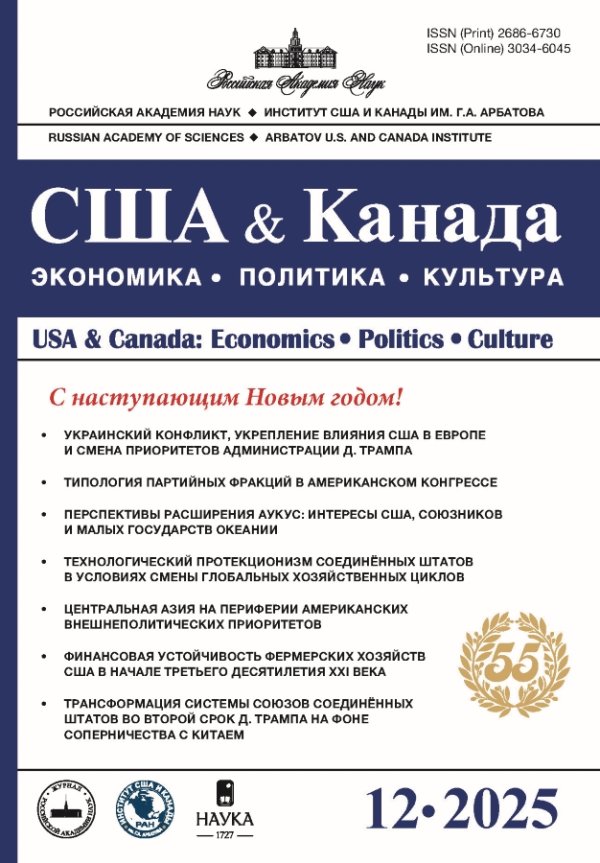
USA & Canada: Economics, Politics, Culture

The monthly publication “USA & Canada: Economics – Politics – Culture” (“USA & Canada” Journal) was founded in 1970 as “USA – Economics, Politics, Ideology” (since 1998 Canada was added). It's main purpose was and still is to inform readers about all aspects of domestic and foreign policies of the USA and Canada as well as current theoretical and practical issues of the international policy, world economic relations, development in different countries of the world. It publishes materials representing results of researches carried out by Russian specialists and foreign analysts on Russian – U.S. and Russian – Canada relations. Now it is the leading journal in Russia and CIS on all these matters. Also the journal publishes articles on such matters as security and defense policies, globalization and integration processes, innovation, scientific and technological progress, international terrorism and counter-terrorism, environmental challenges and cultural issues (literature, music, cinema, arts and architecture) etc.

Mission of the Journal is to provide a platform for authoritative researchers from Russia and the CIS countries to discuss processes and events taking place in the USA and Canada.

Among readers of “USA & Canada” journal are: international researchers and students of above mentioned issues, teachers, post-graduate students and students of higher education institutions, executives and staff of federal and regional state authorities, managers and analysts of banks, corporations, large enterprises.

Among the authors of the journal are: the leading analysts of the Institute of USA & Canada Studies, Russian Academy of Sciences, researchers from other Russian academic and non-academic think-tanks of international profile, foreign researchers, industry analysts and banking experts, professors of the universities and higher education institutions, post-graduate students, representatives of the legislative and executive bodies of the Russian Federation and the CIS countries.

The journal is included in the Russian Higher Attestation Commission List of peer-reviewed scientific publications.

The “USA & Canada: Economics – Politics – Culture” journal is distributed by advance subscription only, and is not offered for sale. The subscription may be accomplished in every post-office in Russia using the Federal Postal Service union catalogue, section “ARSMI», the journal index 70925. The subscription may start from every month, for any number of issues.

Since 2009 it has been possible to receive the full-text online version. The subscription for it is done centrally through the Russian Electronic Library system https://elibrary.ru/title_about.asp?id=8241

Editor-in-Chief of the journal - A. Panov.

Media registration certificate: ПИ № ФС 77 - 71487 от 13.11.2017

Current Issue

Open Access Open Access  Restricted Access Access granted  Restricted Access Subscription Access

No 5 (2026)

Cover Page

Full Issue

Open Access Open Access
Restricted Access Access granted
Restricted Access Subscription Access

The Current Discourse

Trumpism and Economy: First Results and Prospects
Supyan V.B.
Abstract
The article aims to show the economic results of the first year of President Trump’s economic policy. It deals with factors that played the most important role in changes of economic situation in a country. Among them are dynamics of demands and consumption, government expenditures, foreign trade and fiscal policy, and the state of such important markets as housing and energy. According to estimations of key analytical centers of the USA, President Trump’s economic policy contains great potential for uncertainty, which doesn’t allow making reasonable forecasts for the foreseeable future. Nevertheless the current forecast estimations don’t contain any significant changes in macroeconomic indicators during next two years. In general the author makes a conclusion that many characteristics of Trump’s economic policy cannot be regarded as well elaborated and implemented into the concept of “trumpism” as a broader social-economic and political phenomenon.
USA & Canada: Economics, Politics, Culture. 2026;(5):5–14
pages 5–14 views

Global Security

The Impact of Non-Nuclear Strategic Weapons Development on Maintaining Strategic Stability
ANTONOV A.I.
Abstract
The article examines the impact of the development of non-nuclear strategic weapons (NNSW) on the maintenance of strategic stability and the prospects for arms control. The evolution of the conceptual framework for strategic offensive arms in non-nuclear configurations is traced from SALT I through New START, which expired on February 5, 2026. Particular attention is paid to the problem of distinguishing between nuclear and non-nuclear warheads on strategic offensive arms and the associated risks of nuclear conflict escalation. The author analyzes the U.S. concepts of Prompt Global Strike, the "Golden Dome" missile defense system, and the "Left of Launch" strategy as an interconnected chain aimed at achieving global military superiority. The article reviews advanced U.S. hypersonic weapons programs as well as the role of cyber weapons and non-kinetic means as a new dimension of the strategic balance. It concludes that strategic offensive arms in non-nuclear configuration, given their emerging counter-force capabilities, cannot be excluded from limitations in future arms control negotiations, and that the NNSW problem will only intensify.
USA & Canada: Economics, Politics, Culture. 2026;(5):15–32
pages 15–32 views

Foreign Policy

Regionalization within a "Trump Scenario" Using the Example of Azerbaijan
Gegelashvili N.A.
Abstract
This article examines the process of regionalization of the South Caucasus within the framework of the Greater Middle East (GME) concept, using Azerbaijan as an example during Donald Trump's second term. It identifies the ways and means of implementing Washington's policy in this region, which the American administration views as a significant Middle Eastern vector. It analyzes the unprecedented intensification of US policy in this area, aimed both at realizing geopolitical interests – the creation of alternative transport corridors bypassing Russia and China – as well as economic interests – the development of active cooperation in the economic sphere. This also serves the interests of the countries in the region, particularly Azerbaijan, whose position in the region has significantly strengthened recently. The ultimate goal of the United States is to transform the region from a zone of turbulence into “a zone of peace and prosperity”, which is necessary for the development of American business in accordance with Donald Trump's scenario.
USA & Canada: Economics, Politics, Culture. 2026;(5):33–45
pages 33–45 views
Defense Cooperation between Canada and the Republic of Korea: Evolution and Strategy in the Indo-Pacific Region
Solyanova M.V.
Abstract
The article examines the evolution of defense cooperation between Canada and the Republic of Korea, noting its transformation from a historically conditioned alliance into a multidimensional strategic partnership. It analyzes the driving forces behind this cooperation, including the pursuit of strategic hedging amidst US-China rivalry, managing the threat from the DPRK, a mutual need for alliance diversification, and a shared commitment to a rules-based international order. Special attention is paid to the formalization of defense-industrial cooperation, expressed in the signing of key memorandums of understanding and potential arms supply deals, such as KSS-III submarines. The vectors of defense cooperation are considered, including increasing interoperability and joint military exercises, ensuring the security of sea lines of communication, and deepening cooperation in cybersecurity and defense research.
USA & Canada: Economics, Politics, Culture. 2026;(5):46–61
pages 46–61 views
The Impact of US Strategy and Chinese Policy in the Arctic on the Development Prospects of Russia's Arctic Zone
Morozov Y.V.
Abstract
The purpose of this article is to provide a comprehensive assessment of the prospects for the development of Russia's Arctic zone taking into account the influence of the U.S. strategy and China's policy in this region, which is becoming an area of cooperation and competition between Washington, Moscow, and Beijing in the context of global warming. In this regard, the article analyzes the U.S. strategy in the Arctic and China's policy in the region as well as the prospects for Russia's development of its Arctic zone in cooperation with China. The article concludes with a summary of the prospects for the development of the Arctic from the perspective of Russian interests. To substantiate these statements, the article provides a comparative analysis and synthesis of the national concepts of the United States, China's policy, and their positions in various areas of interaction and confrontation that influence the prospects for the development of the Russian Arctic zone and its regional security.
USA & Canada: Economics, Politics, Culture. 2026;(5):62–77
pages 62–77 views
US-Russia Space Cooperation in 1991–2014: Main Models and Features
Makarov D.D.
Abstract
Between 1991 and 2014, the core characteristics of US-Russian space cooperation emerged. In the ongoing discussions about new joint projects, it is important to fill gaps in understanding the nature of the Russian-American space partnership. To this end, two assessment models – those of E. Sadeh, J.P. Lester, and Z. Sadeh, as well as D. Broniatowski – are proposed. They complement each other and provide a comprehensive picture. The analysis is based on agreements signed between the two countries during this period. The study, using the first model, shows that communications between Washington and Moscow were conducted either through Roscosmos (the Roscosmos State Corporation for Space Activities, hereinafter referred to as Roscosmos) or through the government. The second model reflects the uneven dynamics of the two countries' relations. The US more often initiated cooperation and acted as the lead party in projects. At the same time, NASA programs were dependent on technologies provided by Roscosmos.
USA & Canada: Economics, Politics, Culture. 2026;(5):78–90
pages 78–90 views

Ecology

Environmental Governance of Lake Tahoe as a Framework for Enhancing the Legal Regime of Lake Baikal
Kolobov R.Y.
Abstract
This article presents a comparative legal analysis of protection regimes for unique lake ecosystems, focusing on Lake Tahoe (USA) and Lake Baikal (Russia). The study examines the complex regulatory framework of Lake Tahoe, including federal statutes, California and Nevada state laws, and the Interstate Regional Planning Compact. Special emphasis is placed on the Tahoe Regional Planning Agency (TRPA) and the integration of scientific data into legal norms, particularly through Environmental Threshold Carrying Capacities. The article explores economic instruments for environmental protection, such as the Lake Clarity Crediting Program and Transfer of Development Rights (TDR), as well as the legal formalization of scenic values via the Visual Contrast Rating System. Drawing on this analysis, the author identifies systemic deficiencies in the domestic legal regulation of Lake Baikal, specifically the failure to integrate the Central Ecological Zone of the Baikal Natural Territory into the broader legal classification system. While the direct reception of the American interstate compact model is substantiated as unfeasible due to constitutional differences, the article demonstrates the potential for adapting specific management tools proven effective in the Tahoe Basin. The study argues for comprehensive zoning of the Baikal Buffer Ecological Zone and advocates for recognizing the Central Ecological Zone as a specially protected natural territory (SPNA) sui generis to facilitate a unified management system.
USA & Canada: Economics, Politics, Culture. 2026;(5):91–107
pages 91–107 views

History

The Gold Mining Industry of the USA on the Eve of and During the Second World War
Kirsanov A.K., Grebenyuk P.S., Guzeev A.A.
Abstract
The article presents a comprehensive analysis of the U.S. gold mining industry on the eve of and during the Second World War. Drawing on archival materials, statistical reports, and scholarly publications, the study examines the scale and geographical distribution of gold production, technological characteristics of deposit development, the structure of production costs, as well as trends in wages and labor productivity. The relevance of the research lies in its ability to trace the impact of shifts in government economic policy – from the stimulation of gold production following the increase in gold prices in 1934 to its administrative restriction during the Second World War – and to compare market-corporate and centralized state models of organizing gold mining. The study identifies a structural transformation of the industry, characterized by an increase in the number of enterprises from 3,783 in 1930 to 12,193 in 1935, followed by stabilization at 9,569 enterprises by 1940. A high degree of regional concentration of production is demonstrated, with gold mining concentrated in five principal states (California, Alaska, South Dakota, Colorado, and Utah), alongside a significant diversity of organizational forms. A comparative analysis with the Soviet gold mining model of the same period reveals substantial differences in labor productivity, production costs, and industry structure. The findings contribute to the study of U.S. economic history, mining history, and the comparative analysis of organizational and economic models of gold mining in the twentieth century.
USA & Canada: Economics, Politics, Culture. 2026;(5):108–126
pages 108–126 views
Informatsiya dlya avtorov
Redaktsiya z.
USA & Canada: Economics, Politics, Culture. 2026;(5):127–128
pages 127–128 views