
🔧На сайте запланированы технические работы
25.12.2025 в промежутке с 18:00 до 21:00 по Московскому времени (GMT+3) на сайте будут проводиться плановые технические работы. Возможны перебои с доступом к сайту. Приносим извинения за временные неудобства. Благодарим за понимание!
🔧Site maintenance is scheduled.
Scheduled maintenance will be performed on the site from 6:00 PM to 9:00 PM Moscow time (GMT+3) on December 25, 2025. Site access may be interrupted. We apologize for the inconvenience. Thank you for your understanding!


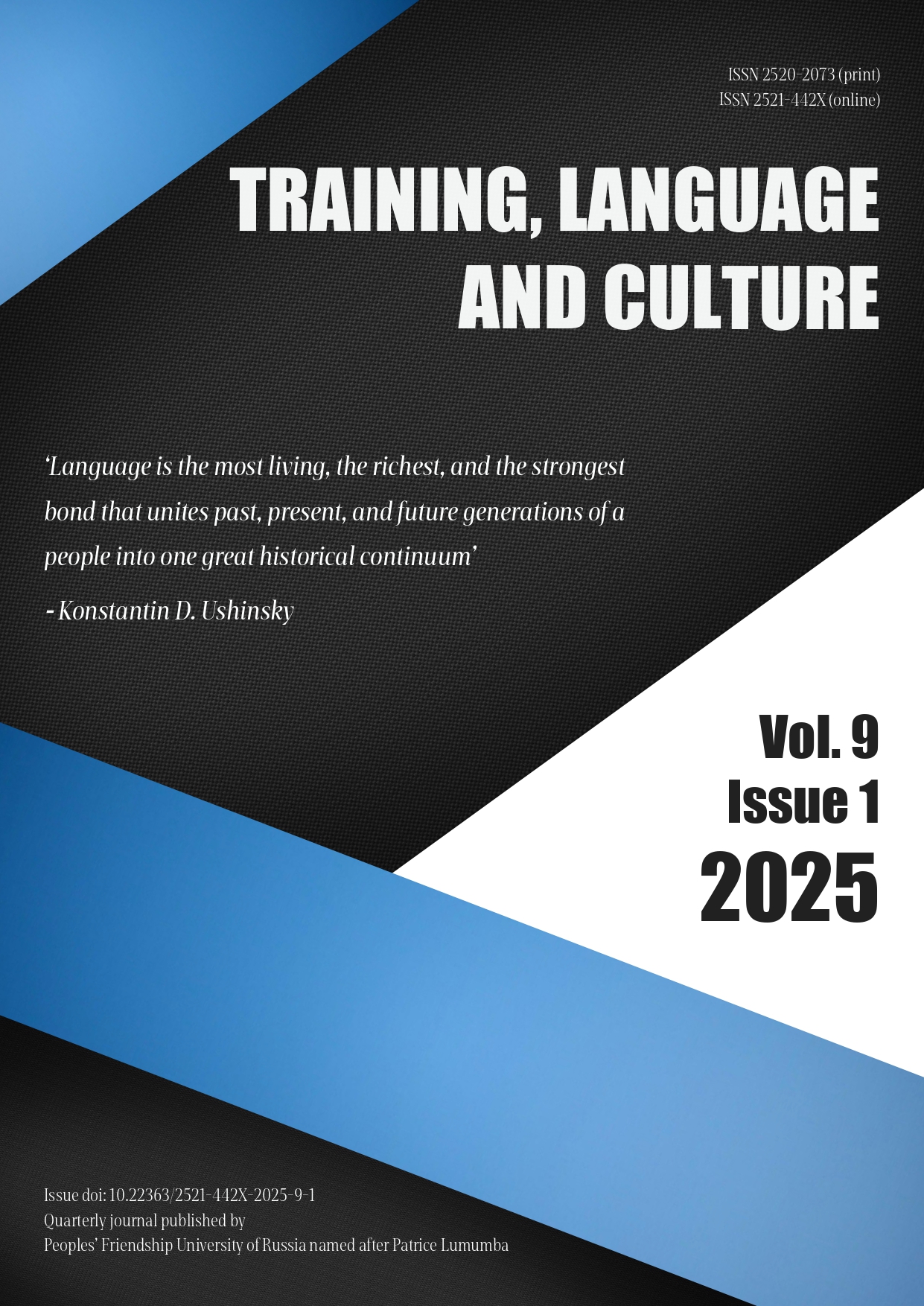
Training, Language and Culture

Главный редактор: Елена Николаевна Малюга, д-р филол. наук, профессор

ISSN: 2520-2073 (Print) | 2521-442X (Online)

Издается с 2017 г. Периодичность: 4 выпуска в год (ежеквартально)

Учредитель / издательРоссийский университет дружбы народов имени Патриса Лумумбы

Открытый доступ: Platinum Open AccessПлата за публикацию: не взимается

Рецензирование: двойное слепое. Язык публикаций: английский

Индексация: Белый список РЦНИ, РИНЦ, ВАК (как индексируемый в МНБД), Scopus (Q1 SJR, Cite Score, Q2 SNIP), Ulrich's Periodicals Directory, Linguistics Abstracts Online (Wiley),  DOAJ, ROAD, Google Scholar, CyberLeninka

Официальный сайт: https://rudn.tlcjournal.org 

Цели и тематика

Training, Language and Culture (TLC) – рецензируемый научный журнал, целью которого является популяризация и распространение исследований в области языка, лингвистики, образования и культуры, с особым фокусом на профессиональную коммуникацию и профессиональный дискурс. Редколлегия журнала Training, Language and Culture приглашает к публикации исследовательские статьи и рецензии на книги, освещающие проблемы, актуальные для научного и профессионального сообществ.

Предметные области

Training, Language and Culture ориентируется на следующие области научных интересов:

  • теоретические и практические аспекты языка и лингвистики;
  • культурология;
  • межличностная и межкультурная профессиональная коммуникация;
  • обучение языку и культуре, включая приемы и технологии, тестирование и оценку.

Миссия журнала

Training, Language and Culture – научное рецензируемое издание, предлагающие онлайн-доступ к исследованиям, рассматривающим особенности устройства языков, процессов формирования и передачи значений в различных культурных и коммуникативных условиях, а также технологий обучения этим и другим аспектам языкового функционирования. Эти процессы носят динамический характер, поскольку языки и культуры развиваются и меняются в контексте различных глобальных явлений и событий. TLC призван осветить этот динамизм, предоставить платформу для публикации конструктивных исследований по актуальным вопросам и способствовать их внедрению в педагогическую практику, профессиональную коммуникацию и исследования в сфере профессионального дискурса. Журнал адресован и принимает работы ученых и практиков, занимающихся исследованиями по специальностям: (1) языки народов зарубежных стран; (2) теоретическая, прикладная и сравнительно-сопоставительная лингвистика; (3) теория и методика обучения и воспитания.

Подать статью: https://rudn.tlcjournal.org/submit-rus.html

Текущий выпуск

Том 9, № 3 (2025)

Статьи

AI meets education: How ChatGPT transforms reading skills in Omani EFL learners
Behforouz B., Al Ghaithi A.
Аннотация
The main objective of this study was to measure the impact of ChatGPT on the reading skills of language learners. Therefore, a total of fifty Omani students with intermediate English proficiency were selected and randomly assigned into two groups, one control group and an experimental group, with an equal number of students in each group. Both groups received the traditional face-to-face training to engage with the reading comprehension skills, techniques, and strategies in understanding the texts and finding answers for various types of questions arising from the test, but the experimental group received extra explanation and practice from ChatGPT. To compare the results in both groups, the researcher developed and modified some reading tests. Their reliability and validity were measured and monitored by the experts. After a month of treatment, the findings revealed that both groups initially received higher scores in the reading posttests compared to their pretests, but the experimental group performed significantly better than the control group. Additionally, further analysis of the delayed posttests of reading showed that the control group had no increment in their scores while the experimental group continued its progress, and performance was significantly higher, suggesting improved retention of reading abilities. The results of this study are useful for teachers, students, and educational institutions.
Training, Language and Culture. 2025;9(3):10-21
pages 10-21 views
(De)Motivating factors of e-mentoring integration in English academic writing classrooms
Mudra H.
Аннотация
It remains unquestionable that learning a language such as English through online mode may have transformative impacts on students’ motivational process. Grounded from the rationale, this study explored EFL students’ (de)motivating factors in integrating e-mentoring methods during academic writing projects. Thirteen selected university students with different demographic variables (i.e., grade, gender, university, age, language proficiency) attended multiple interviews, focus group discussions, and classroom observation as data collection methods. The data were analysed through the integration of IDEEAS framework, consisting of Inclusion, Design, Engagement, Evaluation, Assessment, and Support phases and a descriptive statistical analysis. The findings are twofold. First, e-mentoring motivated EFL students to engage with academic paper writing as it effectively reduced cultural and linguistic barriers (i.e., through online tutorials, games, or discussion), promoted always-on communication (i.e., through synchronous and asynchronous modes), and relied on process rather than product (i.e., through dialogic syllabus). Nevertheless, e-mentoring remained demotivating for the students as it concerned with verbalised communication, threatened face-to-face interaction, and caused them to rely on online culture. This study implies that university stakeholders, mentors, or supervisors have to integrate e-mentoring into English learning curriculum and facilitate online learning procedures systematically. In short, motivating and demotivating factors in e-mentoring process remain critical as academic paper writing cannot be successfully engaged with online meeting. The e-mentor has to implement particular strategies by intensively utilising online apps to increase effective communication and overcome drawbacks during the academic writing project.
Training, Language and Culture. 2025;9(3):22-39
pages 22-39 views
The effects of task-based learning on English reading motivation among vocational college students
Yu H., Singh C.K., Mulyadi D.
Аннотация
The English language proficiency of students enrolled in vocational colleges in China has remained a significant concern for teachers and curriculum developers. Task-based learning has been put forward as a feasible approach to tackle this problem. Research on the effects of task-based learning on English reading motivation among vocational students can provide new ideas for vocational English reading education. The aim of this study is to explore the effects of task-based learning on the English reading motivation of Chinese vocational students. This study employed a mixed method approach, a quasi-experiment in phase 1 and followed by semi-structured interviews in phase 2. The population for this study comprised of vocational college students in Guizhou Province, China. Random sampling and purposive techniques were used in this study. Instruments include pretest, post-test, questionnaire, and semi-structured protocol. Data obtained from pretest and post-test was analysed descriptively, independent sample t-test, paired sample t-test and data from the interviews were analysed using thematic analysis. The average score of reading motivation for external (M = 3.08, SD = 0.69) and internal (M = 3.20, SD = 0.67) are at a low moderate level for control group and average score of reading motivation in terms of external (M = 3.47, SD = 0.71) and internal (M = 3.56, SD = 0.71) are at a low moderate level for experimental group. Two main themes emerged namely improved motivation and their critical thinking skills. The findings of this study have implications for English reading instruction and motivation for vocational college students.
Training, Language and Culture. 2025;9(3):40-54
pages 40-54 views
The role of language transfer in Arabic-speaking EFL learners’ comprehension of scope ambiguity in doubly quantified sentences
Makhlouf D., Zibin A., Altakhaineh A.R.
Аннотация
This study examines the influence of language transfer on Arabic-speaking EFL learners’ understanding of quantifier scope ambiguity and the impact of their first language on resolving three types of doubly quantified sentences. Fifty English literature and applied English students from the University of Jordan participated, split into two groups: 25 with medium proficiency and 25 with advanced proficiency. A 14-item test with doubly quantified sentences and static pictures assessed how English proficiency influences comprehension of scope ambiguity across three patterns: numerical, universal, and existential quantifier sentences. Results indicated that higher proficiency participants better understood existential quantifier sentences, which are more complex. However, proficiency did not significantly affect comprehension of universal or numerical sentences. Numerical sentences were the most challenging due to ambiguity in linking numbers and objects, while universal sentences were easier due to their predictable meaning. In line with language transfer theory, the data analysis suggests that L1 syntactic structures influence the processing of doubly quantified sentences, with participants exhibiting tendencies to favour interpretations aligning with familiar L1 patterns. The study concludes that language transfer plays an important role in the accurate identification of scope ambiguity interpretations, particularly when L2 structures diverge from L1 norms, and provides recommendations for future research.
Training, Language and Culture. 2025;9(3):55-70
pages 55-70 views
A constructivist inquiry into English-Medium Instruction in Moroccan higher education
Razkane H., Ben Hammou S., Sayeh A.Y.
Аннотация
As Morocco undergoes a shift in its linguistic landscape, English has gained prominence as a key medium for academic and professional mobility, particularly in science, technology, and business fields. This study investigates the recent implementation of English-Medium Instruction (EMI) at tertiary education in a context traditionally dominated by French and Arabic. In particular, it explores the perceptions, experiences, and strategies of Moroccan university students in a private institution in Casablanca regarding the adoption of EMI in Computer Science and Business Administration programmes. Drawing on a qualitative design grounded in constructivist grounded theory, data were collected through semi-structured interviews with 35 undergraduate students and analysed through open, axial, and selective coding. Over 300 initial codes were generated, leading to the emergence of key themes such as the global value of English, institutional and pedagogical barriers to EMI, lecturer preparedness, and the need for multilingual balance. Findings reveal strong student support for English as a global language of science, communication, and employment, while also highlighting significant challenges, including limited early exposure, underprepared instructors, and lack of disciplinary language support. Students advocated for the need for early EFL integration at the primary level, EMI-specific teacher training, and the normalisation of English for Academic Purposes (EAP) across all disciplines. Importantly, they also called for the preservation of local languages through a balanced multilingual policy.
Training, Language and Culture. 2025;9(3):71-83
pages 71-83 views
Economic and educational benefits of mother tongue and second language use: Evidence from Uzbekistan
Ibragimova N.M.
Аннотация
Despite growing recognition of the role of language skills in shaping human capital, the understanding of their influence on individual success in multilingual transition countries such as Uzbekistan remains limited. This study addresses this gap by empirically examining the interdependence of mother tongue and second-language use with individual income and academic attainment. The estimation draws on nationally representative microdata from the 2021 Household Budget Survey (HBS), based on a randomly distributed sample across all regions of Uzbekistan. The study estimates the return on language capital, contributing to a better understanding of its economic and academic outcomes in Uzbekistan. The empirical strategy applies well-established models (Marschak, Rubinstein, Grin, etc.) and the Mincer earnings function to new data using Ordinary Least Squares (OLS) with regional fixed effects, where income premiums are associated with each linguistic group and respondents’ educational level. The findings reveal that the return on income for respondents with native Uzbek is not higher than for respondents who speak other languages. Moreover, native language education has no statistically significant effect on improving educational attainment levels. In contrast, the use of a second language (primarily English) increases earnings by 10-20% on average, with higher income premiums observed in economically active regions. The implications of the study include the interpretation of weaknesses in existing language practices and policies.
Training, Language and Culture. 2025;9(3):84-98
pages 84-98 views
Content-based instruction for psychology majors: Issues and solutions for ESP curriculum development
Berezina Z.I.
Аннотация
English for Specific Purposes (ESP) has been widely integrated into higher education, but psychology has not yet received systematic attention within this framework. Existing courses tend to emphasise general academic skills and simplified texts, leaving a gap in provision of instruction consistent with the communicative practices of the discipline. The purpose of this article is to determine the potential of content-based instruction (CBI) to establish a structured approach to integrating language study with psychology-specific discourse, while identifying obstacles that arise in curriculum design. The study used a qualitative comparative methodology that combined text and genre analysis with curriculum audit. A corpus of fifty psychology texts comprising research articles, case reports, ethical documents, and poster guidelines was analysed for rhetorical organisation, lexical clusters, modality, and multimodal features. These findings were systematically compared with the contents of an existing ESP syllabus and textbook for psychology majors. The analysis showed that psychology requires competence in genres ranging from empirical reporting and diagnostic narration to ethically binding documentation and multimodal dissemination. In contrast, the curriculum reviewed concentrated on essays, oral presentations, and general vocabulary lists, with little exposure to authentic disciplinary texts. The results demonstrate a substantial gap between disciplinary requirements and current practice. The study argues that CBI provides a viable framework for addressing this misalignment by extending genre coverage, incorporating unadapted texts, integrating multimodal tasks, and focusing on discipline-specific lexis. The implications are pedagogical and institutional, calling for closer collaboration between language instructors and psychology faculty to bring ESP provision into correspondence with professional training.
Training, Language and Culture. 2025;9(3):99-112
pages 99-112 views
Cognitive processing of educational polycode text: An experimental eye-tracking study
Tubalova I.V., Garina A.V.
Аннотация
This study investigates the cognitive processing of educational PCTs by Russian-speaking readers, addressing the research gap concerning how this process is executed, regulated, and influenced by various factors. The primary aim is to explore the principles of text-image integration during the reading of an educational PCT by native Russian-speaking readers. Employing the concept that eye movements correspond to the logic of cognitive processing, the study uses eye-tracking methods to analyse this process. It relies on eye-movement data from 67 Russian students in the socio-humanities who read an educational polycode biology text in Russian. Findings reveal that the verbal component plays a dominant role in the cognitive processing of this text type, suggesting that this dominance is not dependent on the national educational culture. At the same time, the reading pattern is influenced by the learners’ experience with educational texts of a specific content type - in this case, biology. The study also confirms and identifies the mechanisms of the regulatory function of the verbal component during the reading of an educational PCT. The implications of this study are both theoretical and practical: it contributes to the understanding of how the cognitive processing of educational texts is carried out and what factors influence it and underscores the importance of the mindful use of images in the design of educational materials. Moreover, its findings can be applied in developing principles for teaching visual literacy.
Training, Language and Culture. 2025;9(3):113-125
pages 113-125 views
pages 126-128 views

Согласие на обработку персональных данных с помощью сервиса «Яндекс.Метрика»

1. Я (далее – «Пользователь» или «Субъект персональных данных»), осуществляя использование сайта https://journals.rcsi.science/ (далее – «Сайт»), подтверждая свою полную дееспособность даю согласие на обработку персональных данных с использованием средств автоматизации Оператору - федеральному государственному бюджетному учреждению «Российский центр научной информации» (РЦНИ), далее – «Оператор», расположенному по адресу: 119991, г. Москва, Ленинский просп., д.32А, со следующими условиями.

2. Категории обрабатываемых данных: файлы «cookies» (куки-файлы). Файлы «cookie» – это небольшой текстовый файл, который веб-сервер может хранить в браузере Пользователя. Данные файлы веб-сервер загружает на устройство Пользователя при посещении им Сайта. При каждом следующем посещении Пользователем Сайта «cookie» файлы отправляются на Сайт Оператора. Данные файлы позволяют Сайту распознавать устройство Пользователя. Содержимое такого файла может как относиться, так и не относиться к персональным данным, в зависимости от того, содержит ли такой файл персональные данные или содержит обезличенные технические данные.

3. Цель обработки персональных данных: анализ пользовательской активности с помощью сервиса «Яндекс.Метрика».

4. Категории субъектов персональных данных: все Пользователи Сайта, которые дали согласие на обработку файлов «cookie».

5. Способы обработки: сбор, запись, систематизация, накопление, хранение, уточнение (обновление, изменение), извлечение, использование, передача (доступ, предоставление), блокирование, удаление, уничтожение персональных данных.

6. Срок обработки и хранения: до получения от Субъекта персональных данных требования о прекращении обработки/отзыва согласия.

7. Способ отзыва: заявление об отзыве в письменном виде путём его направления на адрес электронной почты Оператора: info@rcsi.science или путем письменного обращения по юридическому адресу: 119991, г. Москва, Ленинский просп., д.32А

8. Субъект персональных данных вправе запретить своему оборудованию прием этих данных или ограничить прием этих данных. При отказе от получения таких данных или при ограничении приема данных некоторые функции Сайта могут работать некорректно. Субъект персональных данных обязуется сам настроить свое оборудование таким способом, чтобы оно обеспечивало адекватный его желаниям режим работы и уровень защиты данных файлов «cookie», Оператор не предоставляет технологических и правовых консультаций на темы подобного характера.

9. Порядок уничтожения персональных данных при достижении цели их обработки или при наступлении иных законных оснований определяется Оператором в соответствии с законодательством Российской Федерации.

10. Я согласен/согласна квалифицировать в качестве своей простой электронной подписи под настоящим Согласием и под Политикой обработки персональных данных выполнение мною следующего действия на сайте: https://journals.rcsi.science/ нажатие мною на интерфейсе с текстом: «Сайт использует сервис «Яндекс.Метрика» (который использует файлы «cookie») на элемент с текстом «Принять и продолжить».