



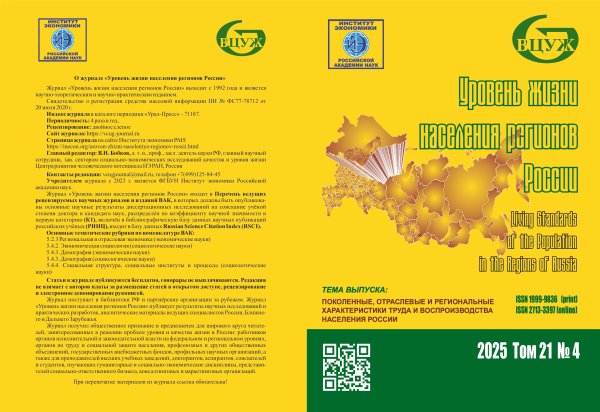
Vol 21, No 4 (2025): GENERATIONS, INDUSTRIAL AND REGIONAL CHARACTERISTICS OF LABOUR AND REPRODUCTION OF THE POPULATION OF RUSSIA
- Year: 2025
- Published: 04.12.2025
- Articles: 14
- URL: https://journals.rcsi.science/1999-9836/issue/view/24069
Full Issue

Chief editor's column
CHIEF EDITOR’S COLUMN
 497-501


DISCUSSION FORUM
Increasing Labour Productivity or a New Wave of Optimization in the Cultural Sphere?
Abstract
The main purpose of this paper is to explore the correctness of applying the labour productivity concept in social sector in general, and special in the cultural sector, as accepted in the national project «Efficient and Competitive Economy» (federal project «Labor Productivity») for 2025-2030. The article analyses the challenges associated with applying the labour productivity indicator "by output" to the cultural sector, particularly through the index defined in the national project as "increase in the number of visits per employee" for cultural institutions. The incorrect nature of this approach is revealed both through statistical data calculated for specific types of cultural activity (theatres, museums, public libraries, concert organizations), and through the inaccurate calculation methodology contained in ministry documents. Applying the concept of labour productivity, appropriate for industrial production and the commercial service sector, to social sector, particularly the cultural sector, distorts the non-commercial nature of cultural activity and underestimates the social significance of cultural goods. Increased labour productivity in cultural institutions is planned to be achieved through lean production concept, originally developed to reduce costs in mass-production enterprises. This also demonstrates the inadequacy of a unified approach to assessing performance in manufacturing production and socially significant sectors. A detailed examination of the federal project's methodology reveals a new wave of optimization in the cultural sector, where rhetoric about the need to increase labour productivity conceals another one reduction in the network and number of cultural employees, as well as the deprivation of cultural institutions' financial and economic independence.
502-517
Economic research
Russia's Food Import Dependence: Transformation Under Sanctions and Price Risks to Living Standards
Abstract
This article aims to analyze Russia's dependence on food imports for domestic consumption in the context of sanctions and factors creating price risks affecting living standards. The research methodology is based on the principles of Russian statistics and the Russian Federation's Food Security Doctrine. The primary sources of information include data from Rosstat, customs statistics, Rosselkhoznadzor, the Bank of Russia, and the FAO (Food and Agriculture Organization of the United Nations). This article examines changes in the study area since 2014 using the food import dependence indicator—a calculated indicator that determines the role of the global market in shaping a country's food resources. The level of import dependence for certain types of socially significant products was calculated using statistical balances of consumer goods. Calculations showed that it differs from the self-sufficiency indicator (an adjustable indicator of food security) in both level and dynamics. Various combinations of these dynamics are identified: a decrease in import dependence amidst rising self-sufficiency, an increase in the former indicator amidst a decline in the latter, and an increase in the former indicator amidst a rise in the latter. It is substantiated that assessing transformation processes based on aggregated product types is insufficient; a detailed approach to their broader composition is essential. The article demonstrates that, as a result of global problems in the global food market in recent years, a persistent risk factor for living standards has emerged due to the accelerated growth of global prices, as well as the appreciation of the US dollar. It was determined that core imported inflation, calculated based on the ruble equivalent of the imported product, influences consumer price indices in the food market, decreasing as import dependence declines. The study suggests including import dependence and imported inflation indicators in food security indicators, allowing for a more comprehensive assessment of its status and the areas that pose challenges to the population's standard of living.
518-530
Typology of Russian Regions Based on Inflationary Development Characteristics and Their Impact on Real Monetary Incomes of the Population
Abstract
The aim of the study is to typologize regions depending on the impact of their inflationary development patterns on the real monetary incomes of the population and to develop recommendations for the transformation of real economic growth into an increase in living standards in Russian regions. The main objectives of the study are to assess the degree of impact of the inflationary development of the regions on the real economic growth of the country and, on this basis, to determine priority measures to ensure the positive dynamics of monetary incomes of the population. The study was based on comparative and retrospective analysis methods, which used gross regional product (GRP) indicators as the sum of gross value added for 2016-2022 in the economic sectors of 82 regions of the Russian Federation in current and constant (2016) prices. The quality of Russian regions' GRP growth was characterized according to its inflationary degree, which allowed identifying regions with exceptionally inflationary development. The Russian regions were ranked according to the specific values of GRP inflationary growth (per capita). The regions that play a significant role in the inflationary development of Russia have been identified. These regions are characterized by the most pronounced inflationary characteristics of GRP dynamics and high specific values of GRP inflationary growth (per capita). It is shown that as a result of the impact of inflationary factors, these regions do not guarantee an increase in real monetary incomes of the population adequate to the real growth of GRP. In this regard, recommendations were proposed for the transformation of real economic growth into an improvement in the standard of living in the regions of the Russian Federation.
531-545
Increasing Labor Productivity in Conditions of Staff Shortage at Enterprises in the Sverdlovsk Region
Abstract
In the context of the ongoing changes, employers are faced with a persistent shortage of staff. The situation is aggravated by the fact that large industrial enterprises are significantly increasing their production volumes due to a change in production chains, sales channels, and government orders. To ensure them, the business aims to increase labor productivity by using various reserves. At the same time, companies face a number of limitations that prevent them from achieving their goals in this direction. The aim is to study the directions and possibilities of increasing labor productivity at industrial enterprises in the Sverdlovsk region from the positions of heads of enterprises and HR directors, identifying existing limitations and suggesting ways to overcome the difficulties that have arisen. The key research methods were surveys conducted among industrial enterprises of the Sverdlovsk region, as well as among employers and employees of enterprises. The survey of managers showed that in conditions of personnel shortage, the importance of increasing labor productivity increases, the need for an integrated approach to efficiency, including restructuring business models and overall improvement of activities, and not just local changes, but many projects in this area are perceived as costs. The main growth reserves are associated with more efficient use of personnel. It is necessary to eliminate discrepancies between employee motivation and existing incentive systems. The main methods of increasing productivity are training, digitalization, automation and lean manufacturing. The hypothesis has been confirmed that the existing shortage of labor resources and low levels of automation significantly reduce the growth rate of labor productivity at enterprises in the Sverdlovsk region, and it is necessary to implement systemic organizational solutions and innovative approaches that ensure an effective increase in labor productivity in the region.
546-561
Analysis of conditions for achieving national goals of decent standard of living for pensioners
Abstract
This study analyses the conditions for attaining the socio-economic development parameters of the state pension system, as stipulated by statutory instruments. The relevance of this research is underpinned by the forthcoming 2026–2028 budgetary and planning period, which represents a decisive phase in finalising the reform of the fundamental principles governing the insurance-based pension system. These principles were originally established in 2002 and subsequently refined by the governmental «Strategy for the Long-Term Development of the Russian Federation's State Pension System until 2030» (Strategy-2030). The methodological framework is grounded in an actuarial analysis of the conditions for achieving national objectives for a decent standard of living for pensioners, coupled with an assessment of risks associated with fulfilling the state's long-term commitments to all pensioner categories. The actuarial-statistical analysis established that the contemporary state pension system, notwithstanding the execution of its social functions and the implementation of core Strategy-2030 measures—such as the eradication of poverty among all pensioner categories, the removal of funded components from the insurance pension, and the revision of pension entitlement criteria—is subject to the growing influence of external global factors. These factors present strategic risks to the attainment of national objectives for the welfare of older generations, as defined by Russian Presidential Decree No. 309 (2024). The study identified unresolved issues from prior stages of the insurance-based pension reform. It demonstrated that current developments have confronted the national pension system with novel challenges, stemming from objective shifts in the global and national landscape. These challenges extend beyond the remit of the pension system itself and necessitate regulation within the framework of macroeconomic and fiscal policy. Furthermore, the research substantiates that the advancement of digital technologies within the social security system constitutes a pivotal factor in enhancing the efficacy with which the state fulfils its pension obligations to citizens. The study also delineates the conditions requisite for achieving the national goals of a prosperous old age within the established timelines and pinpoints the specific impediments to enhancing the pension system's overall efficiency.
562-576
Risks and Opportunities of Introducing a Basic Income in Russia into the Russian State Pension System
Abstract
The article examines the risks and opportunities of introducing a universal basic income into the Russian pension system. The aim of the presented study is to identify them and justify measures to reduce risks and realize opportunities. The object of the study is the state pension system of the Russian Federation, which includes compulsory pension insurance and state social security. The subject of the study is the risks and opportunities of developing the pension system with the introduction of basic pension income. The research hypothesis is that the risks of introducing a basic pension income as a separate element of the state pension system can be minimized, and the opportunities can be used to improve the standard of living of pensioners. The authors used domestic and foreign scientific publications, legislation in the field of pension provision, analytical reports of Russian and international organizations on the study of the standard of living of the population, social protection and justice for their research. The research methods included: analysis of regulatory legal acts in the field of pension legislation and scientific literature on the problem under study; systematization of risks and opportunities, their assessment and application of appropriate matrices; computational and analytical method; the method of logical substantiation of the outlined approaches, as well as their scientific synthesis. The results of the study are the characteristics of the main elements of a promising pension system – basic pension income, insurance and supplementary pension. A matrix of risks of introducing basic pension income into the pension system has been constructed, and a risk management system has been described. The risks of high, medium and low probability during the transition to a new state pension system and the possibility of improving the standard of living of pensioners are specified. The directions of further research are outlined, which consist in supplementing the logical method of identifying risks and opportunities for introducing basic pension income into the Russian pension system by obtaining appropriate risk-oriented expert assessments, as well as processing the results of a mass survey of respondents from among employees and pensioners who are not experts; to develop a roadmap for the transition from the current mechanism for paying insurance and social pensions to a new one based on risk management and the possibility of introducing basic pension income tools into the pension system.
577-590
Financial Situation and Poverty Risks of Households with Students
Abstract
The purpose of this article is to analyze the financial situation of households with full-time students and to assess the effect of new social benefit for students from poor households on the poverty level and income deficit, and to estimate the amount of additional budget expenditures required to introduce this benefit. Model calculations were based on the Sample Survey of Population Income and Participation in Social Programs (VNDN-2024) conducted by Rosstat. The analysis showed that full-time college and university students are extremely vulnerable and need additional state social assistance. It was found that households with students, and especially households of students, and households with both students aged 17 to 23 and two or more children under 17, experience high poverty risks. Model calculations show that the introduction of a new benefit in the amount of 50% to 100% of the subsistence minimum for students aged 17 to 23 years with per capita income below the poverty line could reduce the poverty level by 1.2 times, and the total income deficit by 1.3 times. The introduction of the benefit will require additional budget funding in the amount of 0.06% of GDP per year and help to improve the financial situation of households with students and the human capital quality of young people.
591-601
Demographic research
The Interrelationship of Demographic and Socio-Economic Indicators of Regional Development in Russia
Abstract
This study integrates spatial, demographic, and socioeconomic data to uncover systemic interdependencies between demographic processes and the level of socioeconomic development across the constituent entities of the Russian Federation. The purpose of this article is to identify and assess the interrelationships between demographic processes (standard of living, fertility, mortality, life expectancy, migration etc.) and indicators of socio-economic development of regions in 1990–2025. Using matrices of pairwise correlation coefficients for 85 regions based on observations of 59 key socio-economic indicators for Federal State Statistics Service the period 1990–2025, together with an original database of strong correlations (r ≥ 0.7), two levels of analysis were undertaken: (1) aggregation of mean correlation coefficients for each selected demographic indicator; and (2) cluster analysis of regional “correlation portraits” using k‑means and hierarchical clustering. To substantiate the findings, a review of Russian and international literature was conducted on the effects of demographic processes on the economy, housing conditions, social infrastructure, and regional development. The results show that life expectancy exhibits the most robust positive associations with gross regional product (GRP) per capita and the cost of a fixed consumer basket, and negative associations with hospital bed availability and the share of the population with incomes below the subsistence minimum. In most regions, the total fertility rate is inversely related to the level of urbanization, housing provision (residential floor area per capita), and credit burden. Population size and density are closely associated with the concentration of medical personnel, while negatively correlating with total credit indebtedness and housing provision. The cluster analysis identifies four regional types—synergistic, transitional, mixed, and contrasting—distinguished by the number and strength of correlation links. The observed patterns corroborate agglomeration‑effects and demographic‑transition theories and underscore the need for a differentiated regional policy that reflects the specificities of socioeconomic development across Russia’s regions.
602-617
The Impact of Demographic Transformations on the Development of Life Insurance Markets in BRICS Countries
Abstract
The article is devoted to the study of the impact of demographic transformations on the development of life insurance markets in the BRICS countries in the period 2014-2022. Based on the analysis of data from the World Bank and national statistics of the BRICS countries, the features of the development of insurance systems in the context of demographic transformations have been studied, as well as the main challenges and opportunities for the insurance market in this context. The main attention is paid to the comparative analysis of demographic indicators (total fertility rate, life expectancy, population dynamics) and their relationship with the dynamics of insurance markets. The purpose of this study is to formulate practical recommendations for the development of the life insurance market in the BRICS countries based on an analysis of demographic trends. In accordance with this goal, the following tasks have been set: to analyze the development of life insurance markets in the context of demographic challenges, identify key demographic trends in the BRICS countries, and propose differentiated measures to optimize the life insurance market for the BRICS countries, taking into account the identified demographic challenges. The study revealed a differentiation of countries: China, Russia and Brazil have entered a phase of active aging, while India and South Africa retain a younger population structure. It has been revealed that demographic changes create new challenges and opportunities for the insurance sector, generating demand for pension and savings products. A set of differentiated recommendations has been developed for government agencies and insurance companies, including tax incentive measures, product diversification, digitalization, and the development of interstate cooperation within the framework of BRICS. The implementation of the proposed measures will make it possible to transform demographic challenges into drivers of growth in the life insurance market and improve the well-being of the population. The identified features of the formation of demand for insurance products can also be used in the future to develop strategies for the interaction of economic agents in the market in conditions of limited resources.
618-630
Sociological research
The Impact of Low Employment Income on Subjective Assessments of the Standard and Quality of Life in Households of Public Sector Workers in the Republic of Bashkortostan
Abstract
This article presents the results of an analysis of sociological survey data collected between 2021 and 2024 among public sector workers in the Republic of Bashkortostan. The study aims to analyze the impact of low employment income on the subjective assessments of the standard and quality of life among these workers' households. The research reveals the interconnections between professional identity, income level, and coping strategies. The study finds that low earnings from work not only determine the limited purchasing power of households but also shape undervalued assessments of social status and promote the choice of survival strategies over professional development. Nominal wage growth fails to outpace inflation, and extensive work experience does not guarantee financial stability, leading to a devaluation of professional identity. The results indicate the formation of a vicious cycle where even long professional tenure does not ensure financial security, and professional identity, traditionally a significant status marker, loses its value. Material factors dominate work motivation, especially among low-income groups, compelling workers to opt for survival strategies instead of professional self-realization. Gender pay asymmetry persists, and adaptation strategies are polarized across income groups. The research confirms the structural nature of working poverty. Addressing it requires comprehensive institutional reforms: modernizing the wage system, developing targeted support programs (retraining, soft loans), and enhancing the social prestige of socially significant professions. According to the authors, without such reforms, the public sector risks turning into a "poverty trap," which could have negative consequences for the development of human capital and long-term socio-economic development of both the regions and the country as a whole.
631-647
Scientific life
Quality and Standard of Living of the Population in Modern Russia: Realities, Trends, and Solutions (Review of the All-Russian Scientific and Practical Conference with International Participation)
Abstract
The article is devoted to an overview of the All-Russian Scientific and Practical conference with international participations «Quality and standard of living of the population in modern Russia: realities, trends, and solutions» (in memory of E.I. Kapustin), held on October 28 and 29, 2025 at the Institute of Economics of the Russian Academy of Sciences. Representatives of Russian and foreign research and educational organizations discussed a wide range of topical issues related to demography, employment, income policy, standard and quality of life, social support and pension provision. The abridged materials of the abstracts of the conference speakers submitted to the authors who participated in the it organization and holding are presented.
648-660
Bookshelf
Russian Society Facing Modern Challenges. Reflections on the collective monograph by M.K. Gorshkov and N.E. Tikhonova, "Russian Society and the Challenges of the Time. Book Eight"
Abstract
This article analyzes and highlights key aspects raised in the new collaborative monograph "Russian Society and the Challenges of Our Time. Book Eight," edited by RAS Academician M.K. Gorshkov and N.E. Tikhonova and published by Ves Mir. The materials presented in this collaborative monograph reflect the complex processes of adaptation and transformation of social institutions, as well as group and individual strategies, during a period of turbulence. Changes in labor, education, healthcare, culture, and mass communications are analyzed, as well as their impact on the structure of social stratification and mobility. It is worth emphasizing that the work devotes considerable attention to examining the influence of information flows and digital technologies on the formation of public opinion, political preferences, and models of social interaction. This collaborative monograph offers the authors' interpretations and theoretical models explaining the complex interrelations between the socioeconomic, political, and cultural factors shaping the development of Russian society. The presented research results can be used to develop evidence-based social policy strategies aimed at reducing social tensions, improving living standards, and strengthening social cohesion. This peer-reviewed research paper will be of interest to a wide range of readers interested in current issues in the development of Russian society and seeking to understand the underlying processes occurring in the country.
Personalities
The 75th Anniversary of Serikzhan Khamitovich Bereshev
670-672