




 Acesso aberto
 Acesso está concedido
 Somente assinantes
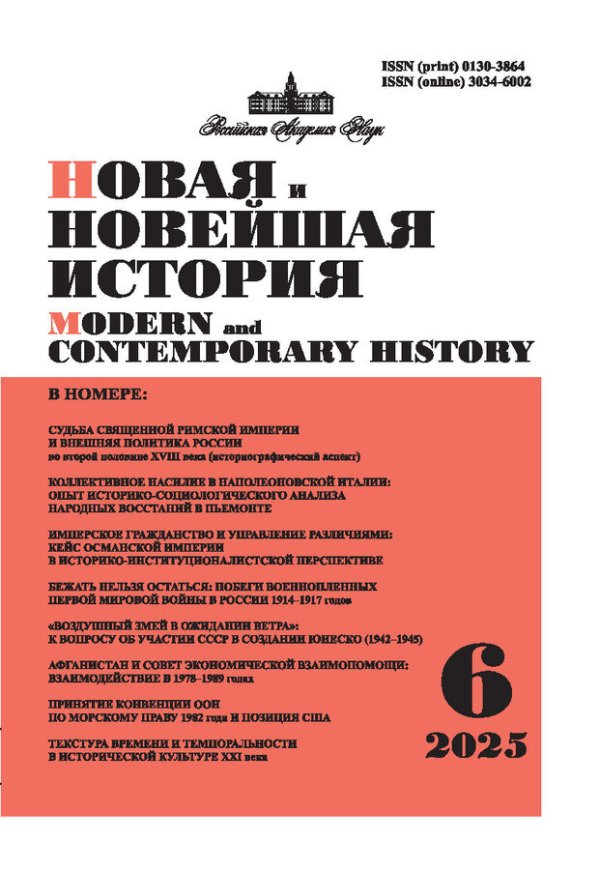
Nº 6 (2025)

Theory and methodology of history
The Fate of the Holy Roman Empire and Russian Foreign Policy in the Second Half of the Eighteenth Century: A Historiographical Perspective
Resumo
This article analyses historiographical approaches to the transformation of the Holy Roman Empire of the German Nation after the Peace of Westphalia in 1648. Scholars have generally interpreted this process as the gradual decline of imperial institutions under the pressure of territorial particularism, the dualism of Austria and Prussia, dynastic conflicts within the Habsburg Monarchy, and the external shocks of the European wars of succession and the French Revolution. The study highlights a factor that has received less systematic attention: the emergence of the Russian Empire in 1721 as a new imperial actor in the European diplomatic and legal order. Russia initially sought equality with the Holy Roman Empire and later positioned itself as a guarantor of its constitutional integrity. Drawing on existing historiography, the article reviews research on the German orientation of Russian foreign policy, the recognition of the Russian imperial title, the Holstein question and the legitimisation of the Grand Dukes Peter Feodorovich and Paul Petrovich as Dukes of Holstein-Gottorp, as well as Russia’s role in guaranteeing the Peace of Teschen (1779). The author concludes that the interaction between Russia and the institutions of the Holy Roman Empire remains insufficiently studied. Further examination of this relationship is essential for understanding both the late history of the Empire and Russia’s integration into the European state system of the eighteenth century.
 5-18
5-18


The Texture of Time and Temporalities in the Historical Culture of the Twenty-First Century
Resumo
The problem of time has long occupied a central place in philosophy and intellectual history, yet it continues to resist final comprehension, remaining, as Paul Ricoeur observed, an unresolved aporia. In contemporary scholarship, new efforts are directed towards constructing a transdisciplinary theory of time that integrates philosophical reflection, historical reasoning, and the social sciences. Within the conditions of the Anthropocene, this rethinking of historicity entails a shift from a single, linear conception of time to the study of multiple and intersecting temporalities. The growing body of literature over the past decade, together with the intensity of theoretical debate, reveals the emergence of a “temporal turn” in historical culture and the consolidation of a distinct field of time studies. These approaches focus on the texture of time as a lived and experienced phenomenon, drawing attention to its material, affective, and relational dimensions. The study of temporality now intersects with the material, affective, and relational turns in the humanities, linking historical inquiry to broader transformations in human self-understanding. Exploring the interplay of heterogeneous temporal constellations complicates the historian’s task yet expands the possibilities of historical explanation. The temporal turn, therefore, signals not only an epistemological revision within historical thought but also a profound reconfiguration of how modern societies imagine duration, continuity, and change in the twenty-first century.
19-31
Modern history
Collective Political Violence in Napoleonic Italy: A Historical and Sociological Study of Popular Uprisings in Piedmont, 1797–1801
Resumo
This article examines popular uprisings in Piedmont during the French occupation between 1797 and 1801, analysing how the lower social strata challenged the state’s monopoly on violence. It offers a new interpretative framework for understanding well-known revolts in Acqui, Asti, Mondovi, and other Piedmontese towns. Political developments in late eighteenth-century Piedmont unfolded under abnormal conditions marked by economic crisis and social dislocation. The collective violence of the rural and urban poor emerged as a means of restoring perceived social justice and resolving localised socio-political conflicts. During the uprisings, participants often assumed the right to exercise coercive power, creating temporary and authoritarian local centres of authority that rivalled the state. Patterns of collective violence spread rapidly and independently of rebel tactics, and targeted both French occupiers and local political activists — particularly Jacobins. The intensity of popular violence peaked between 1799 and 1801, reflecting the cumulative pressures of social and religious grievances. By 1800–1801, the scope of violence had broadened to include not only political intermediaries but also agents of the Turin administration itself. These episodes reveal the emergence, in Piedmont, of a new form of anti-state protest — one that preceded the full integration of the region into the imperial hierarchy of the Napoleonic state. The study combines historical and sociological approaches to illuminate how collective violence shaped the local experience of revolution and occupation in northern Italy.
32-46
Geopolitical Rivalry between Russia and Austria-Hungary in the Late Nineteenth and Early Twentieth Centuries: A Factor Analysis
Resumo
This article analyses the nature of the geopolitical rivalry between Russia and Austria-Hungary — one of the underlying causes of the Great War — through a historiographical and factor-based approach. Drawing on extensive scholarly literature and selected published sources, the study identifies several key international determinants that shaped relations between the two empires in the second half of the nineteenth and early twentieth centuries: the German, British, Slavic, and Straits factors. Particular attention is paid to Britain’s role as a global financial and diplomatic centre that consistently sought to curb Russian influence, especially in the Balkans. Germany, which had initially drawn closer to Russia after the Crimean War in an effort to reassert its great-power status, gradually became Austria-Hungary’s principal protector. This shift reflected the growing disparity in strength between the two empires: while Russia was expanding its military, naval, and economic capacities, Austria-Hungary’s power was visibly waning. Over time, Berlin’s conciliatory diplomacy gave way to a more assertive stance, reinforcing the antagonism between St Petersburg and Vienna. The author also argues that in practical European politics, the so-called “Slavic” and “Eastern” questions did not exist as coherent strategic frameworks but rather as fragmented sets of issues and initiatives, each shaped by shifting alliances and competing imperial interests.
47-59
The Tenassur Incidents in Ottoman and Russian Accounts: The Trabzon Case
Resumo
This article investigates the phenomenon of tenassur — the reconversion of former Christian converts to Islam back to Christianity — through a focused case study of the Istavris community in the province of Trabzon during the late nineteenth and early twentieth centuries. Drawing upon previously unused Russian consular reports alongside Ottoman archival sources, it offers a comparative and multi-perspectival account of these contested religious identities. While earlier scholarship has highlighted hidden Christian practices and local strategies of dissimulation, this study demonstrates that the Istavris’ public declarations of Christianity were shaped not only by the Tanzimat and Reform Edicts, which proclaimed religious equality, but also by the fiscal and military burdens imposed on Ottoman subjects. Their attempts to secure exemption from conscription by reclaiming Christian status provoked divergent responses from civil and military authorities, ranging from cautious tolerance to coercive repression. The analysis further reveals how foreign consular interventions, particularly by Russian officials, complicated Ottoman governance of these populations. By situating tenassur incidents at the intersection of law, religion, diplomacy, and military policy, the article underscores the tension between imperial reformist ideals and the pragmatic imperatives of state control. In so doing, it contributes new evidence and perspectives to debates on conversion, identity, and state-society relations in the late Ottoman Empire.
60-71
Imperial Citizenship and the Rule of Difference: Historical Institutionalism and the Case of Ottoman Empire
Resumo
This study interrogates the institution of imperial citizenship as a historically sedimented and juridically ambivalent construct, situated at the intersection of law, identity, and imperial governance. Employing the analytical lens of historical institutionalism, it examines the Ottoman Empire, tracing how path-dependent trajectories, critical junctures, and feedback mechanisms gave rise to a dual logic of imperial rule: the codification of differentiated citizenship and the preservation of communal autonomy through legal pluralism. The Ottoman Nationality Law of 1869 serves as a focal point, representing an attempt to redefine subjecthood from confessional allegiance to secular legal membership. Citizenship thus functioned not merely as a legal status but as a colonial apparatus for segmenting populations, regulating allegiance, and constraining political agency. The analysis contends that imperial citizenship in its Ottoman incarnation cannot be understood through the liberal idiom of universal rights, but rather as a mode of governance structured through asymmetry, legal ambiguity, and communal stratification. The institutional legacies of these arrangements – marked by legal pluralism, differential inclusion, and identity-based governance – continue to reverberate within post-imperial polities. Ultimately, imperial citizenship reveals itself less as a neutral legal category than as a historically contingent artifice of rule: simultaneously integrative and exclusionary; universalist in rhetoric, yet particularist in practice.
72-90
20th century
The Periodical Press in England and Russia during the First World War: A Comparative Perspective
Resumo
This article examines the operation of the periodical press in Britain and Russia during the First World War, with particular attention to the systems of military censorship that shaped its functioning. Military censors sought above all to restrict public access to information that could reveal military or state secrets. The study compares the mechanisms, practices, and consequences of censorship in the two empires, identifying both shared tendencies and distinctive national features. By the early twentieth century, the press no longer merely reported events but had become an active force in forming public opinion and mediating between state and society. The article argues that wartime censorship, rather than silencing the press, often prompted editors to develop strategies of adaptation and self-regulation, contributing to a complex reconfiguration of the public sphere in both Britain and Russia.
91-101
“Escape Impossible to Stay”: Prisoners of War and the Practice of Escape in Russia during the First World War, 1914–1917
Resumo
The article reinterprets the escapes of prisoners of war in Russia during the First World War (1914–1917), challenging the conventional explanation that attributes them solely to weak supervision. It argues that this administrative perspective denies prisoners’ subjectivity and overlooks escape as an expression of agency. Drawing on official documents and contemporary reports, the study examines how the adaptation of prisoners to captivity created new social dynamics that made escape both imaginable and practicable. As prisoners developed inclusive forms of socialisation, communication networks, and mutual support, escape attempts became increasingly systematic. The persistence and recurrence of escape patterns, despite the authorities’ countermeasures, demonstrate that preventing such acts was effectively impossible. Choosing between “to escape, it is impossible to stay” and “to stay, it is impossible to escape,” prisoners asserted their autonomy and forced the Russian authorities to treat them as active participants in the wartime experience. The study also considers the response of the Russian administration and counterintelligence, which redefined escapes as deliberate subversive acts rather than minor breaches of discipline. This shift reveals how the phenomenon of captivity extended the reach of war far beyond the battlefield, drawing diverse social groups into its orbit and reshaping the boundaries between coercion, adaptation, and resistance.
102-112
The League of Nations and the “East Karelian Question” in the Early 1920s
Resumo
The “East Karelian Question,” widely discussed in Russian and international historiography, has usually been examined in connection with the Russian Civil War and Soviet-Finnish relations. This article focuses on its international dimension – the engagement of the League of Nations with the dispute between Finland and Soviet Russia in the early 1920s. Drawing on previously unpublished documents from the League’s LONTAD digital archive, the study reconstructs the process through which the East Karelian issue became part of the League’s agenda. Finland’s territorial claims to Pechenga and Karelia, first raised at the Paris Peace Conference of 1919, were dismissed by the Allied powers, but the question resurfaced amid the Åland Islands dispute between Finland and Sweden. After the Tartu Peace Treaty of October 1920, Finnish diplomacy sought to internationalise the matter by alleging Soviet violations of the treaty and by invoking the protection of the Karelian population. Supported by other Baltic states, Finland’s campaign transformed a bilateral disagreement into a recognised item of international concern. By tracing the League’s deliberations, the article shows how the East Karelian Question reflected wider tensions between the principles of national self-determination and state sovereignty in post-war Europe, and how smaller states used the League as an instrument of political leverage in the early interwar international system.
113-121
“Nikolashka Was Better Able to Manage than Stalin”: Peasant Socio-Political Sentiments in Soviet Russia, 1934–1936
Resumo
The article explores the socio-political sentiments of Russian peasants during the socialist reconstruction of the countryside in 1934–1936. It is based on previously unused reports produced by students of the All-Union Communist Agricultural University named after Y.M. Sverdlov, who documented their observations during summer field practice. These materials offer a rare empirical record of peasant attitudes at the end of the second five-year plan and provide new insight into rural perceptions of Soviet power. The study employs historical and sociological analysis to investigate how collective farmers and individual peasants interpreted state policies and leadership. It demonstrates that peasants often contrasted Stalin’s governance with that of the deposed tsar, encapsulated in the ironic remark: “Nikolashka was better able to manage than Stalin”. The reports reveal both compliance with and resistance to official ideology, illustrating how everyday experience shaped rural political consciousness. The article also assesses the mediating role of communist students in transmitting and interpreting state policy in the countryside, as well as their influence on peasant views of authority. The findings enhance understanding of the complex interplay between state initiatives and popular perceptions during Stalin’s rule, highlighting the contradictions and adaptations that defined peasant life in mid-1930s Russia.
122-137
“A Kite Waiting for the Wind”: The USSR and the Founding of UNESCO, 1942–1945
Resumo
This article examines the participation of the Soviet Union in the wartime negotiations that led to the establishment of the United Nations Educational, Scientific and Cultural Organization (UNESCO) between 1942 and 1945. The Second World War created the conditions for a new international order centred on the United Nations, within which education, science, and culture were viewed as vital tools for ensuring lasting peace. The USSR played an active role in shaping the framework of post-war multilateral cooperation but ultimately refused to join UNESCO. Drawing on documents from the Archive of the Foreign Policy of the Russian Federation and published collections of US and British diplomatic papers, the study analyses the motives behind Moscow’s position. It argues that the Soviet government supported international cooperation in principle but found the proposed organisational structure politically unfavourable: voting procedures would have marginalised Soviet influence, while the leadership already possessed its own ideological and propaganda mechanisms. The French draft charter of September 1945 failed to resolve these concerns, reinforcing the USSR’s decision to abstain. The article concludes that the Soviet refusal was driven primarily by pragmatic considerations rather than by ideological confrontation. It also highlights that the diplomatic approaches developed during these negotiations anticipated the Soviet Union’s later strategies in other United Nations bodies and offer new insight into the early Soviet vision of multilateral diplomacy.
138-153
Classical Music as a Bridge: Soviet-Portuguese Cultural Encounters in the 1950s–1960s and the Vianna da Motta International Piano Competition
Resumo
This article examines the history of Soviet musicians' participation in the Vianna da Motta International Piano Competition in Portugal during the 1950s and 1960s, when classical music became the only officially sanctioned field of Soviet-Portuguese cultural engagement. While historians have explored twentieth-century Soviet-Portuguese relations, the specific dynamics of cultural exchange through music have received little scholarly attention. This study situates the competition within the broader framework of bilateral relations, tracing the influence of private initiatives on cultural contact, the responses of officials in Moscow and Lisbon, and the significance of classical music in Soviet cultural diplomacy and the international image of the USSR on the Iberian Peninsula. Drawing on previously unexamined archival sources from Russian and Portuguese collections, the article demonstrates that although the Salazar regime maintained deep suspicion towards the Soviet Union, it gradually conceded to limited cultural rapprochement. These concessions stemmed both from the advocacy of influential Portuguese cultural figures and from the global prestige attached to international music competitions as instruments of soft power. The experience of Soviet-Portuguese cultural exchanges in this period underscores the pivotal role of individual actors, whose creativity and persistence enabled cultural communication amid ideological hostility. Against the backdrop of Cold War confrontation, classical music emerged as a rare domain of mutual recognition and symbolic victory over political barriers.
154–169
Afghanistan and the Council for Mutual Economic Assistance, 1978–1989: Forms and Dynamics of Interaction
Resumo
The article analyses Afghanistan’s interaction with the Council for Mutual Economic Assistance (CMEA) between 1978 and 1989, focusing on institutional cooperation and bilateral relations with individual socialist countries. Based on documents from the Russian State Archive of the Economy, it identifies 1979 as the start of permanent CMEA-Afghan cooperation, preceding the Soviet military intervention. The study examines the main forms of economic interaction, including credit assistance, trade relations, and joint projects, as well as the 1987 Cooperation Agreement between the CMEA and the Democratic Republic of Afghanistan. The research employs comparative-historical, chronological, and problem-analysis methods to trace the evolution of these relations and assess their impact. It argues that the CMEA-Afghan partnership was an experiment in integrating a developing country, marked by political instability, into the socialist and global economic systems. The Agreement aimed to institutionalise cooperation and strengthen Afghanistan’s participation in multilateral socialist economic frameworks, yet its implementation coincided with the decline of both the Soviet Union and the CMEA, limiting its effectiveness. By introducing previously unpublished archival sources, the article contributes to the study of late Cold War economic diplomacy and socialist internationalism. It also offers new insights into how the socialist bloc attempted to engage with the developing world through economic instruments rather than purely political or military means.
170-178
The Adoption of the 1982 UN Convention on the Law of the Sea and the Position of the United States
Resumo
This article analyses the diplomacy of the United States during the eleventh session of the Third United Nations Conference on the Law of the Sea, which concluded with the adoption of the 1982 Convention. Drawing on declassified materials from the US Department of State and official UN records, the study reconstructs the evolution of Washington’s position under the Reagan administration. It demonstrates that the United States sought to safeguard its commercial and strategic interests in the exploitation of deep seabed resources and to resist provisions inspired by the New International Economic Order, which favoured developing states. Despite efforts to build an alternative regime together with its Western allies, the US delegation failed to secure support for its amendments to Part XI of the draft Convention. The analysis shows that the decision to call for a formal vote was less an act of diplomatic calculation than a declaration of principle that revealed the limits of American influence within a shifting global order. The article situates these developments within the broader context of Cold War politics and the transformation of US ocean policy in the early 1980s.
179-189
Contemporary history
Balancing Interests: Economic Cooperation and Ideological Divergence in Turkish-Egyptian Relations since 1948
Resumo
This article examines the evolution of Turkish-Egyptian bilateral relations from their formal establishment in 1948 to the present day. While economic cooperation between Ankara and Cairo has generally aligned with the mutual interests of both states, political engagement has remained comparatively unstable, shaped by both domestic dynamics and broader geopolitical shifts. During the Cold War decades, ideological divergences and conflicting regional alignments largely defined the tenor of the relationship. It was only with the global reconfiguration following the Cold War’s end that Turkey and Egypt began to prioritise pragmatic economic partnership. Drawing upon governmental records and the documentation of international organisations, this study traces the principal phases of political and economic interaction, identifying key turning points. The analysis foregrounds the Arab Spring as a pivotal episode that reshaped the trajectory of Turkish-Egyptian relations. Despite ensuing political antagonism and divergent positions in regional conflicts, notably in Libya and the Eastern Mediterranean, trade relations persisted and, in some areas, expanded. The authors argue that while entrenched ideological and political divisions continue to complicate relations, shared economic interests have acted as a stabilising force. Recent developments in Gaza may offer a renewed opportunity for rapprochement and strategic realignment.
190-202
The United States Military Base in Okinawa: Origins, Local Narratives, and Historical Memory
Resumo
This article investigates the history of the United States military base in Okinawa and its long-term impact on local communities, with particular attention to the ways in which Okinawans have constructed narratives around the base. By situating present-day tensions in the Taiwan Strait within a longer historical trajectory, the study highlights continuities that link the post-war American occupation with Okinawa’s reversion to Japan in 1972 and the subsequent decades. Drawing on first-hand historical sources and extensive interviews with residents, it examines how the American presence reshaped everyday life and social values. The case of Henoko illustrates how communities developed strategies to coexist with the base while sustaining local identity, influenced both by the district’s rural and Communist heritage and by the base’s emergence as the region’s dominant economic actor after 1945. The analysis shows how these historical and social dynamics altered livelihoods, value systems, and perceptions of security. By treating Okinawa as a case study, the article contributes to wider debates on the entanglement of foreign military power, local society, and historical memory, and offers comparative insights for other communities negotiating the presence of overseas bases.
203–213
Messages
Patrice Lumumba at One Hundred: A Biographical Reappraisal
Resumo
This article marks the centenary of Patrice Lumumba, the first Prime Minister of the Democratic Republic of the Congo, whose political life and tragic death became emblematic of Africa’s struggle for independence. It traces Lumumba’s intellectual and political evolution from a representative of the Congolese évolué class — an advocate of a “Belgian-Congolese community” based on gradual reform and coexistence — to a leading figure of the radical Pan-African and national liberation movement after the 1958 All-African Peoples’ Conference. The study examines the challenges Lumumba faced in governing a newly independent Congo, a country quickly transformed into a Cold War battleground and a site of competing geopolitical interests over Africa’s vast strategic resources. It analyses the factors behind his failed attempts to secure military support from Ghana and the Soviet Union, which sealed his defeat by pro-Western forces and led to his assassination. The article also explores the resurgence of scholarly and political interest in Lumumba as a symbol of African independence and of the unfulfilled aspirations associated with decolonisation. A critical reassessment of his legacy, achievements, and errors is particularly relevant today, as Africa enters a new phase of postcolonial self-determination and struggles to assert genuine sovereignty. The analysis draws on documents from Russian and British archives, Lumumba’s speeches, memoirs of contemporaries, and official publications of the United Nations, the USSR, and the United States.
214-228
Samuel Nujoma: “Father of the Nation” in Namibia
Resumo
This article explores the life and political career of Samuel (Sam) Nujoma, widely regarded as the “Father of the Nation” in Namibia. It traces his journey from the son of a peasant and a handyman to the leader of a mass political movement and three-term president of Namibia. The study examines the strategies and methods employed by the South West Africa People’s Organization (SWAPO) and its armed wing, the People’s Liberation Army of Namibia (PLAN), under Nujoma’s command, in the struggle for independence. Particular attention is given to the connections between Namibian freedom fighters, Nujoma himself, and the Soviet Union. The article draws on participants’ memoirs, archival documents, and materials from the author’s long-term engagement with Nujoma, spanning nearly half a century, including direct conversations with him both as SWAPO party president and head of state.
229-244
Reviews
Born of Revolution Rec. ad op.: D.V. Zaitseva. JEAN-LAMBERT TALLIEN: THE UNLOVED SON OF THE FRENCH REVOLUTION. Saint-Petersburg: Nauka Publishing House, 2024. 266 p.
245-246
IN SEARCH OF SUPPORTS AND PROPS: COLONIAL EMPIRES IN THE INTERWAR PERIOD Rec ad op.: S.G. Malkin, E.Yu. Sergeev, A.B. Larin, S.O. Buranok, D.A. Nesterov. TRANSFERS OF THE COLONIAL ORDER: MODELS OF INTERNAL SECURITY AFTER THE GREAT WAR. Samara: Publishing House SamNTS RAS, 2024. 268 p.
247-251
“THE BONMOT THAT ‘SISYPHUS WAS ACTUALLY A HAPPY MAN’ WAS CLEARLY NOT INVENTED BY SOMEONE WHO HAPPENED TO WRITE A REVIEW MONOGRAPH ON MODERN HISTORY” Rec. ad op.: U. Herbert. THE HISTORY OF GERMANY IN THE TWENTIETH CENTURY / translated from the German by K. Levinson. Moscow: New Literary Review Publishing House, 2024. Vol. 1. 616 p.; Vol. 2. 896 p. (Historia mundi series).
251-254
Articles
UKAZATEL' MATERIALOV, OPUBLIKOVANNYKh V ZhURNALE «NOVAYa I NOVEYShAYa ISTORIYa» V 2025 godu
255-262
DLYa AVTOROV
263-264