






 Email this article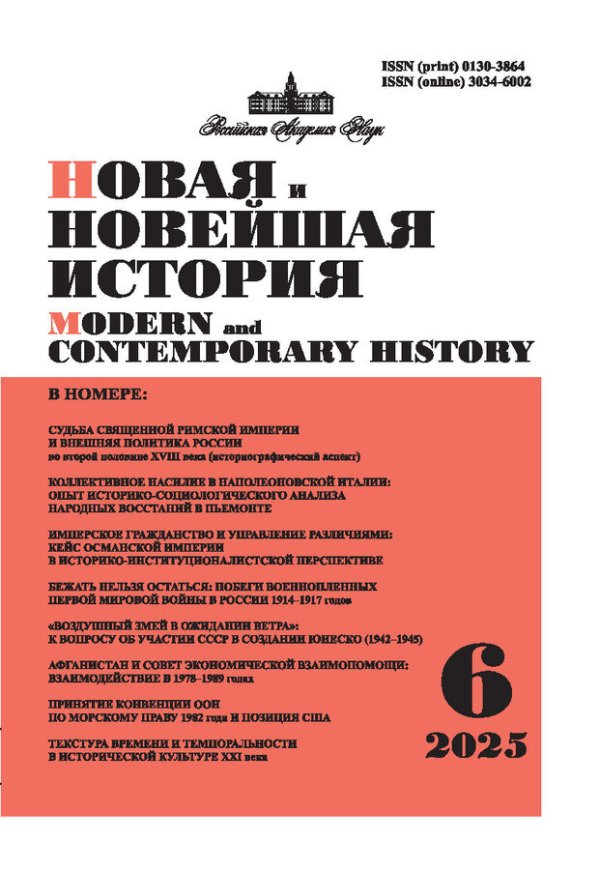
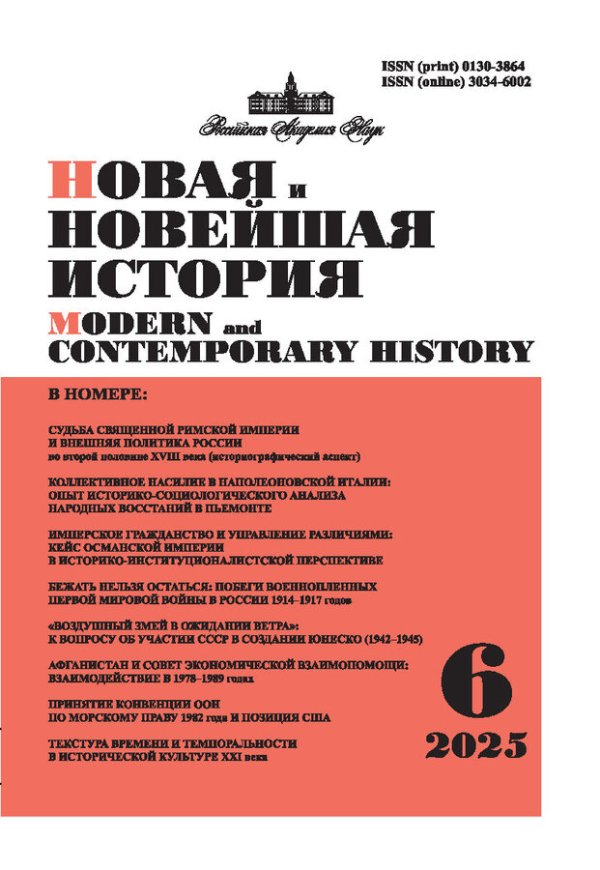
“Nikolashka Was Better Able to Manage than Stalin”: Peasant Socio-Political Sentiments in Soviet Russia, 1934–1936
- Authors: Tikhomirov N.V1
-
Affiliations:
- Russian State University for the Humanities
- Issue: No 6 (2025)
- Pages: 122-137
- Section: 20th century
- URL: https://journals.rcsi.science/0130-3864/article/view/360466
- DOI: https://doi.org/10.7868/S0130386425060091
- ID: 360466
Cite item
 Open Access
 Access granted
 Subscription Access

Abstract
The article explores the socio-political sentiments of Russian peasants during the socialist reconstruction of the countryside in 1934–1936. It is based on previously unused reports produced by students of the All-Union Communist Agricultural University named after Y.M. Sverdlov, who documented their observations during summer field practice. These materials offer a rare empirical record of peasant attitudes at the end of the second five-year plan and provide new insight into rural perceptions of Soviet power. The study employs historical and sociological analysis to investigate how collective farmers and individual peasants interpreted state policies and leadership. It demonstrates that peasants often contrasted Stalin’s governance with that of the deposed tsar, encapsulated in the ironic remark: “Nikolashka was better able to manage than Stalin”. The reports reveal both compliance with and resistance to official ideology, illustrating how everyday experience shaped rural political consciousness. The article also assesses the mediating role of communist students in transmitting and interpreting state policy in the countryside, as well as their influence on peasant views of authority. The findings enhance understanding of the complex interplay between state initiatives and popular perceptions during Stalin’s rule, highlighting the contradictions and adaptations that defined peasant life in mid-1930s Russia.
About the authors
N. V Tikhomirov
Russian State University for the Humanities
Author for correspondence.
Email: tihomirov_n@rambler.ru
ORCID iD: 0000-0002-2808-3763
ResearcherId: KIC-4155-2024
Moscow, Russia
References
- Batchenko V.S. Peasant resistance to the anti-religious policy of the state in the late 1920s – early 1930s: the experience of compeling an electronic database (in the western region) // Proceedings of the Institute of Russian History of the RAS. 2012. № 12. P. 372–381. (In Russ.)
- Viola L. Peasant rebels under Stalin: Collectivization and the culture of peasant resistance. Moscow, 2010. (In Russ.)
- Vjazinkin A.Ju. Generation of the "revolutionary turning point" in the fate of the Russian village in the first third of the 20th century: problems of historiography // Questions of history. 2022. № 7 (2). P. 153–165. (In Russ.)
- Vjazinkin A.Ju., Jakimov K.A. Peasant Pessimism in the Days of Collectivization (1920–30s): Anti-Soviet Rhetoric of the "Revolutionary Turning Point" Generation // Herald of the Arhivist. 2023. № 3. P. 753–764. (In Russ.)
- Ggaziosi A. The great soviet peasant war. Bolsheviks and peasants. 1917–1933. Moscow, 2008. (In Russ.)
- Ippolitov V.A. Letters to newspapers as indicators of public santiments of peasants from the "revolutionary turning point" generation in 1924–1928 // Bulletin of Vologda State University. Series History and Philology. 2022. № 4. P. 8–13. (In Russ.)
- Kedrov N.G. Collectivization of the Russian Peasantry: the genesis of the Problem in Russian Post-Soviet Historiography // The ways of Russia. 1917–2017: one hundred years of change: A collection of articles / eds M.G. Pugacheva, V.P. Zharkov. Saint-Petersburg, 2018. P. 91–99. (In Russ.)
- Kedrov N.G. The bast shoes of Stalinism. The political consciousness of the peasantry of the Russian North in the 1930s. Moscow, 2013. (In Russ.)
- Koznova I.E. The Stalin Era in the memory of the peasantry of Russia. Moscow, 2016. (In Russ.)
- Kuznecov I.A. The political culture of the peasantry and the political regime in the USSR in the 1920s–1930s // State power and the peasantry in the 19th – early 21st century]. Kolomna, 2013. P. 480–484. (In Russ.)
- Lipatova N.V., Ignatova L.V. Officiality and Secrecy: Relationship of the Peasantry and the Local Soviet Authorities in the Mid 20s – early 30s of 20th Century (on Materials of the Press and Special Denunciations) // Stalinism and the peasantry: a collection of scientific articles and materials of round tables and meetings of the theoretical seminar "The Peasant question in national and world history" / eds P.P. Marchenya, S.Y. Razin. Moscow, 2014. P. 114–123. (In Russ.)
- Mercheja P.P., Razin S.Ju. Peasant mentality as a factor of political history of Russia: about the collection of conference papers within the framework of the research project "People and Power" // New Historical Bulletin. 2016. № 3 (49). P. 200–215. (In Russ.)
- Paramonov V.N. "The Great turn" in the perception of contemporaries // Vestnik of Samara University. History, Pedagogics, Philology. 2016. № 3 (1). P. 33–41. (In Russ.)
- Slezin A.A., Jakimov K.A. The public mood of the peasants of the "revolutionary turning point" generation at the turn of the 1920s–1930s // Scientific dialogue. 2022. Vol. 11. № 8. P. 453–469. (In Russ.)
- Tikhomirov N.V. The final stage of collective farm construction in the Central Chernozem region in the reports of VKSU students on industrial practice // The Bryansk state university herald. 2024. № 2 (60). P. 166–173. (In Russ.)
- Tikhomirov N.V. "We Are Alone Here Like Orphans": Leningrad Students' Rural Practice in the Initial Period of Collectivisation // Novaya i Novejshaya Istoriya. 2024. № 3. P. 209–227. DOI: https://doi.org/10.31857/S0130386424030166 (In Russ.)
- Трагедия советской деревни. Коллективизация и раскулачивание. Документы и материалы: в 5 т. 1927–1939. М., 1999–2006.
- Jakimov K.A. Protest moods in the Tambov peasantry of the "revolution turning generation" at the initial stage of collectivization // Tambov in the past, present and future: Materials of the XXIV All-Russian Scientific Conference dedicated to the 150th anniversary of S.V. Rachmaninov. Tambov, 2023. P. 126–130. (In Russ.)
Supplementary files
