
🔧На сайте запланированы технические работы
25.12.2025 в промежутке с 18:00 до 21:00 по Московскому времени (GMT+3) на сайте будут проводиться плановые технические работы. Возможны перебои с доступом к сайту. Приносим извинения за временные неудобства. Благодарим за понимание!
🔧Site maintenance is scheduled.
Scheduled maintenance will be performed on the site from 6:00 PM to 9:00 PM Moscow time (GMT+3) on December 25, 2025. Site access may be interrupted. We apologize for the inconvenience. Thank you for your understanding!


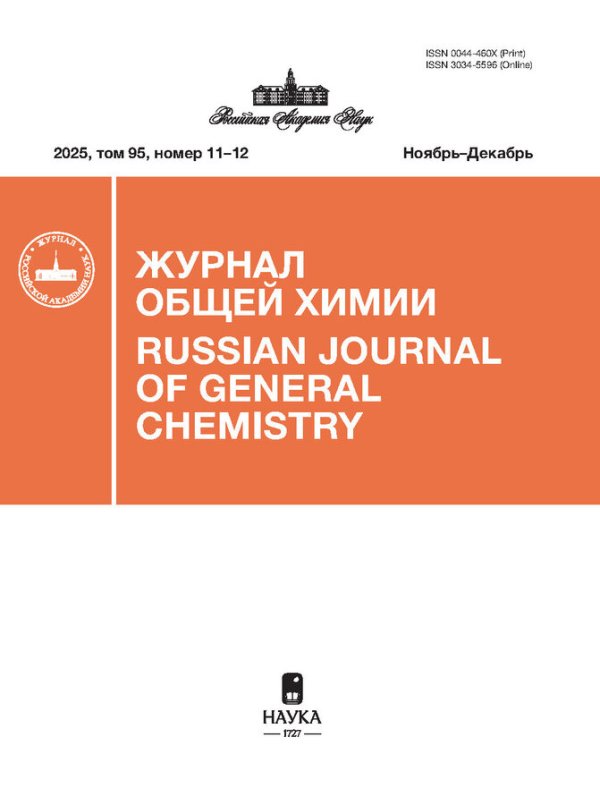
Russian Journal of General Chemistry

ISSN (print)0044-460X

Founder: Russian Academy of Sciences

Editor-in-Chief: Oleg G. Sinyashin, Academician of the Russian Academy of Sciences, Doctor of Chemistry sciences, professor

Frequency / access: 12 issues per year / Subscription

Included in:  White List (2nd level), Higher Attestation Commission list, RISC

Media registration certificate: ПИ № ФС 77 – 66719 от 28.07.2016

最新一期

开放存取 开放存取  受限制的访问 ##reader.subscriptionAccessGranted##  受限制的访问 订阅存取

卷 95, 编号 11-12 (2025)

封面

完整期次

开放存取 开放存取
受限制的访问 ##reader.subscriptionAccessGranted##
受限制的访问 订阅存取

Articles

Synthesis and Cytotoxic Activity of Some 2-Aminopyrroles
Zykova S., Galembikova A., Igidov N., Boychuk S., Gankova K., Denisova E.
摘要
Recyclization of 2,3-furandione hydrazones with cyanoacetic acid/cyanoacetamide in absolute toluene or dioxane in the presence of triethylamine as a basic catalyst afforded 2-amino-[1-benzamido-5-(2-naphthalen-2-yl)-2-oxoethylene]-4-oxo-4,5-dihydro-1H-pyrrole-3-carboxylate and ethyl 2-amino-1-[4-methylbenzamido-5-(2-naphthalen-2-yl)-2-oxoethylene]-4-oxo-4,5-dihydro-1H-pyrrole-3-carboxamide. Cytotoxicity and safety profile of 2-aminopyrrole derivatives, which inhibit tubulin polymerization, were studied.
Russian Journal of General Chemistry. 2025;95(11-12):491-498
pages 491-498 views
Effect of Methylation of 5-Hydroxy-6-methyluracil on Lipophilicity and Solubility in Water
Petrova S., Fayzrakhmanov I., Ivanov S.
摘要
The values of lipophilicity and solubility in aqueous solutions at pH = 7.4 and 25°C were determined by theoretical and experimental (HPLC) methods for 5-hydroxy-6-methyluracil and its N- and O-methylated derivatives: 5-methoxy-6-methyluracil, 5-hydroxy-3,6-dimethyluracil, 5-hydroxy-1,3,6-trimethyluracil and 5-methoxy-1,3,6-trimethyluracil. It was found that the introduction of methyl groups into the 5-hydroxy-6-methyluracil molecule leads to an increase in lipophilicity and solubility in aqueous solutions.
Russian Journal of General Chemistry. 2025;95(11-12):499–504
pages 499–504 views
Reaction of 5,5-Dihalogen-6-hydroxy-6-methyldihydropyrimidine-2,4-diones with KI in a Water–Acetone Medium
Chernikova I., Yunusov M.
摘要
Treatment of 5,5-dichloro-6-hydroxy-6-methyluracil with an excess of KI in an aqueous acetone medium yielded 5-hydroxy-6-methyluracil. A similar reaction of 5-bromo-5-chloro- and 5,5-dibromo-6-hydroxy derivatives of 6-methyluracil, as well as 5,5-dibromo-6-hydroxy-5,6-dihydrouracil, leads to the formation of 5-monohalogen derivatives via a halophilic mechanism.
Russian Journal of General Chemistry. 2025;95(11-12):505-510
pages 505-510 views
N’-(5H-Chromeno[2,3-b]pyridin-5-yl)-N-(cyclo)alkanoylhydrazines: Synthesis and Biological Activity
Gorokhov V., Polyudova T., Zabolotnykh S., Gorokhova S., Chekanova L.
摘要

A series of N’-(5H-chromeno[2,3-b]pyridin-5-yl)-N-(cyclo)alkanoylhydrazines was prepared for the first time by the reaction of 5H-chromeno[2,3-b]pyridin-5-ol with (cyclo)alkanoylhydrazines in acetic acid medium and their antioxidant and antibacterial activities were investigated. Three alternative methods for the synthesis of N’-(5H-chromeno[2,3-b]pyridin-5-yl)-N-(cyclo)alkanoylhydrazines were proposed. The stability of the obtained compounds, depending on the structure of the hydrocarbon radical, their antioxidant and antibacterial activities were studied. The greatest antibacterial effect of N’-(5H-chromeno[2,3-b]pyridin-5-yl)-N-(cyclo)alkanoylhydrazines was shown against the mycomembrane bacteria Mycobacterium smegmatis me2 155.

Russian Journal of General Chemistry. 2025;95(11-12):511–520
pages 511–520 views
Synthesis, Acute Toxicity and Analgesic Activity of N-Aryl-2,3-dimethyl-4-thioxo-3,4,5,6-tetrahydro-2H-2,6-methanobenzo[g][1,3,5]oxadiazocine-11-carboxamides
Manapov R., Zamarayeva T., Slepova N., Rudakova I., Dmitriev M.
摘要
The reaction of N-aryl-3-oxobutanamides with salicylic aldehyde and N-methylthiourea in ethanol in the presence of KHSO4 leads to N-aryl-2,3-dimethyl-4-thioxo-3,4,5,6-tetrahydro-2H-2,6-methanobenzo[g]|[1,3,5]-oxadiazocine-11-carboxamides. Structure of the compounds was established using 1H, 13C NMR spectroscopy and single crystal X-ray crystallography. Acute toxicity and analgesic activity of the synthesized compounds were studied.
Russian Journal of General Chemistry. 2025;95(11-12):521-526
pages 521-526 views
Reactions of 4-Chloro-N-(4,5-dihydro-1H-imidazol-2-yl)-6-methoxy-2-methylpyrimidine-5-amine (Moxonidine) with Aroylpyruvic Acids and Their Functional Derivatives. Analgesic Activity of the Obtained Compounds
Gein V., Prudnikova A., Igidov N., Rudakova I., Dmitriev M.
摘要
Refluxing mixture of 4-chloro-N-(4,5-dihydro-1H-imidazol-2-yl)-6-methoxy-2-methylpyrimidine-5-amine (moxonidine) with methyl ether of benzoylpyruvic acid leads to the formation of benzoylpyruvic acid and 4-hydroxymoxonidine hydrochloride. The presence of anhydrous sodium acetate in the reaction mixture leads to the salt of moxonidine with benzoylpyruvic acid. The interaction of moxonidine with 5-aryl-2,3-dihydro-furan-2,3-diones in acetic acid medium leads to the formation of moxonidine salts with aroylpyruvic acids, the structure of which was confirmed by the retrosynthetic analysis of moxonidine with benzoylpyruvic acid. The X-ray diffraction analysis was performed for the single crystals of 4-hydroxymoxonidine hydrochloride and moxonidine 2,4-dioxo-4-(4-methylphenyl)butanoate. It was shown that the prepared salts are able to suppress somatic pain in laboratory mice in the acetic acid writhing test.
Russian Journal of General Chemistry. 2025;95(11-12):527–535
pages 527–535 views
One-Pot Synthesis of Hybrid Derivatives of Indane Series Containing Diphenylphosphoryl Fragment
Khodak A., Gorunova O., Bystrova N., Kochetkov K.
摘要

A simple and convenient one-pot method was proposed for the synthesis of a series of 2-[α-(diphenylphosphinyl)-aryl]-3-hydroxyinden-1-ones in 60–91% yields. This method is based on the reaction of 2-arylideneindane-1,3-diones with diphenylphosphine chloride upon heating in ethanol for 0.5–2 h. The structures of the resulting compounds were determined using a combination of physicochemical methods.

Russian Journal of General Chemistry. 2025;95(11-12):536–541
pages 536–541 views
Synthesis and Antimicrobial Activity of 3-Acylmethylene-2-oxo-1,4-benzoxazine-6-sulfonic Acids and Their Sodium Salts
Mishunina N., Gein V., Novikova V.
摘要
The reactions of para-hydroxy-meta-aminobenzene sulfonic acid with methyl esters of acylpyruvic acids were studied. Short-term boiling of equimolar amounts of the initial reagents in acetic acid in the presence of sodium acetate produces sodium salts of 3-acylmethylene-2-oxo-1,4-benzoxazine-6-sulfonic acids, the treatment of which with sulfuric acid leads to 3-acylmethylene-2-oxo-1,4-benzoxazine-6-sulfonic acids. Structure of the compounds was established on the basis of IR and 1Н NMR spectroscopy data. Antimicrobial activity of the obtained compounds was studied.
Russian Journal of General Chemistry. 2025;95(11-12):542–546
pages 542–546 views
Synthesis and Antimicrobial Activity of (2Z)-4-Aryl-2-hydroxy-4-oxo-N-[4-(N-R-sulfamoyl)phenyl]but-2-enamides and Their Silver Salts
Gein V., Bobrovskaya O., Vasiliev V., Novikova V., Makhmudov R., Romanov A., Maksimov A., Nazarets O., Kasimova N.
摘要
The reaction of (2Z)-4-aryl-2-hydroxy-4-oxo-N-[4-(N-R-sulfamoyl)phenyl]but-2-enamides with silver nitrate in a 2:1 ethanol-DMF mixture yielded their silver salts. Antibacterial and antifungal activity and acute toxicity of the obtained compounds were studied.
Russian Journal of General Chemistry. 2025;95(11-12):547–553
pages 547–553 views
N-Sulfinyltrifluoromethanesulfonamide in [4+2]-Cycloaddition Reactions
Tolstikova L., Astakhova V., Moskalik M.
摘要
The reaction of N-sulfinyltrifluoromethanesulfonamide with acyclic conjugated dienes in methylene chloride was shown to afford the corresponding cycloadducts in high yields. Methyl vinyl ketone reacted with N-sulfinyltrifluoromethanesulfonamide in the presence of thionyl chloride, also affording the cycloaddition product, while terminal alkenes in this reaction give the corresponding sulfinamides.
Russian Journal of General Chemistry. 2025;95(11-12):554-561
pages 554-561 views
Synthesis of Novel 2,3-Dihydro-1,4-thiaselenine Derivatives by Reaction of 2-Bromomethyl-1,3-thiaselenole with Carboxylic and Dicarboxylic Acids and Their Salts
Filippov A.
摘要
Effective methods were developed for the preparation of new derivatives of 2,3-dihydro-1,4-thiaselenine with high yields based on the reaction of 2-bromomethyl-1,3-thiaselenole with a series of carboxylic and dicarboxylic acids (containing halogens, a double bond, a benzene ring and heterocycles), which proceeds with a rearrangement with ring expansion.
Russian Journal of General Chemistry. 2025;95(11-12):562-571
pages 562-571 views
One-Pot Synthesis of 2,6-Bis(organylsulfanyl)-9-selenabicyclo[3.3.1]nonanes from Selenium Dibromide, Cyclooctadiene and Thiols
Musalov M., Pakeeva A., Potapov V.
摘要

A one-pot synthesis of 2,6-bis(organylsulfanyl)-9-selenabicyclo[3.3.1]nonanes in 90–97% yields was developed based on the transannular addition of selenium dibromide to cyclooctadiene followed by the reaction with alkane- and arenethiols.

Russian Journal of General Chemistry. 2025;95(11-12):572-578
pages 572-578 views
Extraction of Lanthanides(III) from Nitric Acid Solutions with Complexes of Biscarbamoylmethylphosphine Oxides with Bis[(trifluoromethyl)sulfonyl]imide
Turanov A., Karandashev V., Khvostikov V.
摘要
The extraction of lanthanides(III) with solutions of biscarbamoylmethylphosphine oxide complexes with bis[(trifluoromethyl)sulfonyl]imide (HTf2N) was studied. It was found that lanthanide(III) ions are extracted from nitric acid solutions with solutions of such complexes by the cation exchange mechanism. The stoichiometry of the extracted lanthanide(III) complexes was determined, the influence of the structure of biscarbamoylmethylphosphine oxides, the nature of the organic solvent and the concentration of HNO3 in the aqueous phase on the efficiency of metal ion extraction into the organic phase was considered. It was found that the conversion of bis-CMPO into complexes with HTf2N leads to an increase in the extraction of lanthanide(III) ions from nitric acid solutions.
Russian Journal of General Chemistry. 2025;95(11-12):579–585
pages 579–585 views
Design of Postmetallocene Catalytic Systems of Arylimine Type for Olefin Polymerization: XX. Synthesis of N-(3-Allyloxy-2,4,5,6-Tetrafluorophenyl)Salicylaldimines and Their Complexes with Titanium(IV) Dichloride
Oleynik I., Nikulshin P., Oleynik I.
摘要
The reaction of salicylic aldehydes containing substituents at positions 3 and 5 with 3-allyloxy-2,4,5,6-tetrafluoroaniline in the presence of para-toluenesulfonic acid yielded a series of corresponding (N-aryl)salicylaldarylimines, which form titanium(IV) dichloride complexes L2TiCl2 upon interaction with TiCl2(OPr-i)2.
Russian Journal of General Chemistry. 2025;95(11-12):586–596
pages 586–596 views
Effect of Electrolyte Concentration on the Enthalpy of Cobalt(II) Complexation Reactions with Oligoglycines
Bychkova S., Gorboletova G., Krutova O.
摘要
The thermal effects of complexation reactions in the Co(II)-amino acid (glycine, diglycine, and triglycine) system in aqueous solution at 298.15 K and ionic strengths of 0.2, 0.5, 0.75, and 1.0 (KNO3) were determined using a calorimetric method. Standard thermodynamic characteristics (∆rH°, ∆rG°, ∆rS°) of complexation reactions were calculated. A comparative analysis of the obtained data was performed. It was shown that hydration equilibria occurring at the functional groups of amino acids and peptides not only significantly influence the dissociation processes of these ligands but also play a significant role in the formation of their complexes with metal cations. The interaction of the cobalt(II) ion with diglycine leads to more significant ordering of the system compared to triglycine.
Russian Journal of General Chemistry. 2025;95(11-12):597–607
pages 597–607 views
Self-Propagating High Temperature Synthesis of MAX Phases of Ti-Al-C System with Addition of B4C
Stolin P., Bazhina A., Nazarko I., Kulikova A., Ivanov A., Antipov M., Homenko N.
摘要
In this work self-propagating high-temperature synthesis was used to obtain Ti-Al-C system MAX phases in situ reinforced with TiB2 and TiC, from B4C, and powders of titan, aluminum and soot, the following reaction mechanisms were identified. During the synthesis on the air, the formation of nitride phases TiN and Ti2AlN was registered in synthesized material. The possibility of formation of ternary carbide with stoichiometry of Ti3AlC with cubic antiperovskite structure was demonstrated. Characteristic thermograms, acquired during synthesis and following deformation of investigated materials, are presented.
Russian Journal of General Chemistry. 2025;95(11-12):608-615
pages 608-615 views
Electrochemical Properties of Induction Melt Al-Substituted AB5-Type Intermetallics
Shmalii S., Shamov I., Lapshin A., Sanin V., Melnikov S., Tarasov B., Volodin A.
摘要
Intermetallic compounds LaNi5-xAlx (x = 0.1–0.9) were synthesized by the induction melting method. The structure, morphology and phase composition of the obtained intermetallics were determined. It was shown that the intermetallics correspond to the Hauke phase with a hexagonal structure of the CaCu5-type. The electrochemical characteristics of the compounds as negative electrodes of nickel-metal hydride power sources were studied. It was shown that the maximum specific capacity of the electrodes (320 mAh/g) is achieved with an Al content of 0.47 mol per intermetallics formula unit. A direct correlation was established between the composition, specific electrochemical capacity, high-rate dischargeability and cyclic stability of these materials.
Russian Journal of General Chemistry. 2025;95(11-12):616-622
pages 616-622 views

Согласие на обработку персональных данных с помощью сервиса «Яндекс.Метрика»

1. Я (далее – «Пользователь» или «Субъект персональных данных»), осуществляя использование сайта https://journals.rcsi.science/ (далее – «Сайт»), подтверждая свою полную дееспособность даю согласие на обработку персональных данных с использованием средств автоматизации Оператору - федеральному государственному бюджетному учреждению «Российский центр научной информации» (РЦНИ), далее – «Оператор», расположенному по адресу: 119991, г. Москва, Ленинский просп., д.32А, со следующими условиями.

2. Категории обрабатываемых данных: файлы «cookies» (куки-файлы). Файлы «cookie» – это небольшой текстовый файл, который веб-сервер может хранить в браузере Пользователя. Данные файлы веб-сервер загружает на устройство Пользователя при посещении им Сайта. При каждом следующем посещении Пользователем Сайта «cookie» файлы отправляются на Сайт Оператора. Данные файлы позволяют Сайту распознавать устройство Пользователя. Содержимое такого файла может как относиться, так и не относиться к персональным данным, в зависимости от того, содержит ли такой файл персональные данные или содержит обезличенные технические данные.

3. Цель обработки персональных данных: анализ пользовательской активности с помощью сервиса «Яндекс.Метрика».

4. Категории субъектов персональных данных: все Пользователи Сайта, которые дали согласие на обработку файлов «cookie».

5. Способы обработки: сбор, запись, систематизация, накопление, хранение, уточнение (обновление, изменение), извлечение, использование, передача (доступ, предоставление), блокирование, удаление, уничтожение персональных данных.

6. Срок обработки и хранения: до получения от Субъекта персональных данных требования о прекращении обработки/отзыва согласия.

7. Способ отзыва: заявление об отзыве в письменном виде путём его направления на адрес электронной почты Оператора: info@rcsi.science или путем письменного обращения по юридическому адресу: 119991, г. Москва, Ленинский просп., д.32А

8. Субъект персональных данных вправе запретить своему оборудованию прием этих данных или ограничить прием этих данных. При отказе от получения таких данных или при ограничении приема данных некоторые функции Сайта могут работать некорректно. Субъект персональных данных обязуется сам настроить свое оборудование таким способом, чтобы оно обеспечивало адекватный его желаниям режим работы и уровень защиты данных файлов «cookie», Оператор не предоставляет технологических и правовых консультаций на темы подобного характера.

9. Порядок уничтожения персональных данных при достижении цели их обработки или при наступлении иных законных оснований определяется Оператором в соответствии с законодательством Российской Федерации.

10. Я согласен/согласна квалифицировать в качестве своей простой электронной подписи под настоящим Согласием и под Политикой обработки персональных данных выполнение мною следующего действия на сайте: https://journals.rcsi.science/ нажатие мною на интерфейсе с текстом: «Сайт использует сервис «Яндекс.Метрика» (который использует файлы «cookie») на элемент с текстом «Принять и продолжить».