
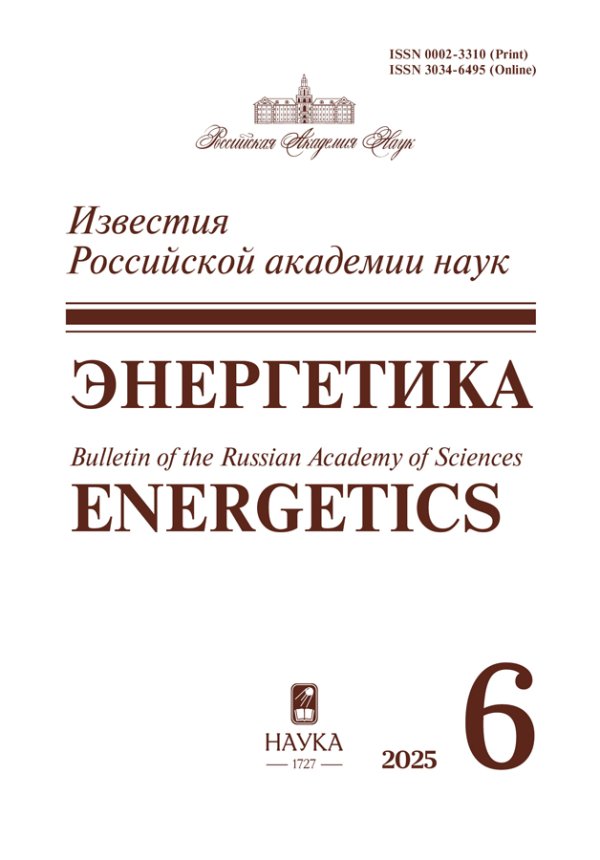
Bulletin of the Russian Academy of Sciences. Energetics

ISSN (print): 0002-3310

Media registration certificate: ПИ № ФС 77 - 67158 от 16.09.2016

Founder: Russian Academy of Sciences

Editor-in-chief: Volkov E.P., academician RAS, Doctor of Sc., Full Professor

Frequency / Access: 6 issues per year / Subscription

Included in: White list (4th level), Higher Attestation Commission list, RISC

Edição corrente

Acesso aberto Acesso aberto  Acesso é fechado Acesso está concedido  Acesso é fechado Somente assinantes

Nº 6 (2025)

Capa

Edição completa

Acesso aberto Acesso aberto
Acesso é fechado Acesso está concedido
Acesso é fechado Somente assinantes

Articles

Determining the Optimal Composition of Heating Equipment for Prosumers Taking into Accumulation of Energy Based on Agent Technologies
Barakhtenko E., Mayorov G., Sokolov D., Tashlykova V.
Resumo

Determining the optimal composition of heating equipment for prosumers, taking into account energy accumulation, is a pressing task, since the number of prosumers increases every year and this has a significant impact on the functioning of heat supply systems. In recent years, energy production technologies have been improving, new methods of its conversion have appeared and the accumulative capacity of heat energy storage systems has increased. At the same time, when searching for the optimal composition of equipment for prosumers, it is necessary to take into account the interests of the centralized heat supply system, i.e. find a balance between centralized and distributed heat generation. In view of this formulation of the problem, it is necessary to apply new approaches to its solution in conditions of different interests, taking into account the presence of active elements in the heat supply system. The study uses a multi-agent approach, which allows us to represent the heat supply system as a set of agents with their own behavior and, as a result of their interaction, search for a solution. The article presents a mathematical formulation of the problem of determining the optimal composition of heating equipment for prosumers with energy accumulation systems taking into account the interests of the centralized heat supply system based on a generalized desirability criterion. The structure of a multi-agent system for solving the set task and the algorithms for the operation of agents of this multi-agent system have been developed. A multi-agent model of a test scheme of a heat supply system has been created. A number of experiments have been conducted and an analysis of the obtained results has been performed, showing the efficiency of the methodology proposed by the authors for determining the optimal composition of heating equipment for prosumers, taking into account energy accumulation.

Bulletin of the Russian Academy of Sciences. Energetics. 2025;(6):5-26
pages 5-26 views
An Algorithm for Determining the Calculated Electrical Loads of Electric Vehicles Charging Stations
Voronin V., Nepsha F., Ilyushin P.
Resumo
The study is devoted to the analysis of factors affecting the power consumption of electric charging infrastructure facilities, as well as the development of an algorithm for determining the calculated electrical loads of electric vehicle charging stations. The article presents the results of an analytical review of research in the field of determining the calculated electrical loads of electric vehicle charging stations, and compares the results obtained by different authors with the identification of the main influencing factors. To study electrical loads, a simulation model has been developed that makes it possible to simulate minute-by minute power consumption profiles with specified parameters of electric charging stations and electric vehicles, including taking into account the charging behavior of electric vehicle owners. A quantitative assessment of the importance of the factors influencing the demand coefficient of the electric charging infrastructure of electric transport has been carried out. An expression is proposed and an algorithm is developed for determining the calculated electrical loads of homogeneous and heterogeneous groups of electric vehicles charging stations.
Bulletin of the Russian Academy of Sciences. Energetics. 2025;(6):27-56
pages 27-56 views
Numerical Study of the Heat Transfer Characteristics of a Heat Exchanger Based on the Triply Periodic Minimal Surface Primitive
Bragin D., Mustafin R., Zinina S., Popov A., Eremin A.
Resumo

Heat exchange devices based on triply periodic minimal surfaces (TPMS) demonstrate a significant increase in heat transfer compared to traditional heat exchangers of the same volume. However, most studies focus on modeling individual sections rather than the entire heat exchanger. In this study, a full-scale heat exchange device based on the Primitive surface with inlet and outlet manifolds was modeled. Numerical simulation was used to determine the flow pattern within the heat exchanger based on the Primitive surface. The proposed implementation of manifolds for flow distribution contributed to an increase in the Nusselt number by up to 80% and a reduction in the friction factor by up to 200%. An increase in the Reynolds number leads to a decrease in friction coefficients and an increase in Nusselt numbers; however, the overall performance indicator j/f for TPMS decreases with increasing Re. This study highlights the significant potential of using such a structure as a two-phase heat exchanger in thermal management systems.

Bulletin of the Russian Academy of Sciences. Energetics. 2025;(6):57-78
pages 57-78 views
The Influence of Coal Composition on Specific Emission of Carbon Dioxide of Promising Thermal Energy Plants with Advanced Steam Parameters
Donskoy I., Epishkin N.
Resumo
The paper examines the possibility of reducing specific emissions of carbon dioxide on thermal power plants by selecting the composition of coal fuel (30 grades of coals available in Russia were selected). For this purpose, variant optimization calculations were carried out using a mathematical model of a coal power plant with a capacity of 640 MW. The results of the calculations make it possible to determine technically achievable and economically justified emission levels, as well as to estimate the costs of their reduction.
Bulletin of the Russian Academy of Sciences. Energetics. 2025;(6):79-93
pages 79-93 views
Investigation of That Heat Transfer during Laminar Fluid Flow in a Circular Tube
Vidin Y., Zlobin V.
Resumo
The problem of heat exchange during the flow of liquid in a circular tube has been studied in sufficient detail and is widely covered in the scientific literature. The solution of this type of thermophysical problems is obtained in the form of infinite series and is presented in detail in the monograph [2]. In this case, it is necessary to determine the eigenvalues and eigenfunctions depending on the number of Bio. The article examines the roots of the char acteristic equation and suggests simple algebraic equations for their definition. Based on the formulas obtained for the eigenvalues µ , µ , µ rather narrow ranges of changes in their values are indicated depending on the value of the Bio number. The formulas obtained make it possible to determine the smallest and largest values of eigenvalues in a certain range of Bio numbers. The result ing numerical values of the eigenvalues have sufficient accuracy for engineering calculations.
Bulletin of the Russian Academy of Sciences. Energetics. 2025;(6):94-102
pages 94-102 views
Mathematical Models of Thermal Reaction of Viscoelastic Bodies
Kartashov E., Solomonova E., Tishaeva I.
Resumo
This paper examines mathematical models of the thermal response of viscoelastic bodies under intense heating of the solid boundary (temperature heat ing; thermal heating; heating by the environment). The proposed theory is based on the linear rheological models of Maxwell and Kelvin, introducing stress and strain deviators. A generalized model is considered, incorporating three coordi nate systems simultaneously: Cartesian coordinates – a massive body bounded by a flat surface; spherical coordinates – a massive body with an internal spherical cavity; and cylindrical coordinates – a massive body with an internal cylindrical cavity. Numerical experiments are presented, and the influence of the domain topology on the magnitude of the corresponding thermal stresses is revealed; the properties of Maxwell and Kelvin viscoelastic media are described.
Bulletin of the Russian Academy of Sciences. Energetics. 2025;(6):103-120
pages 103-120 views

Согласие на обработку персональных данных с помощью сервиса «Яндекс.Метрика»

1. Я (далее – «Пользователь» или «Субъект персональных данных»), осуществляя использование сайта https://journals.rcsi.science/ (далее – «Сайт»), подтверждая свою полную дееспособность даю согласие на обработку персональных данных с использованием средств автоматизации Оператору - федеральному государственному бюджетному учреждению «Российский центр научной информации» (РЦНИ), далее – «Оператор», расположенному по адресу: 119991, г. Москва, Ленинский просп., д.32А, со следующими условиями.

2. Категории обрабатываемых данных: файлы «cookies» (куки-файлы). Файлы «cookie» – это небольшой текстовый файл, который веб-сервер может хранить в браузере Пользователя. Данные файлы веб-сервер загружает на устройство Пользователя при посещении им Сайта. При каждом следующем посещении Пользователем Сайта «cookie» файлы отправляются на Сайт Оператора. Данные файлы позволяют Сайту распознавать устройство Пользователя. Содержимое такого файла может как относиться, так и не относиться к персональным данным, в зависимости от того, содержит ли такой файл персональные данные или содержит обезличенные технические данные.

3. Цель обработки персональных данных: анализ пользовательской активности с помощью сервиса «Яндекс.Метрика».

4. Категории субъектов персональных данных: все Пользователи Сайта, которые дали согласие на обработку файлов «cookie».

5. Способы обработки: сбор, запись, систематизация, накопление, хранение, уточнение (обновление, изменение), извлечение, использование, передача (доступ, предоставление), блокирование, удаление, уничтожение персональных данных.

6. Срок обработки и хранения: до получения от Субъекта персональных данных требования о прекращении обработки/отзыва согласия.

7. Способ отзыва: заявление об отзыве в письменном виде путём его направления на адрес электронной почты Оператора: info@rcsi.science или путем письменного обращения по юридическому адресу: 119991, г. Москва, Ленинский просп., д.32А

8. Субъект персональных данных вправе запретить своему оборудованию прием этих данных или ограничить прием этих данных. При отказе от получения таких данных или при ограничении приема данных некоторые функции Сайта могут работать некорректно. Субъект персональных данных обязуется сам настроить свое оборудование таким способом, чтобы оно обеспечивало адекватный его желаниям режим работы и уровень защиты данных файлов «cookie», Оператор не предоставляет технологических и правовых консультаций на темы подобного характера.

9. Порядок уничтожения персональных данных при достижении цели их обработки или при наступлении иных законных оснований определяется Оператором в соответствии с законодательством Российской Федерации.

10. Я согласен/согласна квалифицировать в качестве своей простой электронной подписи под настоящим Согласием и под Политикой обработки персональных данных выполнение мною следующего действия на сайте: https://journals.rcsi.science/ нажатие мною на интерфейсе с текстом: «Сайт использует сервис «Яндекс.Метрика» (который использует файлы «cookie») на элемент с текстом «Принять и продолжить».