


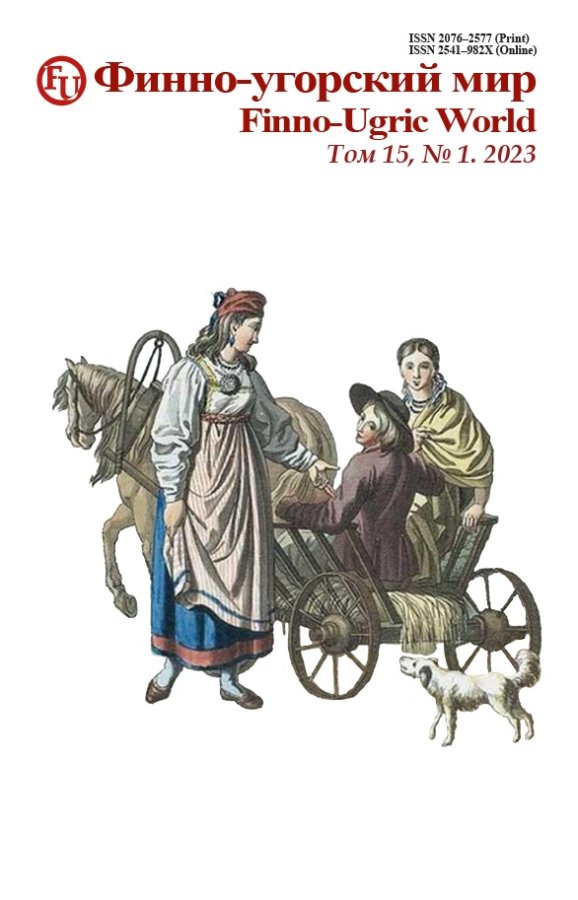
卷 15, 编号 1 (2023)
- 年: 2023
- ##issue.datePublished##: 18.04.2023
- 文章: 14
- URL: https://journals.rcsi.science/2076-2577/issue/view/24212
完整期次

Philology
“Language nests”: the rebirth of the language (on the example of the Inari-Sami and Karelian languages)
摘要
Introduction. The article considers the problems of the revival of languages of small peoples. The subject of the study is the experience of linguists in the revitalization of national languages at a specific location in the Republic of Karelia (village Vedlozero) and Finland (village Inari).
Materials and Methods. The material of the study is based on the data published in the monograph of the Finnish linguist A. Pasanen and taken from the speeches of N. P. Barmina, an activist of the Union of the Karelian People, obtained in the media and from her personal conversations with of the author of the article. When processing the information, the author employs such methods as comparative, analytical and synthetic.
Results and Discussion. Language revitalization primarily includes such measures of language support as description of the grammatical and lexical structure of the language, fixation of phonetic features, documentation of linguistic material of folklore texts and everyday descriptions, etc. At the same time, it requires enormous efforts on individual level from the cultural and linguistic community, and on the community level from the public organizations, educational institutions and government authorities. One of the most effective ways to revive national languages is language training centers. The way they are organized and work are considered on the example of “language nests” in Finland and Karelia.
Conclusion. Based on the measures to save the Finnish language by L. Kotilainen, the author of the publication proposed her own system for the preservation of national languages, which does not always require mandatory state support and funding, although in no case excludes it. In particular, it is proposed to create a network of free language webinars, to organize competitions for the best blogs made in ethno-language, the best master of words who came up with the most successful equivalent of a Russian word.
 8-18
8-18


The correlation of the Komi-Permian and Komi-Zyryan elements in the vocabulary of the Upper-Kama idiom
摘要
Introduction. The Upper-Kama dialect is one of the varieties of the Komi language, which is rather common in the Afanasyevsky area of the Kirov region. The dialect is an intermediate idiom between the Komi-Permian and Komi-Zyryan languages. The purpose of the paper is to analyze the Komi-Permian and Komi-Zyryan components in the lexical system of the dialect.
Materials and Methods. The material for the study was collected during dialectological expeditions to the area of residence of the Kirov Permians in 2002–2012. It was collected from native speakers with a high level of language competence. The research was carried out using descriptive, comparative and statistical methods.
Results and Discussion. The vocabulary of the Upper-Kama dialect is heterogeneous. The most numerous group of words common for the Komi-Permian and Komi-Zyryan dialects is distinguished. Lexemes in the Upper Kama dialects and at a larger territory in the Komi-Zyryan language, but are absent in the Komi-Permian one. There is also a group of words which correspondences are recorded in the southern Komi-Zyryan dialects: Mid-Sysola, Luza-Letka and mainly in the Upper-Sysola one. On the territory of the Upper-Kama idiom there are the lexemes, which isoglosses cover the Upper-Kama and Komi-Permian dialects. However, there are not so many similar Komi-Permian-Upper-Kama isoglosses; most of them can be found in the Zyryan dialects. As a result of the analysis of the texts in the Upper-Kama dialect, it turned out that the overwhelming majority of lexemes are found in all varieties of Komi languages.
Conclusion. The analysis of the lexical composition of the Upper-Kama dialect has shown that the specifi ed idiom cannot be unconditionally attributed to the Komi-Permian language, since the correlation of the Komi-Zyryan and Komi-Permian lexical features in it is approximately the same.
19-27
Historical Studies
Transformations of the identities of the inhabitants in Karelian Arctic Region (based on the research of the Loukhsky district)
摘要
Introduction. The article presents the first results of a historical and sociological study on the impact that the inclusion of several regions of Karelia in the Arctic zone of the Russian Federation has on the identity of its inhabitants, using the example of Loukhsky district, the northernmost region in the Republic.
Material and Methods. The authors proceed from the interrelatedness of the territory, traditions and identities, which never lose their significance but evolve over time. The methodology included the comparative historical method, content analysis, qualitative study and field survey methods. An integrated analysis of the sources is applied, which mostly includes published and unpublished historical, journalistic, and sociological data. The field material is in-depth interviews with the residents of Louhsky district collected in July 2022.
Results and Discussion. A brief overview of the history development of Louhsky district is provided; the results of analyzing materials from mass media and online sources are described. The methods of formalized text analysis, coding, categorization of interview transcripts, cross-interpretation of data by researchers helped distinguish the most typical variants of identities and features characteristic of the district. The differences were detected in the dominant types of identities between the western and the eastern parts of the district, especially in what concerns official representation.
Conclusion. The paper concludes that the ethnic identity is preserved and manifested in the current public discourse within a so-called “festival project of ethnicity”. The interviews show that ethnic identity is giving way to civic or regional identities. Arctic identity is not firmly rooted in the perception of the respondents. The northern identity, i.e., being “northerners”, is more congeneric and easier to comprehend for people in the Karelian Arctic.
28-43
Some aspects of national-state building among the Finno-Ugric peoples in the USSR
摘要
Introduction. The article considers some aspects of the national-state building of the Finno-Ugric peoples in the USSR. It highlights the ways of realization of the policy of the Soviet power in this matter. Its positive achievements, as well as contradictions and omissions in the implementation process are represented. The research aims at giving the complex analysis and the objective assessment of the national-state building processes of the Finno-Ugric peoples in the USSR.
Materials and Methods. The article summarized legislative documents and materials contained in the works of Soviet and contemporary authors on this problem. Such methods of research as comparative, historical, genetic, legal, descriptive, logical were used to achieve the goal. It also employed the method of actualization which allowed to connect the development of modern processes with the historical experience of the past.
Results and Discussion. The research traced the dynamics and certain tendencies of the realization of the national policy towards the Finno-Ugric peoples in the USSR. The analysis of the national-state building processes among them allowed concluding about the significance of the Soviet stage in their development, despite some contradictions, mistakes and omissions in the actions of the Soviet leadership. Underestimation of the national problems of the ethnic groups within the USSR, along with many other unsolved problems in the economy, politics, spiritual and social spheres, accumulated in the State, eventually led to its collapse, which led to problems in geopolitics.
Conclusion. Considering all aspects of nation-state building in the USSR made it possible to conclude on the significance and value of creating national administrative-territorial formations among Finno-Ugric peoples, whose continuations are the present-day national subjects of the Russian Federation. The conclusion was made that the established foundations of the nation-state structure of the Russian Federation should be preserved as an important factor in the preservation and development of Finno-Ugric peoples.
44-52
Mid-level specialists in the Finno-Ugric Republics of the RSFSR in the second half of the 1950s – early 1960s
摘要
Introduction. The majority of mid-level specialists for various sectors of the national economy of the Finno-Ugric Republics of the RSFSR were trained by local specialized vocational institutions. The article studies of the dynamics of the number of mid-level specialists in the sectors of the national economy of the Finno-Ugric Republics in the second half of the 1950s –early 1960s, as well as the share of these specialists in the national economy of these territories.
Materials and Methods. The study is based on statistical materials containing the data on the number of middle-level specialists in various sectors of the national economy in the relevant area. The study was carried out on the basis of comparative, historical, systematic and statistical approaches, which made it possible to trace the dynamics of changes in the number of middle-level specialists and highlight the changes in the share of specialists of certain categories in their total numbers.
Results and Discussion. Based on the data contained in the statistical materials, it was possible to trace the dynamics of the number of mid-level specialists employed in various sectors of the national economy of the Finno-Ugric Republics of the RSFSR. There were changes in the share of certain categories of specialists in relation to their total numbers. In addition, a comparison was made of the dynamics of changes in the share of certain categories of these specialists in the Finno-Ugric Republics with similar dynamics in the RSFSR as a whole for the period under study.
Conclusion. During the period under study, several trends were noted in the dynamics of changes in the number of midlevel specialists employed in the national economy of the Finno-Ugric Republics, and the share of their individual categories. In the second half of the 1950s, the general increase in the number of the personnel was noted, in the early 1960s, the intensity of their growth stopped. In general, over the entire period, the total number of these specialists increased by an average of 2 times, the largest increase was observed in the category of technicians. An increase in the number of specialists classified as technicians caused a noticeable decrease in the share of other categories, which was especially noticeable in the second half of the 1950s.
53-64
Transformation of the composition “köch gösnech” / “köch göstinech” of Komi (Zyryan) in the XX–XXI centuries
摘要
Introduction. The article deals with the concept of “köch gösnech / “köch göstinech” (“a gift from a hare”) of Komi (Zyryan). The purpose of the research is to trace the dynamics of the composition of the concept and determine the symbolism of a gift from the forest.
Materials and Methods. The article is based on the ethnographic materials collected by the author. Literary sources and folklore texts are used to reconstruct the symbolic content of the gift from the forest. The comparative-historical method makes it possible to identify changes in the composition of the “gift from a hare”.
Results and Discussion. The practice of returning home the remains of “road food” was perceived by children as gifts from forest animals (a hare, a squirrel, a fox), where the hare held the palm, which was fixed in the concept “köch gösnech” /“köch göstinech” (“a gift from a hare”). Initially, the composition of the treat included some bread, which was reflected in one of its names – “köch nyan” (“bread from a hare”). In the 1950s–1960s it was sprinkled with salt or sugar. In folk culture bread and salt acted as a talisman, and the shortage of sugar in those years made it possible to consider it as a delicacy. The composition of the gift from the forest additionally included berries, gum for chewing and pine nuts, which emphasized the location of the messenger of the treat. The improvement in the food supply of the rural population affected the contents of the treat, which began to include sweets. This practice continues to this day.
Conclusion. The composition of the “gift from a hare” changed in accordance with the changes in the food. Magical properties were attributed to food that had been outside the living space mastered by a human, capable of endowing children with health and happiness.
65-72
Cultural Studies
Ethnic and confessional culture of Mordovian students (based on the materials of the Internet survey)
摘要
Introduction. The article summarizes the results of a study of the ethnic and confessional culture of Mordovian students. The objectives of the study were to identify the degree of preservation of individual components of ethnic culture among Mordovian students; to analyze of the level of their religiosity and affi liation to the local church; to study the degree of infl uence other cultural systems on their worldview.
Materials and Methods. The methodological basis of the study was the Internet survey. The total of 100 Mordovian students took part in the survey: 63 people from the Republic of Mordovia (Mordovian State Pedagogical University) and 37 people from the Ulyanovsk region (Ulyanovsk State Pedagogical University).
Results and Discussion. The article describes the ideas of Mordovian students about sacred places and national heroes, the profi ciency in the national language, the perception of the national language as a native language, the existence of a festive and ritual culture, religiosity and confessional affi liation, religious behavior and religious beliefs, etc. It reveals and interprets the infl uence of living in the multicultural region on a signifi cant proportion of people who recognize non-Mordovian as their native language, and on the syncretization in the mass consciousness of respondents of holidays of different genesis: international, Russian national, Christian, national public, and Mordovian national holidays.
Conclusion. An analysis of the materials of the Internet survey allows to conclude that, in general, Mordovian students are characterized by a positive attitude towards Mordovian culture. The interest of the respondents is especially noticeable when answering questions that refer to ethnic self-consciousness issues that have more symbolic than practical/everyday meaning. Although Mordovian students consider themselves Orthodox Christians, their religious culture is no less diverse, a signifi cant part of which is integrated to varying degrees in the culture of Orthodoxy. At the same time, some Mordovian students are not without occult infl uence.
73-84
Lexical and symbolic representation of the image of modern Mordovia by the population of the Republic
摘要
Introduction. The article presents the results of the analysis of the lexical and symbolic representation of the image of the Republic of Mordovia by the population of the region. Such study of the components of the ethnocultural image of the Republic is based on the results of a sociological survey which was conducted for the fi rst time.
Materials and Methods. The research material was compiled from the data of the sociological survey “'Identifi cation of brands of the Republic of Mordovia”, conducted in March – April 2022 among the residents of the Republic, as well as among the representatives of the target group, which included the employees of cultural institutions. The method of collecting information was an online survey (CAWI) carried out on the Google Forms platform. The cluster analysis by the kmeans method was used to analyze the obtained data.
Results and Discussion. Based on the cluster analysis, two groups of respondents were identifi ed: those who perceive the region positively and those who evaluate it negatively. The reference points of the positive perception of the Republic were the lexemes friendly, own, hospitable, and the negative – poor. To defi ne modern Mordovia, the respondents most often chose such evaluation lexemes as hospitable, friendly, own, confl ict-free, cultural, sunny, open. The symbolic image of the region for the majority of the respondents is associated with the coat of arms of the region, the fox, the selfdesignation region 13, the birch and Mastorava, the goddess of the Earth.
Conclusion. The results of the sociological survey revealed the predominance of positively colored lexemes of the respondentsʼ responses, which serve to characterize the region and its inhabitants. Mordovia is most often correlated with offi cially approved symbols of the territory and its selfdesignation, as well as with the images personifying such parameters of Mordovian mythology as fertility and the femininity.
85-97
Regional practices and mechanisms of the support of ethnic identity of the indigenous peoples of Yugra
摘要
Introduction. On the example of Khanty-Mansiysk Autonomous Okrug – Yugra the article considers the regional features of ethno-cultural policy. Some legislative features of the protection and preservation of the identity of representatives of indigenous minorities are distinguished. Ethnic identity and self-identifi cation of representatives of the titular ethnic groups are updated. The purpose of the study is to reveal the role of ethno-cultural practices in reference to ethnic identity of the Khanty, Mansi, and Nenets.
Materials and Methods. The theoretical basis is the research in the relevant fi eld, in particular, the works of national authors on ethno-cultural identity. Offi cial materials such as laws and documents of the regional Duma and Charters of public organizations are used.
Results and Discussion. It was found that in the ethno-cultural space of the Ob-Ugric and Samoyed peoples, the key elements are legislative mechanisms aimed at maintaining and preserving ethno-cultural traditions, the activities of public organizations of the Ob-Ugric and Samoyed peoples in each district. Attention is paid to the issues of the viability of native languages in modern conditions, the revival of traditions based on ritual holidays and traditional arts.
Conclusion. It is concluded that the legislative mechanisms in relation to the indigenous peoples are built on the principle of national and regional approaches. In the present conditions, the interest of the indigenous peoples of Yugra to the ethnocultural heritage is increasing. There is a revival of traditions, festivals, customs, and popularization of native languages.
98-109
Events, People, Books
ANOTHER BOOK ABOUT MORDOVIAN PEOPLE
110-112
“YOU ARE MY LOVE,MY JEALOUSY...”. TO THE 85th ANNIVERSARY OF E. E. ZAGREBIN
113-114
LIVING MEMORY OF GENERATIONS
115-117
MARI PHILOLOGY AT THE VANGUARD OF RESEARCH OF VOLGA REGION
118-121
MEDIA FORUM “MULTINATIONAL MORDOVIA: CROSSCULTURAL DIALOGUE”
122-124