
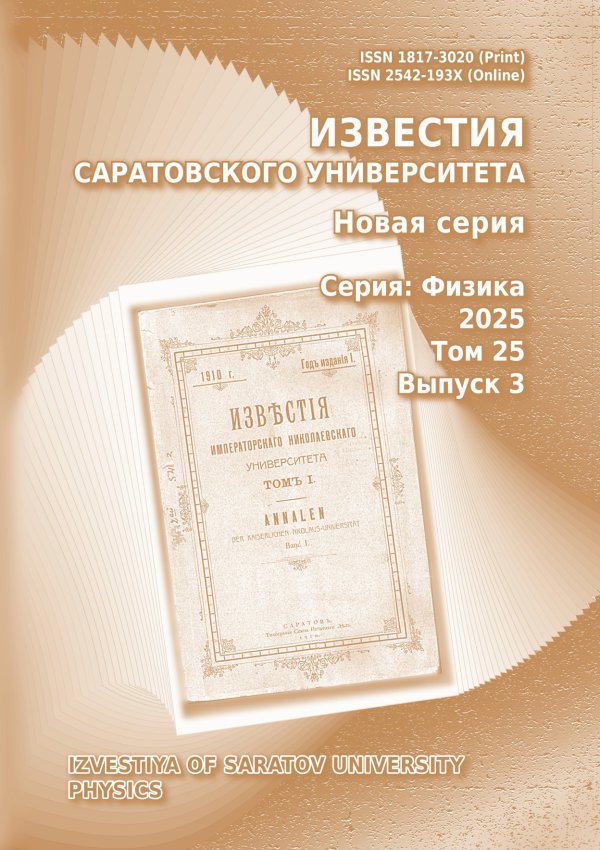
卷 25, 编号 3 (2025)

Theoretical and Mathematical Physics

Maximal field emission current densities in nanostructures

Davidovich M.

摘要

Background and Objectives: The problems of issues of achieving high field emission current densities 2–4 orders of magnitude lower than the limit values 1015–1016 A/m2 are considered. Materials and Methods: Methods of obtaining them, field emission models, as well as possible emission structures providing large integrated currents in ribbon electron beams are analyzed. Results: It has been shown that the high current densities of the order 1010–1012 A/m2 can be achieved in vacuum quantum structures with two or more potential wells during resonant tunneling. Conclusions: Obtaining high-precision sources requires nanotechnology to create heterostructures of the metal-isolator-metal type and the use of low temperatures. Amorphous glass-like diamond (GLD) is a good material for dielectric films, and conductive glasslike carbon (GLC) is a suitable material for conductive films. In fact, the technology of creating thinfilm structures such as GLD-GLC-CLD is used.

Izvestiya of Saratov University. Physics. 2025;25(3):266-276
pages 266-276 views

Determining the structure of couplings in chaotic and stochastic systems using a neural network

Shabunin A.

摘要

Subject and Objectives: The purpose of this work is development and research of an algorithm for determining the structure of couplings of an ensemble of chaotic self-oscillating systems with and without noise, which is based on artificial neural networks (ANN). Ensembles of two cubic maps with diffusive unidirectional and mutual couplings are the systems under study. Materials and Methods: The method is based on the determination of causality by Granger and the use of direct propagation artificial neural networks trained with regularization. Results: The applicability of the algorithm has been considered both for a strictly deterministic system and for a system with low-intensity additive Gaussian noise. The results have shown the possibility of using ANN to identify the degree of influence of the subsystems on each other, as well as to assess the magnitude of the coupling coefficients. At the same time, low-intensity noise demonstrates a minor effect on the measurement results. Moreover, noise can play a constructive role, allowing to determine the connectivity in the cases where measurements become impossible in “pure” systems, for example, in the chaos synchronization mode or in the case of regular modes. Discussion and Conclusions: Although the method has shown its effectiveness for simple mathematical models, its applicability for real systems depends on a number of factors, such as sensitivity to external noise, distortion of the waveforms, the dimension of the array etc. These questions require additional research.
Izvestiya of Saratov University. Physics. 2025;25(3):277-287
pages 277-287 views

Radiophysics, Electronics, Acoustics

Method of recurrent analysis for the generalized synchronization regime detection in different classes of dynamical systems

Illarionova E., Moskalenko O.

摘要

Background and Objectives: In this paper we study the possibility of quantitative determination of the boundary of the generalized synchronization regime in unidirectionally and mutually coupled systems with different attractor topologies by means of the recurrent analysis. Materials and Methods: As the systems under study we consider Lorenz and Rössler systems, as well as radiotechnical generators coupled unidirectionally and/or mutually. To evaluate the obtained data together with the recurrent analysis the spectrum of Lyapunov exponents or synchronization error were calculated for all the systems under study. Results: We have shown that for identical systems with detuned parameters the results of the method of recurrent analysis coincide with a high degree of accuracy with the values obtained using classical methods for the generalized synchronization regime detection, whereas for noindentical systems the proposed method demonstrates less accurate results. Conclusion: The method of calculation the recurrent diagrams allows us to determine the boundary of generalized synchronization in unidirectionally and mutually coupled systems with different attractor topology. The obtained results are in a good agreement with the results of calculation of the spectrum of Lyapunov exponents and synchronization error.
Izvestiya of Saratov University. Physics. 2025;25(3):288-294
pages 288-294 views

Coherent resonance in the modified Vyshkind – Rabinovich model

Romanenko D., Grishin S.

摘要

Background and Objectives: The paper presents the results of theoretical study of the coherence resonance phenomenon in the modified Vyshkind – Rabinovich model. The model describes the chaotic dynamics of three parametrically interacting modes one of that (a high-frequency mode) is amplified and the other two (the low-frequency modes) are linearly damped. Materials and Methods: To observe the coherence resonance, one of the parameters of the modified Vyshkind – Rabinovich model (the high-frequency mode nonlinear increment) is modulated by noise possessing a uniform spectrum in a bounded frequency band. Results: The calculation results demonstrate an autocorrelation time maximum of the chaotic high-frequency mode envelope that is observed at an optimal level of external noise influence. Conclusion: The proposed method for coherence resonance implementation can be extended to noise-suppressed chaotic systems of another type.
Izvestiya of Saratov University. Physics. 2025;25(3):295-304
pages 295-304 views

Optics and Spectroscopy. Laser Physics

Effect of low concentrations of hyaluronic acid on the structure of whey protein isolate during conjugation: Development and optimization of machine learning models based on adaptive boosting for spectroscopic data analysis

Shevtsova S., Saveleva M., Mayorova O., Prikhozhdenko E.

摘要

Background and Objectives: Multicomponent mixtures with bioactive compounds, such as hyaluronic acid (HA) in protein matrices, are critical in pharmaceuticals, nutraceuticals, and cosmetics. However, detecting low-concentration additives (e.g., 0.1–0.5 wt.% HA in whey protein isolate, WPI) remains challenging due to signal interference and matrix complexity. Raman spectroscopy (RS) is a powerful tool for such analyses, but interpreting spectral data requires advanced computational methods. This study leverages adaptive boosting (AdaBoost), an ensemble ML algorithm, to (1) classify WPI-HA mixtures by HA concentration, (2) quantify HA content via regression, and (3) determine the minimal training dataset size needed for robust predictions. Materials and Methods: WPI (5 wt.%) was mixed with HA (0.1, 0.25, 0.5 wt.%) in saline, dialyzed, and dried into thin films. Renishaw inVia spectrometer equipped with a 532 nm laser was implemented to collect 600 spectra/sample (20×30-point maps). Preprocessing included cosmic-ray removal, baseline correction, and L2 normalization. AdaBoost models (scikit-learn) were optimized via GridSearchCV (hyperparameters: DecisionTree max_depth, 1–3; n_estimators, 50–350). Performance was tested across training set sizes (50–500 spectra/sample). Metrics included accuracy (classification) and R2/RMSE (regression). Results: Optimization: 325 DecisionTrees with max_depth = 3 have been found to be the best hyperparameters of AdaBoost. Classification: 50 spectra/sample have achieved 94.5% accuracy; 200/300 spectra have improved this to 97.9%/98.3%, respectively. The models have reliably distinguished WPI + 0.1% HA from WPI (>96% accuracy). Regression: 300 spectra/sample have yielded optimal results (R2 = 0.910, RMSE = 0.061%). Larger datasets (400–500 spectra) have reduced performance (R2 = 0.894), suggesting overfitting. Key bands for analysis: 763 cm–1 (tryptophan), 1003 cm–1 (phenylalanine), and 1240 cm–1 (amide III). Bands at 1450–1667 cm–1 (C–H/amide I/II) have shown negligible importance, indicating minimal HA-induced changes. Conclusion: AdaBoost models efficiently analyze trace HA in WPI with small training datasets (200 spectra for classification, 300 for regression). The method precision and speed make it ideal for industrial applications, while identified spectral markers have deepen understanding of HAprotein interactions. Future work could extend this framework to other multicomponent systems with low analyte concentrations.
Izvestiya of Saratov University. Physics. 2025;25(3):305-315
pages 305-315 views

Biophysics and Medical Physics

Restoration of microhemodynamics on the human body surface using the fractional derivative of temperature oscillations

Sagaidachnyi A., Volkov I., Zaletov I., Mayskov D., Fomin A., Antonov A., Tsoy M., Skripal A.

摘要

Background and Objectives: The possibility of restoring microhemodynamics on the human body surface was investigated through the analysis of skin temperature oscillation signals using integer and fractional order derivatives. Materials and Methods: Microhemodynamic data were simultaneously recorded via photoplethysmographic imaging and infrared thermography in four regions of the hand. To reconstruct microhemodynamics from temperature data, a previously described thermal wave model, along with integer and fractional order derivatives, were applied. A comparative analysis of the amplitude-frequency and phase-frequency characteristics of these transformations was conducted. The fractional-order derivative of temperature oscillations was calculated as the Riemann – Liouville differintegral. For a group of subjects, correlations were computed between the reconstructed microhemodynamic results during a 15-minute resting state using the thermal wave model and the integer/fractional-order derivatives of temperature. Results: It has been established that employing a fractional-order derivative of order 0.4 has yielded the best correlation between the frequency characteristics and those of the thermal wave model. The enhanced temporal-domain signal correlation achieved with the fractional-order derivative, compared to the integer-order derivative, is attributed to more accurate amplitude-frequency and phase-frequency transformations of temperature oscillations. These transformations align with the attenuation and dispersion processes of thermal waves in the skin. Conclusions: For precise restoration of microhemodynamics using skin temperature time derivatives, a the fractional-order derivative of 0.4 is preferable over integer-order derivatives. The described method can serve as a thermalbased technique for investigating blood flow oscillations in microvessels across multiple anatomical regions simultaneously.
Izvestiya of Saratov University. Physics. 2025;25(3):316-332
pages 316-332 views

Study of the influence of electrical impulses on arterial blood microcirculation using laser Doppler flowmetry

Prokhorova V., Kutikova O., Palaguta A., Skripal A., Ermishin D., Rytik A.

摘要

Background and Objectives: The influence of low-voltage electrical current impulses on arterial blood microcirculation was investigated using the method of laser Doppler flowmetry. Materials and Methods: The method involves measuring the blood microcirculation index by quantifying the Doppler frequency shift arising when the microcirculatory bed is probed with laser radiation, followed by the registration of radiation reflected from both moving and stationary tissue components. Results: It has been demonstrated that exposure to electrical current impulses leads to an average 4-fold increase in the myogenic component of the spectrum relative to the baseline sample. This increase is associated with changes in the tone of the vascular wall in blood arterioles. The predominance of neurogenic components of the spectrum after cessation of exposure to electrical impulses has also been revealed. Conclusion: Utilizing the laser Doppler flowmetry method based on the amplitudes of spectral harmonics of vascular oscillation rhythms allows to determine quantitatively the changes in blood flow regulation during exposure to current impulses.
Izvestiya of Saratov University. Physics. 2025;25(3):333-342
pages 333-342 views

Influence of upconversion nanoparticles on the refractive properties of tumor tissue under photodynamic therapy

Lazareva E., Mylnikov A., Navolokin N., Doronkina A., Anisimov R., Lomova M., Kochubey V., Yanina I.

摘要

Background and Objectives: To develop and improve the efficiency of minimally invasive cancer therapy methods, accurate data on the optical properties of biological tissues and their changes after photodynamic therapy using upconversion nanoparticles (UCNPs) of various types are required. One of the optical methods proposed for diagnostics and assessment of tumor tissue development is the method of multiwave refractometry. Materials and methods: In the presented study, a model of alveolar liver cancer (cholangiocarcinoma, PC1) development in rats was used. Photodynamic therapy was carried out using 5 different UCNPs. The refractive index was measured on an Abbe DR-M2/1550 multiwave refractometer (Atago, Japan). Results: The dispersion dependence of tissue samples of model alveolar liver cancer was analyzed in the spectral range of 480–1550 nm after the introduction of 5 different types of UCNPs, as well as after photodynamic therapy. According to the obtained result, the highest value of the Abbe number (53.67 ± 0.68) is characteristic of intact tumor tissue, while UCNPs lead to a decrease in the Abbe number (53.29 ± 0.69), an even lower value of the Abbe number (53.12 ± 0.69) is observed in tissue samples from groups of animals after photodynamic therapy. Conclusions: The results presented in this paper have shown that the introduction of UCNPs of various types and the use of photodynamic therapy cause a change in the refractometric properties of tissues. The presented results can be useful for many methods of laser therapy and optical diagnostics of skin diseases and localization of subcutaneous tumors.
Izvestiya of Saratov University. Physics. 2025;25(3):343-355
pages 343-355 views

Nanotechnologies, Nanomaterials and Metamaterials

Electrically conductive properties of graphene–nanotube hybrid/aluminium oxide interfaces

Slepchenkov M., Murashko D., Kuksin A., Ryazanov R., Lebedev E., Shaman Y., Kitsyuk E., Gerasimenko A., Glukhova O.

摘要

Background and Objectives: Currently, carbon nanostructure/metal oxide interfaces are becoming one of the key components of nanoelectronic devices, including tunnel field-effect transistors. Among carbon nanomaterials, special attention is paid to graphene, the increase in structural stability and control of electrical conductivity of which is an urgent scientific task. One of the solutions to this problem, which has been experimentallytested, is a combination of graphene with carbon nanotubes(CNT) in a hybrid nanostructure. Inthis work, we experimentally obtained for the first time 2D/0D interface samples in the form of a hybrid film of reduced graphene oxide (RGO) and single-walled carbon nanotubes (SWCNTs) with deposited aluminum oxide (Al2O3) nanoparticles. Materials and Methods: Samples with an Al2O3 nanoparticle layer thickness of 5 nm and 20 nm were synthesized. Due to pulsed laser radiation with an energy density of 0.24 J/cm2 (laser processing power of 70 mW), the effect of binding Al2O3 nanoparticles to the surface of RGO/SWCNT nanostructures, as well as the effect of forming SWCNT nanostructures oriented at an angle to the silicon substrate, was achieved. Results: Electrical conductivity measurements were performed for the synthesized samples at temperatures of –50, –10, +20, +60, +140, +200°C. It has been found that with increasing temperature, the electrical conductivity of the sample with a layer thickness of Al2O3 nanoparticles of 5 nm increases by 2.5 times, and the sample with a thickness of 20 nm – by 4.2 times. At the same time, for the sample with a layer thickness of Al2O3 nanoparticles of 20 nm, higher electrical conductivity values are characteristic at all temperatures. Conclusion: Based on the obtained results, the synthesized samples of the RGO/SWCNT/Al2O3 interface can be recommended for use in nanoelectronic devices.
Izvestiya of Saratov University. Physics. 2025;25(3):356-368
pages 356-368 views

Methodological Part

Transformation of subject training of physics teacher during a change in the educational format

Burova T.

摘要

Background and Objectives: The change in the format of education in the main areas of training in higher educational institutions of the country, carried out after the signing of the Bologna Convention in 2003, marked a significant change in the practice of training university graduates. The main goal of the work is to analyze the transformation of a teacher’s subject training during the transition from five-year training in specialty programs to a two-stage bachelor’s + master’s degree system using the example of physics teacher training. Results: Data are provided on the expenditure of educational time on studying physics, mathematics and teaching methods in one- and two-stage systems, as well as the share contribution of specialization disciplines to the total expenditure of educational time. There was a decrease in the level of competence of a bachelor compared to the competence of a specialist in terms of subject training. Conclusion: The necessity of maintaining high standards of training in the main specialty while developing a new education strategy for the formation of teachers who meet the requirements of the time has been shown. In this regard, the emerging trend towards creating a qualitatively new format of education in the direction of 44.03.01 “Pedagogical Education”, accumulating the existing positive experience in training specialists and a practice-oriented approach to training seems timely and promising.
Izvestiya of Saratov University. Physics. 2025;25(3):369-376
pages 369-376 views

Dynamics of quantum transition of a particle in a potential well

Tsoy V.

摘要

Background and Objectives: Usually the quantum transition from the stationary state to another stationary state is considered instantaneous. The quantum transition consists of a perturbation of the initial state and a reduction to the final state. Therefore, an instantaneous change in the particle localization corresponding to the transition from one wave function to another at superluminal speed is unacceptable. Also, a wave train of radiation, if it occurs during the transition, cannot arise instantly. This article proposes a dynamical model of quantum transition in which the reduction to the final state occurs dynamically but not instantly. Methods: The probability amplitudes of the modes in the intermediate state arising from the initial stationary state were determined by solving a system of differential-algebraic equations. The reduction of the intermediate state to the final mode was simulated by piecewise continuous evolution with periodic zeroing of the imaginary part of the wave function. Conclusion: This model has been applied to a particle in a potential well with negative energy. The potential is chosen as the square of the hyperbolic cosecant. Such a three-level well contains two qubits. The time scale of reduction to stationary states of these qubits is hundreds of periods corresponding to the Bohr frequencies of transitions. So the quantum transition is a process with a dynamical perturbation of the initial state and a dynamical reduction to the final state. 
Izvestiya of Saratov University. Physics. 2025;25(3):377-385
pages 377-385 views

From the History of Physics

Historical and biographical epic novel about the life of Pavel N. Yablochkov

Anikin V.

摘要

Background and Objectives: The novel by Saratov writer Alexey A. Booss “The Great Dream,” is reviewed. It presents a historical and artistic biography of the outstanding Russian electrical engineer and inventor Pavel N. Yablochkov, a native of the Saratov province. Materials and Methods: The book reflects various periods of life of the inventor – studies, service, communication with leading physicists and electrical engineers of Russia, inventive and selfless activities in Russia and France, which had a huge stimulating influence on the development of AC electric lighting systems throughout the world. The plot of the book is immersed in the context of the historical era of the second half of the 19th century and reflects the vicissitudes of the life of a talented inventor who experienced both serious difficulties and happy insights in the process of scientific and technical creativity. Conclusion: The novel may be considered as an important contribution to the preservation and protection of the historical memory of the merits of Russian scientists and inventors. Alexey Booss became a laureate of the Saratov literary K. A. Fedin prize. The novel has been recognized as the best-seller of the year.
Izvestiya of Saratov University. Physics. 2025;25(3):386-389
pages 386-389 views

Personalia

In memory of Nikolai Borisovich Skachkov (1945–2025)

摘要

-
Izvestiya of Saratov University. Physics. 2025;25(3):390-391
pages 390-391 views

Согласие на обработку персональных данных с помощью сервиса «Яндекс.Метрика»

1. Я (далее – «Пользователь» или «Субъект персональных данных»), осуществляя использование сайта https://journals.rcsi.science/ (далее – «Сайт»), подтверждая свою полную дееспособность даю согласие на обработку персональных данных с использованием средств автоматизации Оператору - федеральному государственному бюджетному учреждению «Российский центр научной информации» (РЦНИ), далее – «Оператор», расположенному по адресу: 119991, г. Москва, Ленинский просп., д.32А, со следующими условиями.

2. Категории обрабатываемых данных: файлы «cookies» (куки-файлы). Файлы «cookie» – это небольшой текстовый файл, который веб-сервер может хранить в браузере Пользователя. Данные файлы веб-сервер загружает на устройство Пользователя при посещении им Сайта. При каждом следующем посещении Пользователем Сайта «cookie» файлы отправляются на Сайт Оператора. Данные файлы позволяют Сайту распознавать устройство Пользователя. Содержимое такого файла может как относиться, так и не относиться к персональным данным, в зависимости от того, содержит ли такой файл персональные данные или содержит обезличенные технические данные.

3. Цель обработки персональных данных: анализ пользовательской активности с помощью сервиса «Яндекс.Метрика».

4. Категории субъектов персональных данных: все Пользователи Сайта, которые дали согласие на обработку файлов «cookie».

5. Способы обработки: сбор, запись, систематизация, накопление, хранение, уточнение (обновление, изменение), извлечение, использование, передача (доступ, предоставление), блокирование, удаление, уничтожение персональных данных.

6. Срок обработки и хранения: до получения от Субъекта персональных данных требования о прекращении обработки/отзыва согласия.

7. Способ отзыва: заявление об отзыве в письменном виде путём его направления на адрес электронной почты Оператора: info@rcsi.science или путем письменного обращения по юридическому адресу: 119991, г. Москва, Ленинский просп., д.32А

8. Субъект персональных данных вправе запретить своему оборудованию прием этих данных или ограничить прием этих данных. При отказе от получения таких данных или при ограничении приема данных некоторые функции Сайта могут работать некорректно. Субъект персональных данных обязуется сам настроить свое оборудование таким способом, чтобы оно обеспечивало адекватный его желаниям режим работы и уровень защиты данных файлов «cookie», Оператор не предоставляет технологических и правовых консультаций на темы подобного характера.

9. Порядок уничтожения персональных данных при достижении цели их обработки или при наступлении иных законных оснований определяется Оператором в соответствии с законодательством Российской Федерации.

10. Я согласен/согласна квалифицировать в качестве своей простой электронной подписи под настоящим Согласием и под Политикой обработки персональных данных выполнение мною следующего действия на сайте: https://journals.rcsi.science/ нажатие мною на интерфейсе с текстом: «Сайт использует сервис «Яндекс.Метрика» (который использует файлы «cookie») на элемент с текстом «Принять и продолжить».