




 Email this article
 Hemiplegia complicated by opposite hemichorea
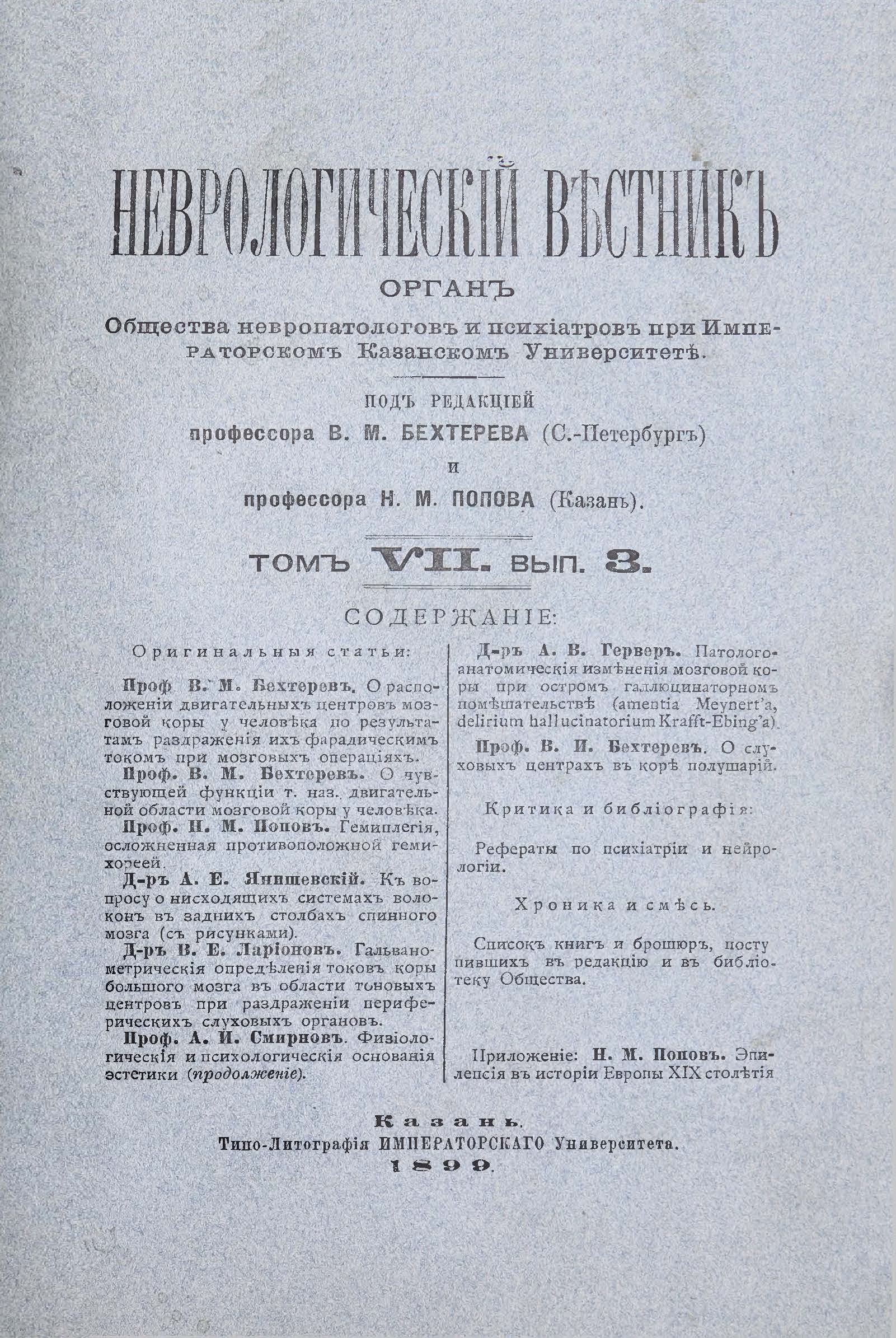
- Authors: Popov N.M.
- Issue: Vol VII, No 3 (1899)
- Pages: 11-28
- Section: Original article
- URL: https://journals.rcsi.science/1027-4898/article/view/50105
- DOI: https://doi.org/10.17816/nb50105
- ID: 50105
Cite item
Full Text

Abstract
Hemiplegias of cranial origin are among such clinical pictures, with which a neuropathologist meets especially often. But, in spite of this, science has not yet said its last word about them. Moreover, some of the symptoms of suffering still remain poorly understood even from the outside, not to mention their pathogenesis. We know, for example, that movement disorders during hemiplegias also extend to the healthy half of the body; these disorders, which have long attracted the attention of observers, are in their considerable part described with sufficient detail; However, at least from time to time, the clinic presents us with new combinations, which indicate how deeply and together with how differently the disease of one hemisphere can affect the motor functions of the other.
Keywords
Full Text
##article.viewOnOriginalSite##About the authors
N. M. Popov
Author for correspondence.
Email: info@eco-vector.com
Prof.
Russian FederationReferences
Supplementary files

