




 Email this article
 The current state of the science of aphasia
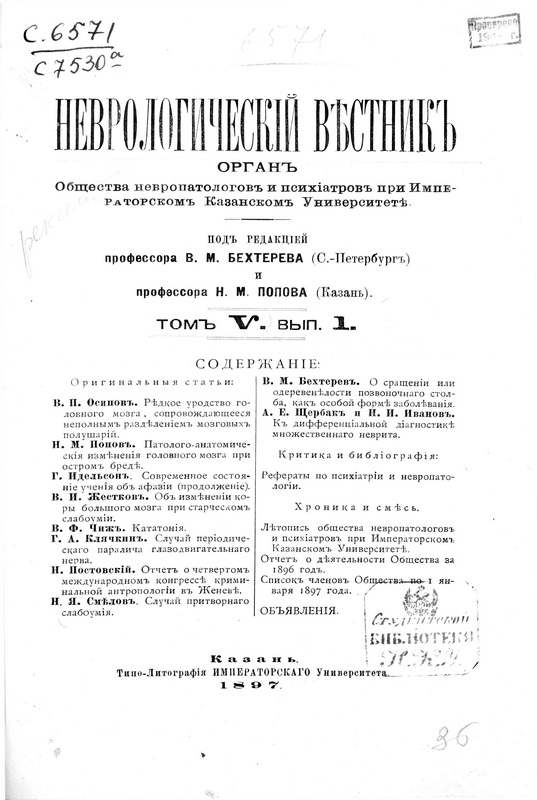
- Authors: Idelson G.
- Issue: Vol V, No 1 (1897)
- Pages: 49-69
- Section: Original article
- URL: https://journals.rcsi.science/1027-4898/article/view/46641
- DOI: https://doi.org/10.17816/nb46641
- ID: 46641
Cite item
Full Text

Abstract
VIII.
The Grashey case and its implications.
A patient with Grashey, in the face of a cranial injury, fell ill with a disorder of the tongue of a sensory character, which soon gave way to another peculiar disorder. The patient did not find the names of the objects around him, except by resorting to the following means; he gazed intently at the known object, and recalled in order the individual letters of the given word; He wrote these letters in order, according to the time he remembered them, and only after all the letters written in this way made up a word, the patient could pronounce the given word. If the object was removed earlier, before he had time to draw the name, then to bring the name, displaying consistently one sign after another, he could not — and, thus, could not, of course, pronounce this word. If the patient was pronounced the word by syllable, then, having reached the last syllable, he no longer remembered the first, because of which he could not repeat it.
Keywords
Full Text
##article.viewOnOriginalSite##About the authors
G. Idelson
Author for correspondence.
Email: info@eco-vector.com
Russian Federation
References
Supplementary files

