Acesso aberto Acesso aberto  Acesso é fechado Acesso está concedido  Acesso é fechado Somente assinantes

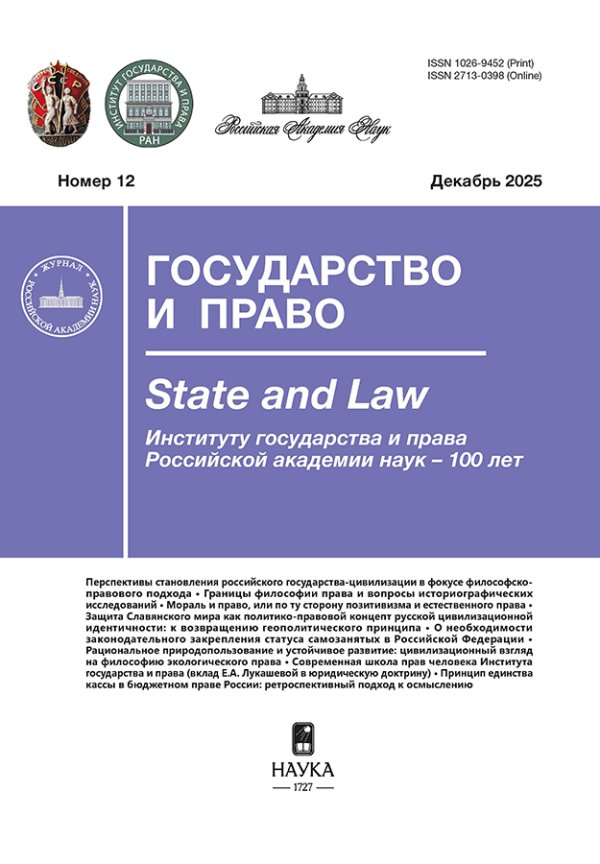
Nº 12 (2025)

Capa

Edição completa

Acesso aberto Acesso aberto
Acesso é fechado Acesso está concedido
Acesso é fechado Somente assinantes

Articles

PROSPECTS FOR THE FORMATION OF A RUSSIAN STATE-CIVILIZATION IN THE FOCUS OF A PHILOSOPHICAL-LAW APPROACH

Lapaeva V.

Resumo

The scientific and practical relevance of the problem under consideration is due to the theoretical underdevelopment of the concept of “state-civilization”, as well as the need for Russia to more clearly position itself as a state-civilization in the context of global transformations associated with the transition to a multipolar world order. The author set the following goals: to give a clearer definition of the concept of “state-civilization” based on the distinction between such concepts as “civilizational identity” and “sociocultural originality”; to analyze the main problems associated with the formation of Russian civilizational identity; to outline the directions of philosophical and legal understanding of Russian civilizational specifics; to answer the question of whether Russia at this stage of its development can be considered as a state-civilization or is it still a project, the implementation of which requires the implementation of an appropriate state and legal policy. The analysis concludes that Russia, which has enormous civilizational potential, is still in the process of becoming a state-civilization. Progress in this direction is hampered by the absence of a value mainstream in the public consciousness of Russians that would express the commitment of society to a certain type of civilizational development, as well as the lack of development of a national project for the future that would be able to unite society and become (due to its universal significance) a factor of “soft power” that would attract allies beyond its borders. To solve these problems, it is necessary to have such a state policy in the field of forming the civilizational identity of Russia that, on the one hand, would be based on the spiritual and sacred sources of Russian statehood, and on the other, would be part of the strategy of Russian modernization.

Gosudarstvo i pravo. 2025;(12):7-15
pages 7-15 views

RATIONAL USE OF NATURAL RESOURCES AND SUSTAINABLE DEVELOPMENT: A CIVILIZATIONAL APPROACH TO THE PHILOSOPHY OF ECOLOGICAL LAW

Brinchuk M.

Resumo

The article examines the methodological links between the two most important resources of ecological development — rational use of natural resources and sustainable development. In the context of the environmental crisis, as an organic part of the systemic crisis, these resources are considered in the light of the civilizational development of society and the needs for improving ecological legislation. Defects in the practice of economic and ecological development and gaps in ecological legislation are identified. In the light of ensuring natural law justice and overcoming the crisis, proposals for improving the concepts of rational use of natural resources and sustainable development are substantiated.
Gosudarstvo i pravo. 2025;(12):110-125
pages 110-125 views

POLITICAL EXTREMISM AS A THREAT TO THE NATIONAL SECURITY OF THE RUSSIAN FEDERATION: POLITICAL AND LEGAL SUPPORT FOR COUNTERING

Golik Y., Chernysheva J.

Resumo

In today’s world, the frequency of political extremism is increasing, and there is a growing number of actions that pose a threat to the security of states. The spread of extremist crimes is one of the most serious threats to the Russian state. Therefore, the main task of law enforcement agencies is to use various criminal and criminological measures to combat political extremism. In order to combat political extremism, it is necessary to implement measures to counter this phenomenon in all areas of public life and to take timely educational and preventive measures. Legislative measures to combat political extremism are complex in nature, and their content can be understood by analyzing the current legislation. The article examines the content, essence, and main features of political extremism, and explores ways to overcome political extremism in Russian society.
Gosudarstvo i pravo. 2025;(12):126-134
pages 126-134 views

QUALIFYING SIGNS OF COERCION TO TESTIFY (PARTS 2–4 OF ARTICLE 302 OF THE CRIMINAL CODE OF THE RUSSIAN FEDERATION): CURRENT ISSUES

Melnikov E.

Resumo

The article is devoted to qualifying types of compulsion to give evidence or coercion of an expert to make a report. The article also discusses certain problematic issues related to the amendments introduced by Federal Law No. 307-FZ of July 14, 2022 to the Criminal Code of the Russian Federation (in Part 1 of Article 302), as well as analyzes the provisions of Resolution No. 20 of the Plenum of the Supreme Court of the Russian Federation dated June 28, 2022 “On certain judicial issues practice in criminal cases of crimes against justice”. Special attention in the article is paid to the analysis of the ratios of such methods of compulsion to give evidence as other illegal actions, violence, mockery and torture.
Gosudarstvo i pravo. 2025;(12):135-140
pages 135-140 views

THE MODERN SCHOOL OF HUMAN RIGHTS OF THE INSTITUTE OF STATE AND LAW (E.A. LUKASHEVA'S CONTRIBUTION TO LEGAL DOCTRINE)

Saidov A.

Resumo

The article analyzes the scientific contribution of Elena Andreevna Lukasheva, an outstanding Russian jurist, Doctor of Law, Corresponding Member of the Russian Academy of Sciences, to the development of modern legal doctrine in the field of human rights. The relevance of the research is due to the continuing importance of E.A. Lukasheva's scientific ideas and developments for modern legal doctrine and practice in the field of human rights. The article examines her fundamental works on the issues of socialist legal awareness and legality, research on the place of human rights in the socio-cultural system of civilizations, works on the relationship between morality and law, as well as issues of the legal and social state.
Gosudarstvo i pravo. 2025;(12):141-153
pages 141-153 views

FORMATION AND DEVELOPMENT OF THE CONSTITUTIONAL DOCTRINE AS A FACTOR IN IMPROVING THE PRACTICE OF CONSTITUTIONAL JUDICATURE

Bezrukov A., Kozhevnikov O.

Resumo

The article presents an analytical review of the main scientific ideas and works of Alexander Nikolaevich Kokotov, one of the leading Russian constitutionalists, a representative of the Ural and then St. Petersburg law schools, Doctor of Law, Professor, Honored Lawyer of the Russian Federation, judge of the Constitutional Court of the Russian Federation, in honor of his 65th birthday. The analysis of the main scientific developments of the scientist in the fields of Constitutional and Municipal Law, federalism and local self-government, Electoral and Parliamentary Law, the system of public authority and constitutional justice is carried out. The authors show the significant contribution of the hero of the day to the development of the science of Constitutional Law and individual constitutional and legal institutions (Parliamentary Law, Electoral Law, the system of public authority, constitutional justice, etc.), as well as to the practice of constitutional justice in Russia. Conclusions are formulated about the promising nature of A.N. Kokotov's key scientific research, a successful combination of serious research and acquired practical experience of the scientist as a factor in improving the quality of the practice of constitutional justice in general. The authors focus on the analysis of the Professor's scientific research, which is devoted to understanding the legal nature of the constitution and constitutional legislation, the system of public authority and constitutional justice, parliamentarism and Electoral Law, Russian federalism and local self-government as the most important areas of development of constitutional doctrine and practice.
Gosudarstvo i pravo. 2025;(12):154-162
pages 154-162 views

MINIMUM WAGES: INTERNATIONAL LABOR STANDARDS AND LEGAL REGULATION IN THE EAEU COUNTRIES

Lyutov N.

Resumo

The article analyzes the extent to which international norms concerning minimum wage standards contained in key human rights instruments (the Universal Declaration of Human Rights of 1948, the International Covenant on Economic, Social and Cultural Rights of 1966, the Constitution of the International Labor Organization (ILO), and the ILO Minimum Wages Convention, 1970 (No. 131)) are implemented in five EAEU states – Armenia, Belarus, Kazakhstan, Kyrgyzstan, and Russia. The conclusion is made that the interpretation of various international labor standards related to minimum wage is an interconnected system of acts of monitoring bodies of various international organizations, and the human right to a salary that ensures a decent standard of living for the employee and his family has been formed as a universal human right. It is proven that all five EAEU countries have sufficient potential to significantly increase the minimum wage.
Gosudarstvo i pravo. 2025;(12):163-172
pages 163-172 views

THE CONSTITUTIONS OF THE FIRST HALF OF THE 19th CENTURY AS AN ELEMENT OF THE EVOLUTION OF AUTOCRATIC POWER

Vinogradova E.

Resumo

The revised constitutions are seen as an important link in the process of searching for effective models of modern statehood, its transformation and adaptation, combining elements of modernization and conservation. In recent years, due to the increased attention to the political and legal context of constitutionalism, the study of sources that clearly state that domestic political and legal ideas and concepts, including those contained in works on the evolution of autocracy, is considered very important. The historiographical analysis of Russian studies of the octroized constitutions seems to be an interesting research task ranging from “concessions” through the stage of “class maneuver” to understanding their mechanism as a “soft” strategy for the modernization of power. The boundaries of the study are determined by the historical context, based on the fact that the “peak” of such a phenomenon as the donation of a constitutional act occurred in the period between the Congress of Vienna (1815) and the revolutions of 1848–1849 in European countries. As a result of the conducted research, it is concluded that the experience of reformed constitutions is an important tool for analyzing modern political processes, demonstrating universal mechanisms of interaction between a strong center, societal pressure and the search for forms of legitimization of power in a changing world.
Gosudarstvo i pravo. 2025;(12):173-183
pages 173-183 views

THE PRINCIPLE OF UNITY OF BUDGET ACCOUNT IN RUSSIAN BUDGETARY LAW: A RETROSPECTIVE APPROACH TO UNDERSTANDING

Artyukhin R., Kozyrin A.

Resumo

The cash system is one of the most important characteristics of Financial Law. The state of public finances, the effectiveness of the budget process in general, and the execution of the budget in particular depend on the choice of the cash system. The centralization of public power and the need to improve state financial control led to the transition from a decentralized cash system to a unified cash system. In Russia, the establishment of the principle of unified cash in budgetary law was associated with the Tatarinov reforms of the 1860°. The Russian historical experience provides a normative and empirical material for understanding the principle of unity of budget account. Throughout the 19th and 20th centuries, all known models of the cash system were used in Russia: the treasury model, the banking model, and the mixed model. The development of Russian budget legislation in the 21st century creates new contours of organizational and legal forms for the cash execution of the budget. Changes in the political and economic situation in the country, as well as improvements in information and communication technologies, are leading to the emergence of new institutions in the field of Budgetary Law. The creation of the treasury payment system in the early 2020s led to the unification of treasury and banking functions within the Russian Treasury, thereby overcoming the antagonism between the banking and treasury models of the state's cash system.
Gosudarstvo i pravo. 2025;(12):184-195
pages 184-195 views

INTELLECTUAL PROPERTY PROTECTION AND DIGITAL PLATFORMS

Yastrebov O., Lepeshin D., Petkiley P.

Resumo

The article examines the specifics of legal regulation of intellectual property rights protection on digital platforms in light of the adoption of Federal Law No. 289-FZ of July 31, 2025 “On Certain Issues of Regulating the Platform Economy in the Russian Federation”. The authors examine the legal nature of digital platforms, defining them as objects of civil rights – information systems, websites on the Internet or computer programs. Particular attention is paid to the status of the owner of the digital platform and its relationship with the concept of an information intermediary, as well as mechanisms for protecting intellectual property rights (including the direction of legally significant messages).
Gosudarstvo i pravo. 2025;(12):196-202
pages 196-202 views

FORMATION OF A HOLISTIC PICTURE OF RUSSIAN HISTORY: SYNTHESIS OF ARCHAEOLOGY, HISTORIOGRAPHY AND HUMANITARIAN THOUGHT

Gorban V., Malikov S.

Resumo

The article analyzes the main activities of scientists to achieve this goal based on the results of the meeting of the Presidium of the Russian Academy of Sciences on September 9, 2025. Taking into account the latest challenges facing the archaeological and historical sciences, the work organized by the Institute of State and Law of the Russian Academy of Sciences on the creation of a national historiographical model of political and legal knowledge is described. The purpose of building this model is to ensure methodological sovereignty, develop principles of reliability and verifiability based on interdisciplinary analysis and work with large amounts of data.
Gosudarstvo i pravo. 2025;(12):203-206
pages 203-206 views

THE LEGAL ECONOMIC RELATION AS AN OBJECT OF THE INTERDISCIPLINARY RESEARCH

Vylegzhanin A., Kalamkaryan R., Lobanov S.

Resumo

The positioning of law – both national or internal law and International Law – in the parameters of an integral system of prescriptions for legally acceptable behavior of its subjects, especially under the regime of ensuring their legal security designates the need to ascertain the modern content of the phenomenon of “legal relationship” in the huge economic space of Russia and beyond this space. In the context of international relations of Russia (both economic and political) the economic legal relations are aimed objectively at the strengthening of the international legal order while the economic competition among States is growing. The work to be reviewed from the first pages of its reading testifies to the fundamental immersion in the topic by the author. The content of the book as a result of interdisciplinary research of the “life” and “diseases” of the economic legal relations without any doubt is of theoretical and practical interest for the Russian lawyers, economic scholars, managers who are within the contemporary economic activity. As for international economic relations the book provides conclusions which are of exceptional demand in the modern geopolitical context.
Gosudarstvo i pravo. 2025;(12):207-213
pages 207-213 views

ON THE SEARCH FOR WAYS TO CONVERT THE RESULTS OF OPERATIONAL AND INVESTIGATIVE ACTIVITIES INTO CRIMINAL PROCEDURAL EVIDENCE IN THE RUSSIAN FEDERATION: INTERDISCIPLINARY RESEARCH

Redkous V.

Resumo

Operational investigative activities are understood as a type of activity carried out openly and covertly by operational units of state bodies authorized by the Federal Law dated July 5, 1995 “On operational investigative activities”, within their authority, through conducting operational investigative measures in order to protect life, health, rights and freedoms of individuals and citizens, property, and ensure the security of society and the state from criminal encroachments. Operational-search activities are the most important forms of operational-search activities, and therefore the legal regulation of their conduct, as well as the use of the results obtained, is the subject of scientific research. The review draws attention to the significant results of an interdisciplinary study of the patterns of transforming the results of operational-search activities into criminal procedure evidence in the Russian Federation, and the work done by the author's team was also positively evaluated.
Gosudarstvo i pravo. 2025;(12):214-220
pages 214-220 views

Discussions and debates

THE PHENOMENON OF LEGAL LIABILITY: FROM IDEA TO REALITY (theoretical and legal research)

Kobzar-Frolova M.

Resumo

The article attempts to comprehend the term "responsibility", the formation and development of ideas about responsibility throughout the thousand-year history of human civilization. The evolution of ideas about responsibility is shown starting from the Russian Truth and ending with the Soviet period of development of Russian statehood (late 80s). Particular attention is paid to the analysis of the development of ideas about responsibility, including criminal responsibility in the period from the end of the 18th to the beginning of the 20th century. The role of academic legal science, scientists of the Institute of State and Law in the development of ideas about the phenomenon of responsibility is emphasized. An analysis of various approaches to understanding the essence of the term "responsibility" formed in the 1950–1970s is carried out. Conclusions are made based on the results of the study. The article continues the study of responsibility as a social phenomenon, previously begun by the author.

Gosudarstvo i pravo. 2025;(12):71-81
pages 71-81 views

THE CONCEPT OF SECONDARY RIGHT IN A CONTEXT OF THE FORMULA OF SUBJECTIVE RIGHT BY S.N. BRATUS'

Kramskoy V.

Resumo

Within the framework of this article, the author continues the scientific development of such a construction of German law as transformative rights and their separate type – secondary right in relation to the Russian legal system. To this end, the author, using the potential of historical, legal and comparative legal methodology, examines in detail the existence of the construction of secondary right in the context of two main concepts of understanding subjective rights: volitional with its inherent theory of imperatives and interest with its inherent theory of permissions. At the same time, for the sake of objectivity, the previously identified signs of secondary rights are described in detail. Focusing on the provisions of these legal ideas and the characteristic features of secondary right, the author consistently comes to the conclusion that the construction of secondary right is indifferent to the theory of imperatives and their coherence with the theory of permissions. In parallel with this, a critical analysis of the understanding of subjective law as the right to one's own behavior of an authorized person, which prevailed for a long time in the Russian legal doctrine, proposed in the late 40° and early 50° of the XXth century by the prominent Soviet jurist S.N. Bratus. Subjecting the individual components to the study S.N. Bratus' ideas about subjective right, the author believes that it is more relevant to the description of the essence of the secondary right, rather than any subjective right. At the same time, the formula of S.N. Bratus's subjective right is finalized by the author for the completeness of the description of the construction of the secondary rights by introducing into it the attribute of the unconditionality of the action of the authorized person for the onset of the legal effect.

Gosudarstvo i pravo. 2025;(12):82-88
pages 82-88 views

Civil and entrepreneurial law

ON THE NECESSITY OF LEGISLATING THE STATUS OF THE SELF-EMPLOYED IN THE RUSSIAN FEDERATION

Kleandrov M.

Resumo

The article discusses the current scientific problem of the lack of legislative support for the status of self-employed individuals in the Russian Federation. It is noted that there are approximately 20 million self-employed individuals in our country, but only about half of them are registered with the tax authorities as simplified taxpayers. This experiment is set to end at the end of 2028. The other half of the self-employed individuals continue to work in the shadows. The lack of properly formalized legal personality of the self-employed entails many disadvantages that have a negative impact on both society and the self-employed themselves, including uncertainty regarding the judicial jurisdiction of cases involving them. The need for a Federal Law on the Self-Employed is justified. Taking into account the fact that self-employed individuals provide significant assistance to citizens, society, and the state through their activities, it is argued that the legal recognition of their status will eliminate existing shortcomings in the legal regulation of their activities and significantly enhance their effectiveness.
Gosudarstvo i pravo. 2025;(12):99-109
pages 99-109 views

Philosophy of law

THE BOUNDARIES OF THE PHILOSOPHY OF LAW AND ISSUES OF HISTORIOGRAPHICAL RESEARCH

Gorban V.

Resumo

The article presents the results of a study on one of the most complex and challenging problems in fundamental legal science, related to defining the limits of the Philosophy of Law. To solve this problem, it may be necessary to turn to studying the logic of sense-making in various traditions of historical philosophical and scientific thinking. The specific logic of sense-making in state and legal matters has certain characteristics, the identification of which allows for a more accurate and objective understanding and description of various legal traditions, going beyond the scope of philosophical and juridical analysis. Recognising the logic of sense-making in state and law requires those basic, intuitive attitudes that characterise a particular way of thinking about and perceiving the world, as coherent and integrated. The findings of research in modern philosophy, particularly those conducted by Academician of the Russian Academy of Sciences A.V. Smirnov, are of significant methodological significance. For the European legal system, it is crucial to contrast ancient logic as substantial and its later adaptations within national legal cultures, while for the Anglo-American legal tradition, initial intuition regarding processuality is most accurate, also characteristic of Arab-Islamic culture. Considering semantic logic types is seen as a promising task in shaping the Russian historical model of political-legal knowledge.

Gosudarstvo i pravo. 2025;(12):16-25
pages 16-25 views

MORALITY AND LAW, OR BEYOND POSITIVISM AND NATURAL LAW

Kornev V.

Resumo

The article examines the problem of the relationship between law and morality in the context of the relationship between positivism and natural law. The author substantiates the idea that morality is a prerequisite for law and its goal, which is especially important in today's world, where the ideas of postmodernism and formalism are spreading, and the digitalization of human relationships is taking place. The article concludes that it is necessary to change the paradigm of legal understanding in connection with the adoption of Presidential Decree No. 809 of November 9, 2022, "On the Approval of the Fundamentals of State Policy for the Preservation and Strengthening of Traditional Russian Spiritual and Moral Values" and the perception of the traditions of Russian theory and Philosophy of Law.

Gosudarstvo i pravo. 2025;(12):26-35
pages 26-35 views

THE PHILOSOPHY OF EUROPEAN CONSERVATISM IN FOCUS ON POWER AND LAW

Vasilev A., Butrim I.

Resumo

The article is devoted to understanding the phenomenon of the philosophy of European conservatism in the context of politics and law. The authors notes the need to update the philosophy of European conservatism taking into account cognitive and applied aspects. It is important to follow the installation to overcome the unscientific and one-sided view of conservatism as an obsolete and reactionary phenomenon of social thought. Conservatism is a full-fledged philosophical trend in political and legal thought along with liberalism and socialism, demonstrating the growth of its significance in the context of the crisis of the liberal tradition. The article analyzes the historical and intellectual prerequisites for the genesis of conservatism in connection with the collapse of the medieval system of Europe and revolutions in the countries of the Western world. Separately, a classification of conservative socio-philosophical concepts is carried out on various grounds: attitude to progress, the role of religion, the national factor, etc. A special place in the study is occupied by the identification of the epistemological and axiological foundations of conservatism: mysticism, anti-rationalism, organicism, solidarity, the cult of public and state interests, elitism and the idea of service, etc.

Gosudarstvo i pravo. 2025;(12):36-46
pages 36-46 views

Legal, political, philosophical and religious thought

THE PROTECTION OF THE SLAVIC WORLD AS A POLITICAL AND LEGAL CONCEPT OF RUSSIAN CIVILIZATIONAL IDENTITY: THE RETURN OF THE GEOPOLITICAL PRINCIPLE

Baburin S.

Resumo

The article examines the issues of civilizational development of Russia through the prism of legal historiography. It is argued that the protection of the Slavic world is a political and legal concept of Russian civilizational identity, without the understanding of which the completeness of the system of Russian political and legal knowledge is inconceivable. After considering the role of Slavophilism in the Russian political and legal culture, the factor of Slavic reciprocity in the modern political and legal concept of Russian civilizational identity, the conclusions are argued that only taking into account the need to strengthen the leading role of Russia in the Slavic world of Europe can ensure the sustainable development of the civilizational space of Russian political and legal culture; that the mission of protecting the Slavic peoples, included in the meanings of the Russian civilizational identity, should be constitutionally enshrined as a constitutional value and part of civic identity; that the preservation and deliverance from ideological deformations of the Russian civilizational identity requires the return of the protection of the Slavic world to the list of Russia’s foreign policy priorities; that the consideration of the protection of the Slavic world as a political and legal concept of Russian civilizational identity implies the need to understand the role of multi-level political decisions in the sphere of national state-building. the spiritual and geopolitical revival of historical Russia, it is necessary to form a new Union state on the basis of the Russian Federation – the Russian Union – and the creation a broader state confederation around Russia.

Gosudarstvo i pravo. 2025;(12):47-54
pages 47-54 views

В субъектах Российской Федерации

THE LEGAL NATURE OF MUNICIPAL GOVERNMENT IN THE SYSTEM OF PUBLIC POWER A SUBJECT OF THE RUSSIAN FEDERATION

Romanchuk I.

Resumo

The author attempts to investigate the contradictions of the activities of municipal authorities in the system of public authority of the subject of the Russian Federation. The free exercise of authority is limited by institutional, organizational and resource factors. It is proved that the existing restrictions caused the presence of a tendency to reduce the number of municipalities, the growing discrepancy in the system of "powers – resources" and "targets – implementation" and led to a decrease in the effectiveness of municipal public authorities.

Gosudarstvo i pravo. 2025;(12):89-98
pages 89-98 views

Court, prosecutor’s office, bar, notarial system

FEATURES OF LEGAL REGULATION OF THE FUNCTIONING OF THE JUDICIAL SYSTEM IN SPECIAL CONDITIONS (CIRCUMSTANCES)

Bolshakova V.

Resumo

The functioning of the judicial system must be ensured under conditions different from the usual (normal) ones. These are conditions in the event of an emergency (or the threat of its occurrence), the introduction of the legal regime of a counter-terrorist operation, a state of emergency or martial law, as well as the announcement of mobilization. The right to legal proceedings and dispute resolution by court is one of the fundamental human rights that cannot be violated under any circumstances, regardless of external conditions or the behavior of the subject of legal relations. At the same time, along with the fact that the right to judicial protection is a constitutionally significant value, the federal legislator is given the opportunity by constitutional provisions to establish a certain procedure and method of seeking judicial protection depending on the conditions of the situation and the behavior of a person. The subject of the research is the knowledge of the order and features of the functioning of the judicial system when introducing special legal regimes or the emergence of special conditions, the purpose of the research is comparative legal and systemic knowledge of the legislative order and methods of implementing judicial protection when introducing special legal regimes in special conditions, as well as the development of proposals for amending the current legislation. The knowledge of the order and features of the functioning of the judicial system in special conditions was carried out using a systemic and comparative legal study as a methodological platform. The use of such a methodology determined the coordinated application of the methods of analysis and synthesis, induction and deduction, historical and dialectical methods, as well as structural, component and functional study within the framework of the systems approach. By describing and substantiating the order and features of the functioning of the judicial system in special conditions, the work reveals the dynamics of the functions of the judicial system depending on its conditions. Based on the results of the study, the author propose amendments to the legislation on the activities of military courts, counter-terrorism, emergency situations and circumstances, which are aimed at organizational and procedural improvement of the rules governing the functioning of the judicial system when introducing special legal regimes or in emergency (other special) circumstances.

Gosudarstvo i pravo. 2025;(12):55-63
pages 55-63 views

CRIMINALISTIC SUPPORT FOR THE INVESTIGATION OF CRIMES IN THE CONTEXT OF A SPECIAL MILITARY OPERATION IN THE PRACTICE OF THE INVESTIGATIVE COMMITTEE OF THE RUSSIAN FEDERATION

Aleksandrova O.

Resumo

The article discusses current issues of criminalistic support for the investigation of crimes committed in the context of a special military operation and in new regions of the Russian Federation. The methodological recommendations developed by the Main Directorate of Criminalistics (Criminalistics Center) of the Investigative Committee of the Russian Federation for effective investigative actions in the context of a special military operation. Special attention is paid to the use of modern technologies such as unmanned aerial vehicles, digital analysis methods, as well as interagency interaction with other law enforcement agencies. The paper provides examples of practical application of the developed techniques, including inspection of accident sites, interrogations, examination and presentation for identification. The article also examines the specifics of investigating crimes related to the use of prohibited means and methods of warfare, and the experience of investigative agencies in the territories of the Donetsk and Lugansk People's Republics, Zaporozhye and Kherson regions.

Gosudarstvo i pravo. 2025;(12):64-70
pages 64-70 views

Согласие на обработку персональных данных с помощью сервиса «Яндекс.Метрика»

1. Я (далее – «Пользователь» или «Субъект персональных данных»), осуществляя использование сайта https://journals.rcsi.science/ (далее – «Сайт»), подтверждая свою полную дееспособность даю согласие на обработку персональных данных с использованием средств автоматизации Оператору - федеральному государственному бюджетному учреждению «Российский центр научной информации» (РЦНИ), далее – «Оператор», расположенному по адресу: 119991, г. Москва, Ленинский просп., д.32А, со следующими условиями.

2. Категории обрабатываемых данных: файлы «cookies» (куки-файлы). Файлы «cookie» – это небольшой текстовый файл, который веб-сервер может хранить в браузере Пользователя. Данные файлы веб-сервер загружает на устройство Пользователя при посещении им Сайта. При каждом следующем посещении Пользователем Сайта «cookie» файлы отправляются на Сайт Оператора. Данные файлы позволяют Сайту распознавать устройство Пользователя. Содержимое такого файла может как относиться, так и не относиться к персональным данным, в зависимости от того, содержит ли такой файл персональные данные или содержит обезличенные технические данные.

3. Цель обработки персональных данных: анализ пользовательской активности с помощью сервиса «Яндекс.Метрика».

4. Категории субъектов персональных данных: все Пользователи Сайта, которые дали согласие на обработку файлов «cookie».

5. Способы обработки: сбор, запись, систематизация, накопление, хранение, уточнение (обновление, изменение), извлечение, использование, передача (доступ, предоставление), блокирование, удаление, уничтожение персональных данных.

6. Срок обработки и хранения: до получения от Субъекта персональных данных требования о прекращении обработки/отзыва согласия.

7. Способ отзыва: заявление об отзыве в письменном виде путём его направления на адрес электронной почты Оператора: info@rcsi.science или путем письменного обращения по юридическому адресу: 119991, г. Москва, Ленинский просп., д.32А

8. Субъект персональных данных вправе запретить своему оборудованию прием этих данных или ограничить прием этих данных. При отказе от получения таких данных или при ограничении приема данных некоторые функции Сайта могут работать некорректно. Субъект персональных данных обязуется сам настроить свое оборудование таким способом, чтобы оно обеспечивало адекватный его желаниям режим работы и уровень защиты данных файлов «cookie», Оператор не предоставляет технологических и правовых консультаций на темы подобного характера.

9. Порядок уничтожения персональных данных при достижении цели их обработки или при наступлении иных законных оснований определяется Оператором в соответствии с законодательством Российской Федерации.

10. Я согласен/согласна квалифицировать в качестве своей простой электронной подписи под настоящим Согласием и под Политикой обработки персональных данных выполнение мною следующего действия на сайте: https://journals.rcsi.science/ нажатие мною на интерфейсе с текстом: «Сайт использует сервис «Яндекс.Метрика» (который использует файлы «cookie») на элемент с текстом «Принять и продолжить».