




 Open Access
 Access granted
 Subscription Access
No 11 (2025)
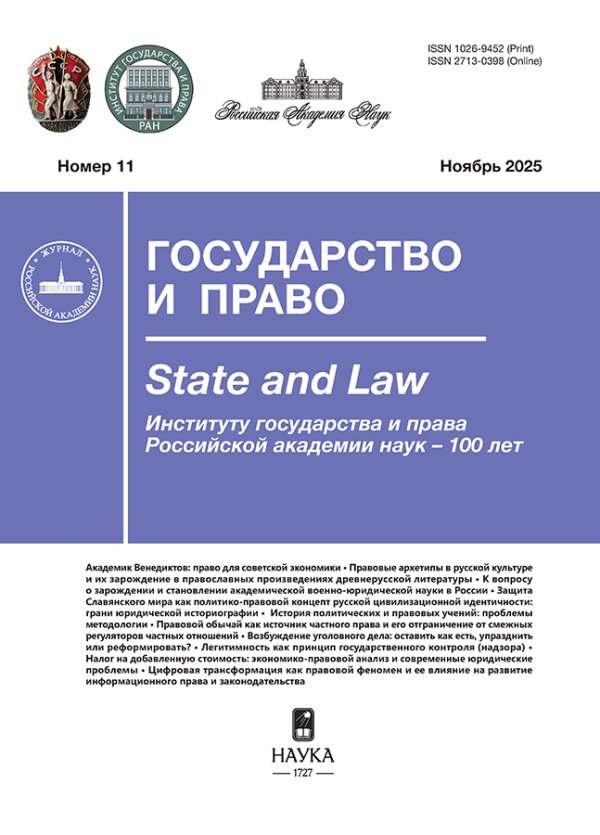

On the 100th anniversary of the Institute of State and Law of the Russian Academy of Sciences
ACADEMICIAN VENEDIKTOV: LAW FOR THE SOVIET ECONOMY
Abstract
The article is devoted to the life and creative path of the outstanding Soviet lawyer, Academician of the USSR Academy of Sciences, Doctor of legal sciences, Professor, long-term employee of the Institute of Law of the USSR Academy of Sciences (now the Institute of State and Law of the Russian Academy of Sciences) Anatoly Vasilyevich Venediktov (1887–1959), whose scientific ideas and concepts, in particular those concerning the right of ownership under socialism (state socialist property), the essence of a legal entity in Soviet law, organizational and legal aspects of economic activity of state enterprises, had a significant impact on the development of domestic legal thought and on the formation of Soviet civil and economic legislation. The ideas of A.V. Venediktov had a significant impact on the formation of scientific schools and trends in the USSR. They retain their significance today. The athours believe that this influence also concerns the formation of new institutions during the reform of legislation (which was clearly demonstrated during the discussion of issues of civil legislation reform in the 2010[6]). The life and work of A.V. Venediktov have been well studied, and, nevertheless, in the year of the 100[th] anniversary of the Institute of State and Law of the Russian Academy of Sciences, given the close connection of A.V. Venediktov with the Institute (it was during his work at the Institute of Law of the USSR Academy of Sciences that A.V. Venediktov was elected an Academician), within the framework of the scientific project of the Institute of State and Law of the Russian Academy of Sciences “Russian Academy of Sciences: Outstanding Legal Scholars. 20[th] century” the authors consider it important to outline the main milestones in the biography and scientific ideas of Anatoly Vasilyevich Venediktov. In preparing the article, unique materials stored in the archive of the Institute of State and Law of the Russian Academy of Sciences were used, including the personal file of A.V. Venediktov.
 7-30
7-30


LEGAL ARCHETYPES IN RUSSIAN CULTURE AND THEIR ORIGIN IN ORTHODOX WORKS OF ANCIENT RUSSIAN LITERATURE
Abstract
The article substantiates the fundamental role of the Orthodox faith in the formation of the main archetypes of the Russian national legal consciousness, acting as the basic principle of the national legal culture. The authors have studied key archetypes (symphonies of power, truth, law, and reconciliation) that retain their significance and their basic semantic image in modern society, but at a new level and in a new historical context. The nature of the most important values of the Russian national legal consciousness, which originated in the bosom of the Orthodox Ancient Russian culture, is established, the mechanisms of their reflection and origin within the semantic structures of political and legal thought are shown, and their origin and role in the formation of national legal and political culture are determined. Referring to foreign experience, the authors also give examples of the manifestation of archetypal images in various cultures. The conducted research proves the importance of appealing to the national tradition, spiritual and moral principles of the Russian national legal consciousness in order to preserve national unity and the civilizational identity of the Russian state.
31-43
ON THE QUESTION OF ORIGIN AND FORMATION ACADEMIC MILITARY LEGAL SCIENCE IN RUSSIA
Abstract
Today, there are many studies on individual areas of Military Law. However, the question of its origins in Russia, where it began, and the date of its birth remains open. The term "the science of Military Law" was first used in the legislative activities of Peter the Great. Military law education began with the establishment of the first military law school in Russia in 1832, the Auditor School. In 1867, the Military Law Academy was founded in Russia. The educational process included a special military law course among the general legal disciplines. Military law was taught in the importance of the amount of knowledge on the legal issues of the military activities of the state. In 1876, the Conference of the Military Law Academy set the task of conducting scientific research for the educational process. In 1878 The Military Law Academy acquired an independent legal status, it was from that moment on that the educational process was firmly based on a scientific basis. Education and science went further together. Military law science has become the foundation of military law education. However, the date of the birth of military law science is January 30, 1876, when the Conference of Military Law Science decided to make the academy "not only an educational institution, but also a scientific one". Based on historical documents, including those from the Russian State Military History Archive and the Russian Academy of Sciences, the article explores the origins of military law science for the first time, besides well as the stages of the development of academic Military Law science. This research fills a gap in the understanding of the emergence and development of the academic school of military legal law science.
44-74
Philosophy of law
THE PROTECTION OF THE SLAVIC WORLD AS A POLITICAL AND LEGAL CONCEPT OF RUSSIAN CIVILIZATIONAL IDENTITY: THE RETURN OF THE GEOPOLITICAL PRINCIPLE
Abstract
Through the prism of legal historiography, the issues of civilizational development of Russia are considered. The thesis is argued that the protection of the Slavic world is a political and legal concept of Russian civilizational identity. It is substantiated that the civilizational identity of any nation in its value is not accidentally equated with sovereignty and is the key to stable development, no solution to the current and future problems of the state and legal development of Russia without taking into account its civilizational identity is simply impossible. It is argued that the Russian civilizational identity includes, among other things, a nationwide inner feeling that all Slavs are friends for the Russian person not only by a single ethnic root, but also by the mood of the soul, the system of spiritual and moral values, that Slavic reciprocity is incompatible with the moral neutrality of society and power. The Slavic world occupies a particularly significant place in the Russian traditional legal consciousness.
75-83
Legal, political, philosophical and religious thought
THE HISTORY OF POLITICAL AND LEGAL DOCTRINES: PROBLEMS OF METHODOLOGY
Abstract
The science of the history of political and legal doctrines is an individualizing (idiographic) and generalizing (nomological) science. The main methodological problems of the history of political and legal doctrines include: availability of written primary sources, arrangement of material and assessment of the content of political and legal doctrines, style of presentation and uniform understanding of terms, methodological dissonance in the presentation of material, attempts to create politically neutral, "objective" theories of law and state, the desire to combine components of different doctrines, thereby creating one "only true" or "true" theory. It is concluded that most methodological problems of the history of political and legal doctrines are a reflection of the de-ideologization of the subject of this science and are in the sphere of doctrinal thinking.
84-92
Constitutional law of Russia
CIVIL SOCIETY IN THE PUBLIC SPHERE OF THE RUSSIAN FEDERATION
Abstract
The article describes the public authority formed in civil society. It is proposed to consider organizational institutions of civil society as bearers of public authority. Those can include not only public associations, non-profit organizations, but also public and governmental organizations, for example, the All-Russian Civil and State Organization the "Assembly of the Peoples of Russia", as well as public chambers, which are essentially joint public and governmental formations. Special attention is paid to public control, which is an important function of civil society and governmental authorities. The author proposes the idea to form a single body of civil society in the future, representing the main public associations, in particular the World Russian People's Council, as well as the highest church bodies of traditional religions. Public authority can be formed as a single system of governmental power and its subsystems. Constitutional scholars propose to adopt a new Constitution of the Russian Federation, which would strengthen the spiritual and moral potential of solidary civil society and the state.
93-107
Court, prosecutor’s office, bar, notarial system
THE WORK OF THE MILITARY INVESTIGATIVE BODIES OF THE INVESTIGATIVE COMMITTEE OF THE RUSSIAN FEDERATION IN THE CONDITIONS OF THE SPECIAL MILITARY OPERATION
Abstract
The article examines a wide range of issues related to the work of the military investigative bodies of the Investigative Committee of the Russian Federation in the context of a special military operation. Special attention is paid to recording the facts of crimes against the peace and security of mankind committed by the military-political leadership, command staff and ordinary employees of the Armed Forces of Ukraine, as well as the results of the investigation of these crimes. The analysis of work in this area is based on specific examples using statistical data. Suggestions have been made to improve work in this area.
108-112
INTERNATIONAL JURISDICTION AND APPLICABLE LAW IN CROSS-BORDER FAMILY DISPUTES: JUNCTA JUVANT?
Abstract
The differentiation between the applicable law and the competent court is a key feature of the isolated model of choice-of-law and jurisdiction principles. Due to the changing paradigm of social development and the improvement of conflict-of-laws approaches, as well as the transformation of jurisdictional regimes and their mutual influence, there is a need to revise this model. A new framework for coordinating choice-of-court and choice-of-law principles should take into account the interplay between conflict-of-laws and International Civil Procedure, as well as its manifestations in both conventional and national mechanisms for cross-border family relationships. This framework should ensure that the rules on applicable law are consistent with the forum's jurisdiction.
113-122
Discussions and debates
OBJECTIVITY AS A METHODOLOGICAL PRINCIPLE OF KNOWLEDGE OF THE STATE AND LAW AND LEGAL IDEALISM
Abstract
The article analyzes the methodological principle of objectivity. Its status in relation to the methodology of cognition of the state and law, other state legal phenomena is determined. It is emphasized that compliance with the requirements of this principle determines the truth of knowledge about them; accordingly, violation leads to false knowledge, legal utopianism. As an example of the latter, the rule of law enshrined in the Constitution of the Russian Federation is given.
123-134
Civil and entrepreneurial law
LEGAL CUSTOM AS A SOURCE OF PRIVATE LAW AND DISTINGUISHING IT FROM OTHER REGULATORS OF PRIVATE LEGAL RELATIONS
Abstract
The article highlights the concept, legal force and order of application of a legal custom in the private law sphere, relying on the theory, rules of international and Russian law and practice of their enforcement. The author's concept of a legal custom has been developed, which makes difference between it as a source (form of expression) of law and a customary rule of law, the content of which is determined based on the established generally accepted practice of conduct of subjects of private law in any field of activity. The qualifying features of customary rules have been identified, such as: a) normativity, which is subject to disclosure through additional characteristics of the established and widely used rules of conduct (sufficient certainty and unambiguity in the content, uniformity, stability, widespread awareness, regularity of use and universality of application); b) the lack of fixation in other sources of law (in particular, in normative legal acts and normative agreements); c) authorization (recognition) by the state throughout indicating the need to apply the custom in the current legislation, international treaty of the Russian Federation or normative act of an international organization to be applied in the Russian Federation. The correlation of a legal custom with business usages and practices, approximate contractual terms and other related regulators of private legal relations has been specified. It is proved that a legal custom can exist not only in the form of an unwritten rule, but also be fixed in any document, including one developed and published by a chamber of commerce or another authorized organization, for example, a self-regulatory one. The documents adopted in this way may serve as the confirmation of the existence of a custom. However, in any case, its existence, recognition and applicability to the legal relationship as a legal rule (opinio juris) are subject to proof in the law enforcement proceedings by the party that refers to its application.
135-144
SOCIAL ROLES OF INDIVIDUALS AND THEIR REFLECTION IN CIVIL LAW
Abstract
A characteristic feature of modern society is multitasking, whereby persons are forced to switch between family and domestic affairs and professional duties, combining public life with a desire for privacy. Digitalisation has made social roles that were previously only available to organisations accessible to citizens. The combination of social roles leads to role conflict, which also needs to be regulated by Civil Law, but without an understanding of the nature of role conflict, its civil law resolution will be incomplete.
145-154
Environmental law
THE LEGAL BASIS OF RUSSIAN GOVERNMENT PROJECTS AND PROGRAMS IN THE ENVIRONMENTAL FIELD
Abstract
Environmental well-being is one of Russia's national development goals. Until 2024, the "Ecology" national project operated, which in 2025 was continued under a name corresponding to the name of the national goal. The article examines the federal documents that serve as the basis for environmental measures in Russia, and how they are approved. The article presents an analysis of the relationship between the national project, the state program and the federal project, as well as the relationship between the concepts of national purpose, national interest and strategic national priorities. Environmental objectives from different strategic planning documents are compared to determine the completeness of coverage of planned and implemented environmental objectives. It has been revealed that currently the legal foundations of the state's environmental projects are undergoing a stage of development in the direction of increasing efficiency, expressed in transparency, concreteness, certainty in time, measurability, and achievability of the goals set.
155-169
Strengthening of legality and struggle with criminality
INITIATION OF CRIMINAL CASE: LEAVE AS IS, ABOLISH OR REFORM?
Abstract
The article is devoted to the consideration of problems that are well known, but have not been resolved. They are inherent in the initiation of a criminal case — the first stage of Russian criminal proceedings. It is said about serious contradictions of the stage of initiation of a criminal case, which have a negative impact on law enforcement practice, including causing the legal inadequacy of the results of verification activities carried out by police and preliminary investigation bodies. It is said that such activities are often carried out in bad faith. In addition, it is said that parts of the similar procedural actions in content cannot be carried out. At the same time, proposals are made about the reasons for the emergence of the stage of initiation of a criminal case — they are associated with the intentions of Soviet scientists-proceduralists to ensure the genuine legitimacy of the preliminary investigation in the context of the original system of pre-trial proceedings that had formed by that time, which implied the endowment of extra-judicial law enforcement agencies with jurisdictional legal capacity. As a result, a conclusion is formulated about the unacceptability of the liquidation of the stage of initiation of a criminal case without extra-systemic unity with other transformations of the Russian criminal process in general, and preliminary investigation in particular, without a clear and distinct understanding of the directions and prospects of the planned reforms.
170-176
SOME CONTROVERSIAL ISSUES OF THE OBJECTIVE SIDE AND THE SUBJECT OF COMPULSION TO GIVE EVIDENCE
Abstract
The article is devoted to certain controversial issues of the objective side and the subject of the corpus delicti provided for in Part 1 of Article 302 of the Criminal Code of the Russian Federation. The article also examines certain problematic issues related to the amendments introduced by Federal Law No. 307-FZ of July 14, 2022 "On Amendments to the Criminal Code of the Russian Federation" in Part 1 of Article 302 of the Criminal Code of the Russian Federation, as well as analyzes the provisions of Resolution No. 20 of the Plenum of the Supreme Court of the Russian Federation dated June 28, 2022 "On Certain Judicial Issues Practice in criminal cases of crimes against justice". Separately, the article focuses on the possible qualification of the actions of an investigator (inquirer, other law enforcement officer) who gave "tacit consent" to compulsion to give evidence or coercion of an expert to make a report.
177-185
Administrative law and process
LEGITIMACY AS A PRINCIPLE OF STATE CONTROL (SUPERVISION)
Abstract
The article attempts to substantiate the concept of legitimacy as a principle of state control (supervision). Based on the analysis of existing scientific approaches to understanding legitimacy, it is proposed to consider legitimacy as one of the principles of state control (supervision), as well as its legal regulation. A conclusion is made about the possibility of attributing this principle both to individual components of the state control (supervision) system, to related institutions, and to the entire system as a whole. A close connection and mutual dependence of the principle of legitimacy with the principles of legality, validity, and other principles of state control (supervision) is proven.
186-193
Budget, taxes, banks
VALUE-ADDED TAX: ECONOMIC AND LEGAL ANALYSIS AND CURRENT LEGAL ISSUES
Abstract
In article, the VAT from positions of the economical and legal analysis is investigated. It is emphasized that the legal analysis of the VAT shall rely always on the accounting of the economic nature of the tax in unity with duality of its legal form. Besides it is very important to understand that the VAT has two economic objects and one legal. The attention is paid to interpretation of article 154 and item 1 of Art. 168 of the Tax Code of the Russian Federation. The opinion of the author on topical issues of modern jurisprudence is proved: about the possibility of increase or reduction of the price of already signed agreement in connection with change of tax laws, and also about the possibility of the exception of the VAT amount of already signed civil agreement in case of release of the taxpayer seller from discharge of duty on payment of the tax.
194-203
Information law and information security
DIGITAL TRANSFORMATION AS A LEGAL PHENOMENON AND ITS IMPACT ON THE DEVELOPMENT OF INFORMATION LAW AND LEGISLATION
Abstract
The article analyzes modern trends and directions of the ongoing digital transformation, as well as the development of the doctrine of Information Law and information legislation in the context of new national goals and the national project "Data Economy and Digital Transformation of the State". The authors examine the categories of "digitalization" and "digital transformation". It is noted that digitalization should imply the possibility of implementing certain functions without human participation, but for a number of processes such an opportunity should always be maintained at least in the alternative possibility mode. Digital transformation involves a change in target settings and indicators, value systems, features of management technologies, channels and forms of communication. Unlike digitalization, digital transformation is a more complex phenomenon and covers a wider range of changes associated with the use of digital technologies, since it is focused on a comprehensive, strategic transformation of processes in order to adapt to changing conditions and use digital capabilities to create new values and achieve a competitive advantage. Digitalization in this regard should be considered as one of the most important processes of digital transformation associated with the active implementation and use of information, including digital, technologies. The authors conclude that within the framework of digital transformation as a legal phenomenon in modern conditions, there is a clear identification of the direction of digitalization associated with the implementation, improvement of the use of information technologies, ensuring effective information interaction, as well as new directions for ensuring technological independence and industrial sovereignty (ensuring scientific, technical, and industrial development to create and maintain information technologies and infrastructure in the territory of the Russian Federation sufficient to guarantee independence from foreign technologies in the field of information technology), as well as ensuring security, including cybersecurity. Such a comprehensive perception is objectively necessary, since the digital transformation of state and municipal administration, the economy and the social sphere is one of the national development goals of the Russian Federation for the period up to 2030 and for the future up to 2036. It is proposed to understand digital transformation as a comprehensive transformation of a particular subject, process, phenomenon or other phenomenon aimed at its improvement and achievement of strategic development goals and meeting the criterion of economic efficiency based on the implementation of a system of initiatives for the introduction of the latest priority domestic digital technologies, the use of data, the development of personnel, competencies and culture for digital transformation, modern approaches to managing the implementation of digital solutions and ensuring information security. The main characteristics of digital transformation are identified and highlighted. The features of the influence of digital transformation on the development of Information Law and information legislation are analyzed. It also examines how digital transformation influences the doctrine of Information Law. In this regard, a brief analysis of the discussed issues of information law and its development under the influence of digital transformation at the Eighth Bachilov Readings, held in 2025 at the Institute of State and Law of the Russian Academy of Sciences, is given.
204-219
Pages of history
ON THE CONCEPT OF A "JUST" TREATY IN BYZANTINE AND MEDIEVAL EUROPEAN LAW
Abstract
The article analyzes the manifestations of the principle of equity in the regulation of contractual relations in the form of "equal scope", "proportionality" of the rights of parties to contractual relations, prevention of abuse by one of the parties and protection of the "weak" side in specific types of contracts under the influence of the ancient legal heritage and the ideas of Christianity in the sources of law of Byzantium, including the Eclogue 726 (741), as well as in the works of T. Aquinas and other theologians and canonists of the Catholic Church in the era of the advanced Middle Ages.
220-228
Criticism and bibliography
MULTIDISCIPLINARY PERSPECTIVES ON ARTIFICIAL INTELLIGENCE AND THE LAW / ed. by H.S. Antunes et al. Springer Publishing, 2024. – 456 pp.
Abstract
The review provides an overview analysis of the monograph prepared by a team of scientists who have worked for several years studying the mutual influence of artificial intelligence technologies and the matter of law. The authors of the monograph examined a wide range of issues within the area under study, identified the main problem areas, and proposed solutions to problems taking into account the possibilities of an interdisciplinary approach. The monograph includes three sections, each of which is devoted to a specific block of issues. The first section concerns the most general issues, including those that are only indirectly related to law. The second section identifies the main ethical and legal problems associated with the use of artificial intelligence. The third section includes the results of research directly related to the formation of legal regulation in the area under study. Familiarization with the results of the authors' work is of interest to legal scholars interested in the problems of legal regulation in the field of artificial intelligence.
229-234
Articles
Pravila dlya avtorov. Poryadok napravleniya, retsenzirovaniya i opublikovaniya statey v zhurnale «Gosudarstvo i pravo»
235-236