



Seropositivity of West Nile virus among acute febrile patients in Ilorin, Nigeria
- Authors: Odebisi-Omokanye M.B.1, Suleiman M.M.2, Sulaiman M.K.1, Atolagbe S.A.1
-
Affiliations:
- University of Ilorin
- Summit University Offa
- Issue: Vol 69, No 4 (2024)
- Pages: 320-328
- Section: ORIGINAL RESEARCHES
- URL: https://journals.rcsi.science/0507-4088/article/view/265955
- DOI: https://doi.org/10.36233/0507-4088-241
- EDN: https://elibrary.ru/pvhwlc
- ID: 265955
Cite item
Full Text

Abstract
Introduction. West Nile Virus (WNV), a member of Flaviviridae family, is one of the most widely distributed arboviruses in the world. In developing countries like Nigeria, fever resulting from the WNV infection is often presumptively ascribed to malaria or typhoid due to misdiagnosis and low-level awareness of the viral infection. This study determined the prevalence of WNV IgM and IgG antibodies among febrile patients in the Ilorin metropolis.
Materials and methods. A total of two hundred (200) blood samples were collected from consenting patients and each serum was screened for anti-WNV IgM and IgG antibodies using indirect enzyme-linked immunosorbent assay (ELISA). Statistical correlation and logistic regression analysis were conducted.
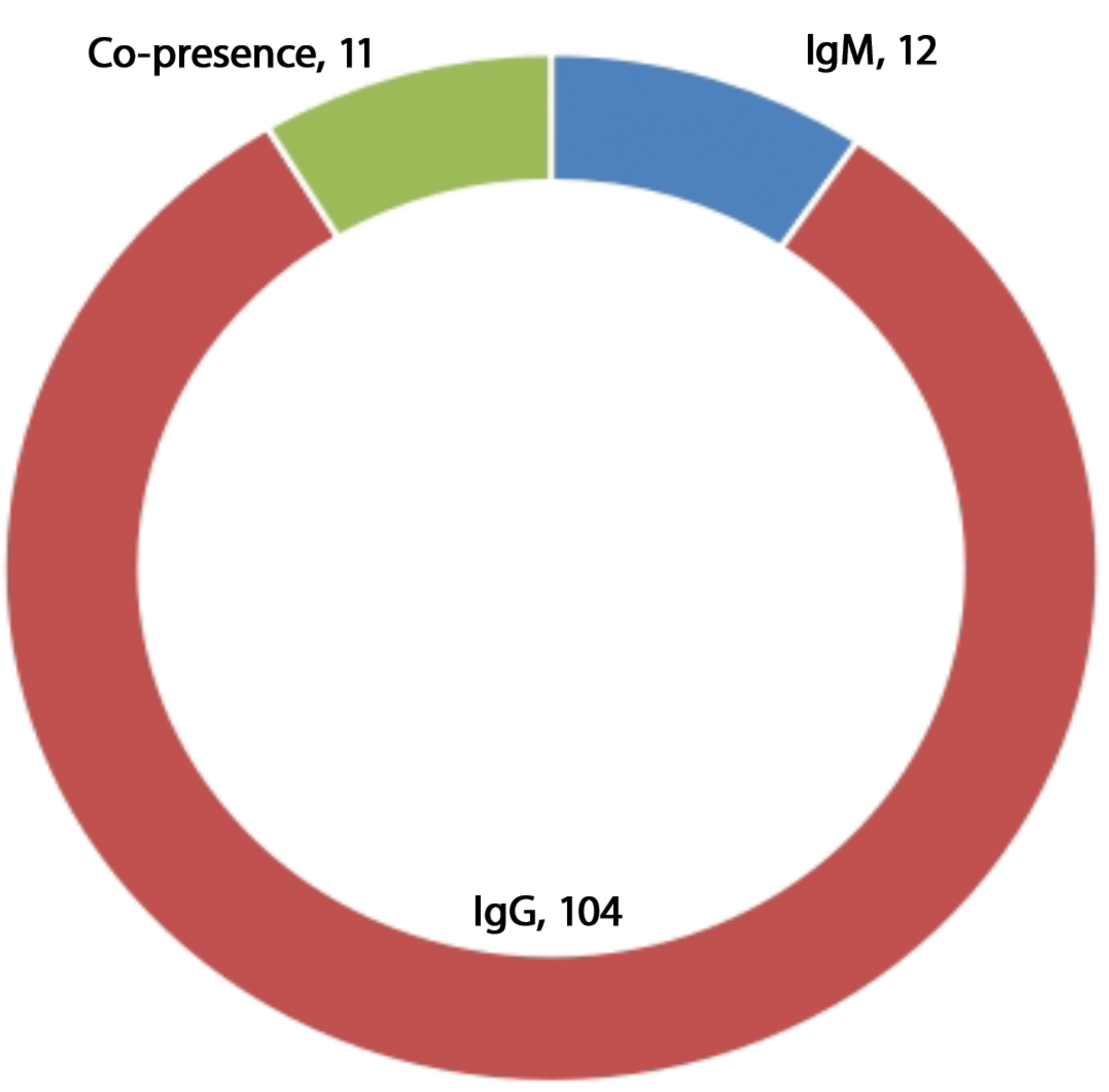
Results. Overall, 6% (12/200) anti-WNV IgM seropositivity rate was recorded amongst the acute febrile patients with higher prevalence (6.30%) in females than in males (5.45%). Anti-WNV IgG positivity rate of 52% (104/200) was recorded, with 50.67% positivity rate in males and 38.95% in female participants. The convalescence phase posited by the 5.4% (11/200) co-detection of anti-WNV IgG and IgM antibodies among the participants was recorded. A statistical correlation was noticed with the age and religion of respondents to WNV serological positivity while gender, occupation, use of mosquito nets and formal education had no positive correlation at p < 0.05. However, based on odd ratio at 95% CI and logistic regression coefficients, the evaluated risk factors such as blood transfusion, residency, malaria parasite, and proximity to stagnant water and bush were significant to anti-WNV IgG and IgM positivity.
Conclusion. The findings of this study show the circulation of WNV in the study area. There is an urgent need for clinicians/physicians to include screening for the West Nile virus in cases of febrile patients before the commencement of treatment.
Keywords
Full Text
##article.viewOnOriginalSite##About the authors
Mutiat Busayo Odebisi-Omokanye
University of Ilorin
Author for correspondence.
Email: odebisi.mb@unilorin.edu.ng
ORCID iD: 0000-0001-9825-3193
PhD in Medical Microbiology, Senior Lecturer, Department of Microbiology
Nigeria, P.M.B 1515, IlorinMuhammed Mustapha Suleiman
Summit University Offa
Email: Suleiman.muhammed@summituniversity.edu.ng
ORCID iD: 0000-0003-3275-1709
PhD in Medical Microbiology, Lecturer, Department of Microbiology
Nigeria, P.M.B. 4412, OffaMariam Kehinde Sulaiman
University of Ilorin
Email: Sulaiman.km@unilorin.edu.ng
ORCID iD: 0000-0002-8295-7855
PhD Microbial and Cellular Sciences, Senior Lecturer, Department of Medical Microbiology and Parasitology, Old College of Health Sciences
Nigeria, P.M.B 1515, IlorinSidiq Abubakar Atolagbe
University of Ilorin
Email: ayinlatorla@gmail.com
ORCID iD: 0009-0007-2330-0232
Postgraduate Student, Department of Microbiology
Nigeria, P.M.B 1515, IlorinReferences
- Petersen L.R., Brault A.C., Nasci R.S. West Nile virus: review of the literature. JAMA. 2013; 310(3): 308–15. https://doi.org/10.1001/jama.2013.8042
- Huhtamo E., Cook S., Moureau G., Uzcátegui N.Y., Sironen T., Kuivanen S., et al. Novel flaviviruses from mosquitoes: mosquito-specific evolutionary lineages within the phylogenetic group of mosquito-borne flaviviruses. Virology. 2014; 464-465: 320–9. https://doi.org/10.1016/j.virol.2014.07.015
- Chancey C., Grinev A., Volkova E., Rios M. The global ecology and epidemiology of West Nile virus. Biomed. Res. Int. 2015; 2015: 376230. https://doi.org/10.1155/2015/376230
- Hayes E.B., Komar N., Nasci R.S., Montgomery S.P., O’Leary D.R., Campbell G.L. Epidemiology and transmission dynamics of West Nile virus disease. Emerg. Infect. Dis. 2005; 11(8): 1167–73. https://doi.org/10.3201/eid1108.050289a
- Calistri P., Giovannini A., Hubalek Z., Ionescu A., Monaco F., Savini G., et al. Epidemiology of West Nile in Europe and in the Mediterranean Basin. Open Virol. J. 2010; 4: 29–37. https://doi.org/10.2174/1874357901004020029
- Mencattelli G., Ndione M.H.D., Rosà R., Marini G., Diagne C.T., Diagne M.M., et al. Epidemiology of West Nile virus in Africa: An underestimated threat. PLoS Negl. Trop. Dis. 2022; 16(1): e0010075. https://doi.org/10.1371/journal.pntd.0010075
- Sampathkumar P. West Nile virus: epidemiology, clinical presentation, diagnosis, and prevention. Mayo. Clin. Proc. 2003; 78(9): 1137–43; quiz 1144. https://doi.org/10.4065/78.9.1137
- CDC. Blood Transfusion and Organ Donation (West Nile Virus); 2024. Available at: https://www.cdc.gov/west-nile-virus/causes/blood-transfusions.html#:~:text=Can%20I%20donate%20blood%20if,should%20tell%20your%20blood%20center
- Powell J.R. Modifying mosquitoes to suppress disease transmission: Is the long wait over? Genetics. 2022; 221(3): iyac072. https://doi.org/10.1093/genetics/iyac072
- Dahmana H., Mediannikov O. Mosquito-borne diseases emergence/resurgence and how to effectively control it biologically. Pathogens. 2020; 9(4): 310. https://doi.org/10.3390/pathogens9040310
- Pealer L.N., Marfin A.A., Petersen L.R., Lanciotti R.S., Page P.L., Stramer S.L., et al. Transmission of West Nile virus through blood transfusion in the United States in 2002. N. Engl. J. Med. 2003; 349(13): 1236–45. https://doi.org/10.1056/NEJMoa030969
- Santini M., Haberle S., Židovec-Lepej S., Savić V., Kusulja M., Papić N., et al. Severe West Nile virus neuroinvasive disease: clinical characteristics, short- and long-term outcomes. Pathogens. 2022; 11(1): 52. https://doi.org/10.3390/pathogens11010052
- Hernandez Acosta R.A., Esquer Garrigos Z., Marcelin J.R., Vijayvargiya P. COVID-19 pathogenesis and clinical manifestations. Infect. Dis. Clin. North Am. 2022; 36(2): 231–49. https://doi.org/10.1016/j.idc.2022.01.003
- Monath T.P., Arroyo J., Miller C., Guirakhoo F. West Nile virus vaccine. Curr. Drug Targets Infect. Disord. 2001; 1(1): 37–50. https://doi.org/10.2174/1568005013343254
- CDC. West Nile virus. Clinical evaluation and disease; 2024. Available at: https://www.cdc.gov/west-nile-virus/hcp/clinical-signs/?CDC_AAref_Val=https://www.cdc.gov/westnile/healthcareproviders/healthCareProviders-ClinLabEval.html
- Ma’aji J.A., Olonitola O.S., Ella E.E. Seroprevalence of West Nile virus (WNV) infection among febrile patients attending selected hospitals in Kaduna state, Nigeria. Sci. Afr. 2020; 10: e00588. https://doi.org/10.1016/j.sciaf.2020.e00588
- Abdullahi I.N., Emeribe A.U., Ghamba P.E., Omosigho P.O., Bello Z.M., Oderinde B.S., et al. Distribution pattern and prevalence of West Nile virus infection in Nigeria from 1950 to 2020: a systematic review. Epidemiol. Health. 2020; 42: e2020071. https://doi.org/10.4178/epih.e2020071
- Abdullahi I.N., Emeribe A.U., Ghamba P.E., Omosigho P.O., Bello Z.M., Oderinde B.S., et al. Distribution pattern and prevalence of West Nile virus infection in Nigeria from 1950 to 2020: a systematic review. Epidemiol. Health. 2020; 42: e2020071. https://doi.org/10.4178/epih.e2020071
- Carson P.J., Borchardt S.M., Custer B., Prince H.E., Dunn-Williams J., Winkelman V., et al. Neuroinvasive disease and West Nile virus infection, North Dakota, USA, 1999–2008. Emerg. Infect. Dis. 2012; 18(4): 684–6. https://doi.org/10.3201/eid1804.111313
- Omilabu S.A., Olaleye O.D., Aina Y., Fagbami A.H. West Nile complement fixing antibodies in Nigerian domestic animals and humans. J. Hyg. Epidemiol. Microbiol. Immunol. 1990; 34(4): 357–63.
- Udeze A.O., Shittu H.K., Ashaka O.S., Jakkari A., Oyefolu A.O. Anti-West Nile virus immunoglobulin G and M profiles of patients with Pyrexia of unknown origin In Ilorin, Nigeria. Biokemistri. 2022; 34(3): 34432–40.
- Murgue B., Murri S., Triki H., Deubel V., Zeller H.G. West Nile in the Mediterranean basin: 1950–2000. Ann. N.Y. Acad. Sci. 2001; 951: 117–26. https://doi.org/10.1111/j.1749-6632.2001.tb02690.x
- Mease L.E., Coldren R.L., Musila L.A., Prosser T., Ogolla F., Ofula V.O., et al. Seroprevalence and distribution of arboviral infections among rural Kenyan adults: a cross-sectional study. Virol. J. 2011; 8: 371. https://doi.org/10.1186/1743-422x-8-371
Supplementary files


