

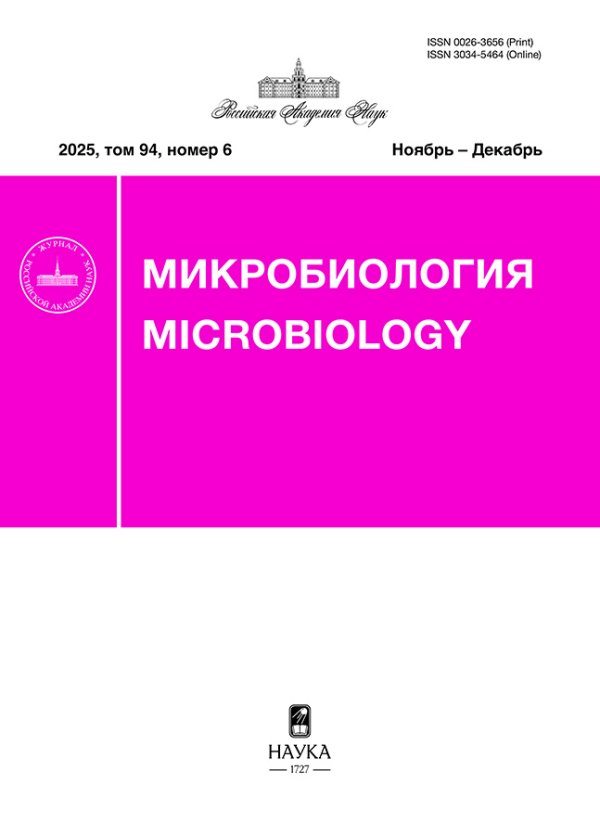
Microbiology


ISSN (print)
:0026-3656 

Media registration certificate: No. 0110237 dated 02/09/1993

Founders

  • Russian Academy of Sciences
  • Institute of Microbiology of the Russian Academy of Sciences

Editor-in-Chief

  • Nikolay Viktorovich Pimenov, Doctor of Biological Sciences

Frequency / Access

6 issues per year / Subscription

Included in

White List (2nd level), Higher Attestation Commission List, RISC


Current Issue

Open Access Open Access  Restricted Access Access granted  Restricted Access Subscription Access

Vol 94, No 6 (2025)

Cover Page

Full Issue

Open Access Open Access
Restricted Access Access granted
Restricted Access Subscription Access

EXPERIMENTAL ARTICLES

The Structure of the Anoxygenic Phototrophic Bacterial Community and Features of Green Sulfur Bacteria in the Meromictic Lake Bol’shiye Khruslomeny (Oleniy Island, Kandalaksha Bay of the White Sea, Murmansk Region, Russia)
Lunina O.N., Patsaeva S.V., Kadnikov V.V., Krasnova E.D., Voronov D.A., Kokryatskaya N.M., Savvichev A.S.
Abstract
In March 2019, hydrochemical and microbiological studies of the meromictic Lake Bol’shiye Khruslomeny, artificially separated from the main marine basin of the White Sea, were carried out. It was shown that the hydrochemical parameters of the lake water in March 2019 and in March 2017 were almost the same, which confirms the meromictic status of the reservoir. In the work, a method for separating bacteriochlorophylls of green sulfur bacteria (GSB) from the absorption spectra of lake water, previously developed on GSB monocultures, was used for the first time. According to the calculation, the proportion of BChl e of brown-colored GSB at the peak of community development reached a third of the total BChl (d + e) content. It was shown that even a small content of brown-colored sulfur bacteria that stably survive in lake water can significantly mask the green pigment of green-colored sulfur bacteria. In the chemocline zone community, Chlorobium phaeovibrioides dominated among anoxygenic phototrophic bacteria (APB) (97.9–99.8% of the total APB community). Thiocapsa rosea, Thiocystis gelatinosa, and Thiohalocapsa halophila were also found. Microscopic examination of brown-stained isolates of Chlorobium phaeovibrioides showed a high diversity of cell morphotypes and cell aggregates (curled filaments, twisted spirals, short chains), characteristic of bacteria of the species Chlorobium phaeovibrioides (DSM 265) (formerly Chlorobium vibriforme sbsp. thiosulfatophilum DSM 265).
Microbiology. 2025;94(6):497–510
pages 497–510 views
Phototrophic Communities of Algo-Bacterial Mats of the Unique Relict Salt Pool Manych-Gudilo
Gorlenko V.M., Savvichev A.S., Belenkova V.V., Kadnikov V.V., Lunina O.N., Kostrikina N.A., Kolganova T.V., Sukhacheva M.V., Letarova M.A., Letarov A.V.
Abstract
Lake Manych-Gudilo is a relict lake formed 2–3 million years ago at the site of the ancient strait connecting the Black and Caspian seas. During the dry season, total water salinity exceeds 50 g/L, with the levels of sulfate and magnesium in the brine higher than in the ocean water. The coastline has numerous bays and separating shallow basins. The article reports the results of investigation of microbial biodiversity in the algo-bacterial mat in a shallow basin with salinity varying from 40 to 70 g/L, which is associated with Lake Manych-Gudilo. The studied mat had the properties of a sulfuret, a community with an intense sulfur turnover. Microalgae of the genus Cladophora and filamentous cyanobacteria were the main producers of organic matter in the benthic community. Among the anoxygenic phototrophic bacteria isolated in pure cultures, halophilic purple sulfur bacteria Ectothiorhodospira marina and Lamprobacter modestohalophilus and green sulfur bacteria Prosthecochloris sp. predominated. Nonsulfur purple bacteria Rhodovulum adriatica, also present in the community, were able to use sulfide for photosynthesis. All identified species were typical of microbial mats of saline and hypersaline basins with elevated levels of sulfate and bivalent cations. The algo-bacterial mat was reconstructed in the laboratory at 80 g/L salinity using a Winogradsky column. Microbial diversity of the experimental mat was studied by sequencing the 16S rRNA gene fragments. The data obtained improved our understanding of bacterial species diversity in microbial mats adapted to extreme hypersaline conditions.
Microbiology. 2025;94(6):511–526
pages 511–526 views
Methanoculleus bovis sp. nov., a New Methane-Producing Hydrogen-Utilizing Archaea from the Rumen of a Cow
Trubitsyn V.E., Rechkina V.I., Suzina N.E., Plotnikov A.O., Valyshev A.V., Kataev V.Y., Shcherbakova V.A.
Abstract

A new methanogen, strain 7TT, was isolated from the rumen of a cow (Moscow region, Russia). Morphologically, the strain is composed of non-motile coccoid cells of irregular shape, 1.3–4.3 μm in size, and small aggregates thereof. The strain uses exclusively a mixture of hydrogen and carbon dioxide as energy substrates for methanogenesis and requires the presence of acetate in the culture medium. The cells grow at a temperature of 20–53°C (optimum 45°C), pH 6.5–7.8 (optimum pH 7.2–7.4), and are tolerant to NaCl levels up to 0.34 M. According to the 16S rRNA gene sequence analysis, the new methanogen belongs to the genus Methanoculleus, sharing a gene similarity level of 98.16% with the closest species of this genus, M. bourgensis MS2T. The average nucleotide similarity (ANI) between the genomes of strains 7TT and M. bourgensis MS2T was 88.24%, and the virtual estimate of hybridization of the genomes of these two strains was 31.40%. The G + C content of genomic DNA is 61.27% mol. %. Based on the phylogenetic analysis and physiological and biochemical properties of the isolate, we propose to classify the isolated strain 7TT (= VKM B-3409T = JCM 39547T) as a new species Methanoculleus bovis sp. nov.

Microbiology. 2025;94(6):527–539
pages 527–539 views
Hydrocarbon-Oxidizing Actinomycetes from Lake Sapropel
Babich T.L., Sokolova D.S., Zotova A.N., Gracheva T.A.
Abstract
A high number of culturable bacteria of the genus Streptomyces (7.84 ± 0.9) × 107 CFU/g was revealed in the actinomycete community of lake sapropel of OOO TPK Kamskiy Sapropel (Naberezhnye Chelny, Republic of Tatarstan, Russian Federation). A total of 14 strains of streptomycetes were isolated in pure culture, growing in a wide range of temperatures and sodium chloride content, possessing hydrolytic, antibiotic and urease activity, capable of biofilm growth, changing the rheological characteristics of the culture fluid when growing on crude oil (Δσ interfacial tension up to 23 mN/m). The ability of streptomycetes to degrade oil n-alkanes with a chain length of C11−C30 was revealed; the addition of starch to the medium activated this process. This makes streptomycetes promising agents both for use in biotechnologies for enhancing oil recovery and in the creation of biopreparations for cleaning soils from oil and oil products.
Microbiology. 2025;94(6):540–548
pages 540–548 views
Features of Betaine Reduction by Haloalkaliphilic Bacteria Alkaliphilus peptidifermentans during Growth on Amino Acids and Ethanolamine
Boltyanskaya Y.V., Detkova E.N., Oshkin I.Y., Parshina S.N., Pimenov N.V., Kevbrin V.V.
Abstract
The ability of the haloalkaliphilic anaerobic bacterium Alkaliphilus peptidifermentans Z-7036T to utilize betaine in oxidation-reduction reactions as an electron acceptor was studied. During growth on serine/threonine, a previously unknown molar stoichiometric ratio with betaine of 1 : 2 was revealed. To explain this phenomenon, a pathway for the degradation of these amino acids was proposed and the sites of conjugation with the betaine reductase complex were determined. The activities of key enzymes of threonine and serine metabolism were measured. The Stickland reaction with betaine for proline and ornithine was demonstrated for the first time and a rationale for its implementation was proposed. Biochemical mechanisms were revealed that make it possible to reduce betaine during growth on ethanolamine. Based on the genome annotation, schemes of metabolic pathways for the degradation of threonine, serine, proline, glutamate, arginine, ornithine and ethanolamine were constructed. For all used substrates, the exchange products were determined and stoichiometric ratios with betaine and products were obtained.
Microbiology. 2025;94(6):549–564
pages 549–564 views
Serine Variant of the Reductive Glycine Pathway of CO2 Fixation in the Anaerobic Thermophile Parvivirga hydrogeniphila
Chernykh N.A., Rusanov I.I., Pikhtereva V.A.
Abstract
Parvivirga hydrogeniphila Es71-Z01O1 is a thermophilic bacterium capable of anaerobically growing in the range of 25–70°C (optimum 47–60°C) and pH 6.0–8.5 (optimum 6.8–7.2) and using molecular hydrogen or formate as electron donors and Fe(III) as an acceptor. Genomic analysis revealed the presence of genes for the serine branch of the reductive glycine pathway in the absence of glycine reductase genes. Proteomic studies demonstrated increased expression of other key enzymes of this pathway: formate dehydrogenase, methyltetrahydrofolate cyclohydrolase, glycine cleavage system, and serine hydroxymethyltransferase. The rate of autotrophic carbon fixation was 0.357 fmol C/cell day, which is comparable with the rates of known autotrophic microorganisms. The obtained results indicate the functioning of autotrophic CO2 assimilation in P. hydrogeniphila, with the serine variant of the reductive glycine pathway being the most probable. The results of the study contribute to the understanding of the metabolic diversity of anaerobic microorganisms and expand knowledge about the distribution of different carbon fixation mechanisms in microorganisms belonging to new phylogenetic groups.
Microbiology. 2025;94(6):565–572
pages 565–572 views
Pleiotropic Effects of Knockout Mutations in the TPS1 and TPS2 Genes Encoding Trehalose Biosynthesis Enzymes of Saccharomyces cerevisiae
Kulakovskaya E.V., Torgov V.I., Nifantiev N.E., Rekstina V.V., Kalebina T.S.
Abstract
The TPS1 and TPS2 genes encoding trehalose-6-phosphate synthase and trehalose-6-phosphate phosphatase play an important role in protecting yeast and fungal cells from temperature stress, dehydration and oxidants, since resistance to these stresses requires accumulation of trehalose. In this work, it was shown that Saccharomyces cerevisiae strains with knockout mutations in the TPS1 and TPS2 genes have greater resistance to heavy metal ions and alkaline stress compared to the parental strain. These mutations do not lead to significant changes in the polyphosphate content in the cells, indicating the absence of a direct relationship between phosphorus homeostasis and the ability to accumulate trehalose. In the cells of Δtps2 the change in localization of cell wall protein Bgl2p was observed: this protein appeared to be intracellular. It is assumed that the resistance of knockout strains to heavy metal ions and alkali is associated with additional pleiotropic effects of these mutations.
Microbiology. 2025;94(6):573–581
pages 573–581 views
The Role of Osmolytes and Membrane Lipids in Cold Adaptation in the Psychrophilic Ascomycete Leuconeurospora pulcherrima
Danilova O.A., Saharova S.A., Ianutsevich E.A., Kochkina G.A., Tereshina V.M.
Abstract
According to the growth rate at different temperatures the ascomycete Leuconeurospora pulcherrima is a psychrophile, as it grows in a temperature range from ‒2 to 22.5°C, with optimum growth observed at 15°C. To study the mechanisms of adaptation to cold, the fungus was grown in a submerged culture at optimal (15°C) and reduced (5°C) temperatures. The amount of osmolytes at 15°C reaches 10%, and in cold conditions it is twice as low. Trehalose (60% of the total) and polyol mannitol (30%) dominate in the fungal osmolytes at the optimal temperature, and their ratio does not change during growth. At 5°C, their ratio also does not change during growth, but the proportion of mannitol increases slightly (35%) and the proportion of trehalose decreases (55%). The membrane lipid profile at both temperatures is dominated by phosphatidylethanolamines, phosphatidic acids and phosphatidylcholines. At 15°C, the proportions of the main phospholipids do not change during growth, only the proportion of sterols doubles. On the contrary, at 5°C during growth, a significant increase in the proportion of phosphatidylethanolamines and phosphatidylcholines is observed against the background of a decrease in the proportion of phosphatidic acids, while the proportion of sterols remains constantly low. Under optimal conditions, linoleic acid dominates in the composition of fatty acids of phospholipids (60% of the total), and at 5°C – linoleic and linolenic, which leads to a significant increase in the degree of unsaturation. Thus, to adapt to cold, the fungus regulates membrane fluidity by significantly increasing the relative content of linolenic acid in phospholipids, decreasing the sterol/phospholipid ratio, dominating non-bilayer lipids in membranes, and increasing the mannitol/trehalose ratio.
Microbiology. 2025;94(6):582–593
pages 582–593 views
Molecular Analysis of Phylogenetic Diversity of Halophilic Methylotrophic Bacterial Communities
Shustova M.N., Kocharovskaya Y.N., Delegan Y.A., Kaparullina E.N., Doronina N.V.
Abstract
The composition of four stable halophilic methylotrophic bacterial communities (3Sol, GBL, SBL, 8sh_L) formed in laboratory conditions as a result of long-term periodic cultivation on a mineral medium with methanol of water samples from salt lakes Dunino (Orenburg oblast), Bolshoe Medvezhye, and Maloe Medvezhye (Kurgan oblast), as well as the Indian Ocean, was studied by the 16S rRNA gene metabarcoding method. Bioinformatics analysis was used to obtain 35892 reads, which were grouped into 105 amplified sequence variants (ASVs). It was shown that representatives of the family Methylophagaceae, methylotrophs of the genus Methylophaga prevailed in all four halophilic methylotrophic communities, and representatives of the family Halomonadaceae, bacteria of the genera Vreelandella and Halomonas prevailed among the associated halophilic heterotrophic microorganisms. Methylotrophic strains of the studied communities were represented by uncultured bacteria, probably metabolically associated with heterotrophs. The strain Vreelandella titanicae was isolated from the 3Sol methylotrophic community and studied in an artificial association with the methylotroph Methylophaga marina VKM B-2056T.
Microbiology. 2025;94(6):594–604
pages 594–604 views
Analysis of Biofilms Formed by Bacteria of the Genus Azospirillum in Soil
Shirokov A.A., Mokeev D.I., Volokhina I.V., Yevstigneeva S.S., Borisov I.V., Filip’echeva Y.A., Matora L.Y., Muratova A.Y., Petrova L.P., Shelud’ko A.V.
Abstract
Strains A. baldaniorum Sp245 and A. brasilense Sp7 formed mono- and multilayer biofilms on the surface of wheat roots both under sterile hydroponic conditions and in non-sterile soil. Derivatives of these strains carrying a plasmid with the gene of the fluorescent protein GFP were used to visualize bacterial biofilms in situ. Azospirillum biofilms/their matrix components bound to soil particles, forming aggregates in the soil, which affected not only its structure, but also the adhesion of the soil to plant roots. Under short-term drought conditions, bacteria in biofilms formed on the surface of the root epidermis and root hairs produced GFP in the root system of plants inoculated with Azospirillum. Sowings from the roots of these plants showed that GFP+ colonies are Azospirillum. Inoculation with strains Sp7 and Sp245 positively affected the relative water content in the leaves of plants exposed to conditions simulating short-term drought in the soil.
Microbiology. 2025;94(6):605–623
pages 605–623 views
Digestive Enzyme Activity and Gut Microbiota Community in African Catfish Clarias gariepinus
Skvortsova E.G., Golovanova I.L., Filippov A.A., Kulivatskaya E.A., Filinskaya O.V., Bogdanova A.A.
Abstract
To improve the growth efficiency and biomass accumulation rate of fish grown in aquaculture, it is necessary to have information on the activity of digestive enzymes and the composition of the intestinal microbiota involved in the digestion of the main components of the feed. In our work, we studied for the first time the activity of glycosidases and proteinases in the intestinal mucosa and chyme, as well as the composition of the intestinal microbiome of two size groups of African catfish Clarias gariepinus grown in tanks with a closed water supply system. Total amylolytic and total proteolytic activities were significantly higher in small fish compared to large ones, the activity of disaccharidases (sucrase and maltase) in the intestinal mucosa did not depend on the fish size. In both size-age groups of African catfish, five bacterial phyla dominated: Pseudomonadota, Bacillota, Actinomycetota, Fusobacteriota and Bacteroidota. In the group of small fish, Pseudomonadota accounted for almost half of the number of intestinal bacteria; in large catfish, the distribution of these bacterial phyla was more uniform. For the first time, a relationship was found between the activity of digestive enzymes and the relative abundance of bacteria of different taxa. The highest positive correlation in the chyme of small catfish was found for the total proteolytic activity with bacteria of the order Lactobacillales of the class Bacilli; in large catfish, with bacteria of the orders Actinomycetales and Bacillales, and the total amylolytic activity with bacteria of the order Fusobacteriales and Clostridiales (Eubacteriales). The data obtained can be used to adjust the composition of the microbiome and digestive enzymes in order to obtain greater biomass of catfish in aquaculture.
Microbiology. 2025;94(6):624–636
pages 624–636 views
Physiological, Biochemical and Toxigenic Properties of Stachybotrys chartarum Growing on Technogenic Substrates
Dorshakova E.V., Dalinova A.A., Titova Y.A., Sokornova S.V., Dubovik V.R., Kochura D.M., Bogomolova T.S., Chilina G.A., Pavlova I.E., Vasilyeva N.V., Rudneva M.V., Berestetskiy A.O.
Abstract
The potential danger of toxin-forming fungus S. chartarum in the walls of buildings in St. Petersburg was assessed, its chemotype-specific signs, and toxicity of conidia and culture fluids were studied. We studied the composition of proteins, the relative quantitative content of trichothecene mycotoxins, as well as the qualitative composition of triprenylphenols of this fungus for the first time in Russia. It was noted that S. chartarum is often found in the St. Petersburg buildings materials containing cellulose, dominating in terms of abundance to other indoor fungi. It was shown that the toxic activity of S. chartarum conidia to Paramecium caudatum is determined by trichothecene mycotoxins, and the toxicity of culture liquids is determined by triprenyl phenols, in particular, stachybotridial. The potential ability detected to synthesize macrocyclic trichothecene mycotoxins in 27% of the S. chartarum strains and 53% to synthesize stachylysin indicates the danger of these micromycetes for the biodamaged premises occupants.
Microbiology. 2025;94(6):637–652
pages 637–652 views
Functional Chitosan Films with Improved Physico-Mechanical and Antibacterial Properties Against Bacillus subtilis and Escherichia coli
Popyrina T.N., Alkhair A.Y., Aksenova N.A., Goncharuk G.P., Ivanov P.L., Kirsh I.A., Akopova T.A.
Abstract
By complexation of chitosan obtained by a mechanochemical method in a twin-screw extruder with dextran sulfate in different ratios (1 : 1, 1 : 2, and 2 : 1), nanoparticles were formed and studied by dynamic laser light scattering to evaluate their hydrodynamic radius and zeta potential. The effect of an increase in the filler concentration in the form of the obtained nanoparticles (from 0 to 5%) on the physico-mechanical characteristics of chitosan-based films, as well as their antimicrobial activity against the Gram-positive bacterium Bacillus subtilis, the Gram-negative bacterium Escherichia coli and the mycelial fungus Aspergillus niger, was evaluated. The results showed that the properties of the films depend on the concentration of the nanoscale filler, providing the best indicators of deformation and strength properties, opacity and antibacterial activity with the highest content of nanoparticles. Thus, in the course of the study, chitosan’s capabilities, such as film formation and complexation, were used to demonstrate the potential of producing packaging materials based on it with improved functional properties with minimal resource costs.
Microbiology. 2025;94(6):653–663
pages 653–663 views
Antifungal Activity of Shell Nanoparticles of Chitosan Asparaginate
Tkachenko O.V., Pozdnyakova N.N., Kostina E.E., Shcherbakova E.V., Shipenok K.M., Shipovskaya A.B.
Abstract
The antifungal effect of shell nanoparticles of chitosan aspartate obtained by in situ self-assembly of protonated macrochains was studied against 9 species of assomycetes and 2 species of basidiomycetes of various physiological and ecological groups and during artificial infection of soft wheat seedlings with the pathogenic fungus Rhizoconia sp. in vitro culture. It was found that the biopreparation has antifungal activity against a wide range of soil-dwelling saprotrophic and phytopathogenic fungi, increasing with increasing concentration of the preparation in the range of 0.001–0.1 g/dl. Suppression of mycelial growth under the influence of nanoparticles was noted for the fungi Trichoderma harzianum (up to 81.3%), Fusarium oxysporum (39.1%), Schizophyllum commune (37.9%), Lecanicillum aphanocladii (30.4%), Alternaria sp. (33.0%), Botrytis sp. (30.0%), Trichoderma viride (25.3%), Sclerotinia cf. sclerotiorum (18.0%), Rhizocionia sp. (15.0%), Talaromyces sayulltensis (7.0%) and Pleurotus ostreatus var. Florida (6.1%). At the same time, a stimulating effect of a low concentration of nanoparticles on the growth of the assomycete T. sayulltensis (20%) isolated from the rhizosphere was found. Rhizocionia sp. in vitro culture in comparison with other phytopathogens demonstrated higher resistance to the biopreparation, however, seed treatment with nanoparticle dispersion followed by cultivation on an artificial infectious background in the presence of fungal spores reduced the degree of damage and the level of development of the plant disease to 33%. Possible mechanisms of the antifungal action of chitosan nanoparticles are discussed. The obtained data allow us to propose preparations based on the dispersion of chitosan aspartate nanoparticles as a safe biodegradable antifungal drug in the practice of plant protection from phytopathogenic fungi.
Microbiology. 2025;94(6):664–675
pages 664–675 views

CHRONICLES

pages 676–678 views

Согласие на обработку персональных данных с помощью сервиса «Яндекс.Метрика»

1. Я (далее – «Пользователь» или «Субъект персональных данных»), осуществляя использование сайта https://journals.rcsi.science/ (далее – «Сайт»), подтверждая свою полную дееспособность даю согласие на обработку персональных данных с использованием средств автоматизации Оператору - федеральному государственному бюджетному учреждению «Российский центр научной информации» (РЦНИ), далее – «Оператор», расположенному по адресу: 119991, г. Москва, Ленинский просп., д.32А, со следующими условиями.

2. Категории обрабатываемых данных: файлы «cookies» (куки-файлы). Файлы «cookie» – это небольшой текстовый файл, который веб-сервер может хранить в браузере Пользователя. Данные файлы веб-сервер загружает на устройство Пользователя при посещении им Сайта. При каждом следующем посещении Пользователем Сайта «cookie» файлы отправляются на Сайт Оператора. Данные файлы позволяют Сайту распознавать устройство Пользователя. Содержимое такого файла может как относиться, так и не относиться к персональным данным, в зависимости от того, содержит ли такой файл персональные данные или содержит обезличенные технические данные.

3. Цель обработки персональных данных: анализ пользовательской активности с помощью сервиса «Яндекс.Метрика».

4. Категории субъектов персональных данных: все Пользователи Сайта, которые дали согласие на обработку файлов «cookie».

5. Способы обработки: сбор, запись, систематизация, накопление, хранение, уточнение (обновление, изменение), извлечение, использование, передача (доступ, предоставление), блокирование, удаление, уничтожение персональных данных.

6. Срок обработки и хранения: до получения от Субъекта персональных данных требования о прекращении обработки/отзыва согласия.

7. Способ отзыва: заявление об отзыве в письменном виде путём его направления на адрес электронной почты Оператора: info@rcsi.science или путем письменного обращения по юридическому адресу: 119991, г. Москва, Ленинский просп., д.32А

8. Субъект персональных данных вправе запретить своему оборудованию прием этих данных или ограничить прием этих данных. При отказе от получения таких данных или при ограничении приема данных некоторые функции Сайта могут работать некорректно. Субъект персональных данных обязуется сам настроить свое оборудование таким способом, чтобы оно обеспечивало адекватный его желаниям режим работы и уровень защиты данных файлов «cookie», Оператор не предоставляет технологических и правовых консультаций на темы подобного характера.

9. Порядок уничтожения персональных данных при достижении цели их обработки или при наступлении иных законных оснований определяется Оператором в соответствии с законодательством Российской Федерации.

10. Я согласен/согласна квалифицировать в качестве своей простой электронной подписи под настоящим Согласием и под Политикой обработки персональных данных выполнение мною следующего действия на сайте: https://journals.rcsi.science/ нажатие мною на интерфейсе с текстом: «Сайт использует сервис «Яндекс.Метрика» (который использует файлы «cookie») на элемент с текстом «Принять и продолжить».