






 Email this article
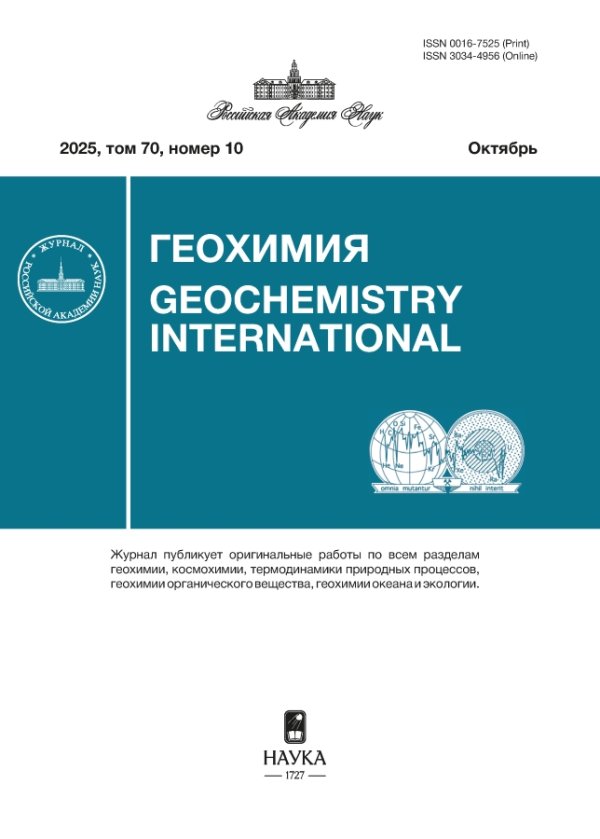
Halogens (F, Cl) in Natural Diamonds: Investigation Using Secondary Ion Mass Spectrometry (SIMS)
- Authors: Kaminsky F.V.1, Ber B.Y.2, Kazantsev D.Y.2, Shilobreeva S.N.1, Tokarev M.V.2
-
Affiliations:
- Vernadsky Institute of Geochemistry and Analytical Chemistry
- Ioffe Institute
- Issue: Vol 70, No 10 (2025)
- Pages: 785-796
- Section: Articles
- URL: https://journals.rcsi.science/0016-7525/article/view/353440
- DOI: https://doi.org/10.7868/S3034495625100012
- ID: 353440
Cite item
 Open Access
 Access granted
 Subscription Access

Abstract
About the authors
F. V. Kaminsky
Vernadsky Institute of Geochemistry and Analytical Chemistry
Email: kaminsky@geokhi.ru
Kosygin Str., 19, Moscow, 119991 Russia
B. Ya. Ber
Ioffe InstitutePolitekhnicheskaya Str., 26, St. Petersburg, 194021 Russia
D. Yu. Kazantsev
Ioffe InstitutePolitekhnicheskaya Str., 26, St. Petersburg, 194021 Russia
S. N. Shilobreeva
Vernadsky Institute of Geochemistry and Analytical ChemistryKosygin Str., 19, Moscow, 119991 Russia
M. V. Tokarev
Ioffe InstitutePolitekhnicheskaya Str., 26, St. Petersburg, 194021 Russia
References
- Асафов Е. В., Соболев А. В., Батанова В. Г.,Портнягин М. В. (2020)Хлор в земной мантии как индикатор глобального рециклирования океанической коры.Геология и Геофизика.61(9), 1149–1164. https://doi.org/10.15372/GiG2020161
- Галимов Э. М., Соболев Н. В., Ефимова Э. С., Ширяев А. А. (1999) Изотопныйсостав углерода в алмазах Венесуэлы.ДАН. Науки о Земле.364(1), 101–106.
- Титков С. В., Рябчиков И. Д., Помазанский Б. С., Магазина Л. Щ.(2011) Микровключения хлоридов в алмазах Сибирской платформы. ДАН. Наукио Земле,437(5), 675–679.
- Abersteiner A.,Kamenetsky V.,Kamenetsky M.,Goemann K.,Ehrig K.,Rodemann T. R. (2017)Significance of halogens (F, Cl) in kimberlite melts: Insights frommineralogy and melt inclusions in the Roger pipe (Ekati, Canada).Chem. Geol.478, 148–163. https://doi.org/10.1016/j.chemgeo.2017.06.008
- Bernini D., Wiedenbeck M.,Dolejš D., Keppler H. (2012) Partitioning of halogens between mantleminerals and aqueous fluids: implications for the fluid flow regimein subduction zones.Contrib. Mineral. Petr.165, 117–128. https://doi.org/10.1007/s00410-012-0799-4
- Beyer C., Klemme S.,Wiedenbeck M., Stracke A., Vollmer C. (2012) Fluorinein nominally fluorine-free mantle minerals: Experimental partitioning of F betweenolivine, orthopyroxene and silicate melts with implications for magmatic processes. Earth Planet. Sci. Lett.337–338, 1–9. https://doi.org/10.1016/j.epsl.2012.05.003
- Broadley M. W., Ballentine C. J., Chavrit D., Dallai L., Burgess R. (2016)Sedimentary halogens and noble gases within Western Antarctic xenoliths: Implicationsof extensive volatile recycling to the sub continental lithospheric mantle.Geochim. Cosmochim. Acta.176, 139–156. https://doi.org/10.1016/j.gca.2015.12.013
- Broadley M. W., Barry P. H., Ballentine C. J., Taylor L. A., Burgess R. (2018a) End-Permian extinctionamplified by plume-induced release of recycled lithospheric volatiles.Nature Geosci. 11, 682–687. https://doi.org/10.1038/s41561-018-0215-4
- Broadley M. W., Kagi H., Burgess R., Zedgenizov D., Mikhail S., Almayrac M., Ragozin A., Pomazansky B., Sumino H. (2018b) Plume-lithosphere interaction, and the formation of fibrous diamonds.Geochem. Persp. Lett. 8, 26–30. https://doi.org/10.7185/geochemlet.1825
- Bromiley D. W., Kohn S. C., 2007. Comparisonsbetween fluoride and hydroxide incorporation in nominally anhydrous and fluorine-freemantle minerals.Geochim. Cosmochim. Acta. 71, A124.
- Bureau H.,Frost D. J., Bolfan-Casanova N., Leroy C., Esteve I., Cordier P.(2016) Diamond growth in mantle fluids.Lithos. 265, 4–15. https://doi.org/10.1016/j.lithos.2016.10.004
- Burgess R.,Layzelle E., Turner G., Harris J. W. (2002) Constraintson the age and halogen composition of mantle fluids inSiberian coated diamonds.Earth Planet. Sci. Lett.197, 193–203. hppt://doi.org/10.1016/S0012-821X(02)00480-6
- Burgess R., Cartigny P., Harrison D., Hobson E.,Harris J. (2009) Volatile composition of microinclusions in diamonds fromthe Panda kimberlite, Canada: Implications for chemical and isotopic heterogeneityin the mantle.Geochim. Cosmochim. Acta.73, 1779–1794. https://doi.org/10.1016/j.gca.2008.12.025
- Crépisson C., Blanchard M., Bureau H., Sanloup C., Withers A. C., Khodja H., Surblé S., Raepsaet C., Béneut K.,Leroy C., Giura P., Balan E. (2014) Clumped fluoride-hydroxyldefects in forsterite: Implications for the upper-mantle.Earth Planet. Sci.Lett.390, 287–295. https://doi.org/10.1016/j.epsl.2014.01.020
- Dalou C., Koga K. T., Shimizu N., Boulon J., Devidal J.-L. (2012) Experimental determinationof F and Cl partitioning between lherzolite and basaltic melt.Contrib. Mineral. Petr.163, 591–609. https://doi.org/10.1007/s00410-011-0688-2
- E-92 (Reapproved2001). Standard Guide for Determining SIMS Relative Sensitivity Factors fromIon Implanted External Standards,ASTM
- Frezzotti M. L., Ferrando S. (2018) Therole of halogens in the lithospheric mantle. In: D. E. Harlovand L. Aranovich (eds.), The Role of Halogens in Terrestrialand Extraterrestrial Geochemical Processes,Springer Geochemistry. p. 805–845. https://doi.org/10.1007/978-3-319-61667-4_13
- Galimov E. M., Kaminsky F.V, Shilobreeva S. N., Sevastyanov V. S., Wirth R., Schreiber A., Saraykin V. V., Karpov G. A., Anikin L. P. (2020) Enigmatic diamonds from the Tolbachikvolcano, Kamchatka. Am. Mineral.105, 498–509. https://doi.org/10.2138/am-2020-7119
- Gibson, S.A., McKenzie, D.(2023) On the role of Earth’s lithospheric mantle in globalvolatile cycles.Earth Planet. Sci. Lett.602, 117946. https://doi.org/10.1016/j.epsl.2022.117946
- Goss J. P., Briddon P. R., Rayson M. J., Sque S. J., Jones R. (2005) Vacancy-impuritycomplexes and limitations for implantation doping of diamond.Phys. Rev.B72, 035214. https://doi.org/10.1103/PhysRevB.72.035214
- Grützner T., Klemme S., Rohrbach A.,Gervasoni F., Berndt J. (2017) The role of F-clinohumite involatile recycling processes in subduction zones.Geology.45,443–446. https://doi.org/10.1130/G38788.1
- Grützner T., Klemme S., Rohrbach A., Gervasoni F., Berndt J. (2018) The effect of fluorine on the stability of wadsleyite: Implications for the natureand depths of the transition zone in the Earth’s mantle.Earth Planet. Sci. Lett.482, 236–244. https://doi.org/10.1016/j.epsl.2017.11.011
- Guggino S. (2012) Fluorine partitioning between nominally anhydrous minerals (olivine,clinopyroxene, and plagioclase) and silicate melt using Secondary Ion MassSpectrometry and newly synthesized basaltic fluorine microanalytical glass standards. Ph. D. Thesis, Arizona State University, 249 pp.
- Guggino S. N., Hervig R. L., Bell D. R. (2007) Fluorine in olivines from plutonic, extrusive,and hypabyssal suites. EOS transations, vol.88.American Geophysical Union, V41B-0609.
- Hervig R. L., Bell D. R. (2005) Fluorine and hydrogen inmantle megacrysts.American Geophysical Union Fall Meeting2005, abstract V41A-1426.
- Hoare B. C., Tomlinson E. L., Barnes J. D., Tappe S., Marks M. A.W., Epp T., Caulfield J., Riegler T. (2021) Tracking halogenrecycling and volatile loss in kimberlite magmatism from Greenland: Evidencefromcombined F-Cl-Br and δ37Cl systematics. Lithos384–385: 105976. https://doi.org/10.1016/j.lithos.2021.105976
- International Standard ISO 18114:2003(E): Surface Chemical Analysis– Secondary-Ion Mass Spectrometry – Determination of Relative Sensitivity Factorsfrom Ion Implanted Reference Materials (2003).
- Izraeli E. S., Harris J. W.,Navon O. (2001) Brine inclusions in diamonds: a new uppermantle fluid.Earth Planet. Sci. Lett.187, 323–332. https://doi.org/10.1016/S0012-821X(01)00291-6
- Johnson L. H., Burgess R., Turner G., Milledge H. J. Harris J. W. (2000) Noble gas halogen geochemistry of mantle fluids:comparison of African and Canadian diamonds.Geochim. Cosmochim. Acta.64, 717–732. https://doi.org/10.1016/S0016-7037(99)00336-1
- Kaminsky F. V., Zakharchenko O. D.,Griffin W. L., Channer D. M. De R., Khachatryan-Blinova G. K. (2000) Diamond from theGuaniamo area, Venezuela.Canadian Mineralogist.38(6), 1347–1370.
- Kaminsky F. V.,Zakharchenko O. D., Davies R., Griffin W. L., Khachatryan-Blinova G. K., Shiryaev A. A.(2001a) Superdeep diamonds from the Juina area, Mato Grosso State,Brazil.Contributions to Mineralogy and Petrology.140(6), 734–753. https://doi.org/10.1007/s004100000221
- Kaminsky F. V., Zakharchenko O. D., Khachatryan G. K., Shiryaev A. A. (2001b) Diamonds fromthe Coromandel area, Minas Gerais, Brazil.Revista Brasileira de Geosciencias.31(4), 583–596.
- Kaminsky F.V, Wirth R., Matsyuk S.,Schreiber A., Thomas R. (2009) Nyerereite and nahcolite inclusions indiamond: Evidence for lower-mantle carbonatitic magmas.Mineral. Mag.73,797–816. https://doi.org/10.1180/minmag.2009.073.5.797
- Kaminsky F. V., Wirth R., Schreiber A. (2013) Carbonatitic inclusionsin deep Mantle diamond from Juina, Brazil: New minerals inthe carbonate-halide association.Can. Mineral.51, 669–688. https://doi.org/10.3749/canmin.51.5.669
- Kaminsky F. V., Ryabchikov I. D., Wirth R. (2016) Aprimary natrocarbonatitic association in the Deep Earth.Mineral. Petr.110, 387–398. https://doi.org/10.1007/s00710-015-0368-4
- Kaminsky F. V., Zedgenizov D. A., Sevastyanov V. S., Kuznetsova O. V. (2023) Distinct groups of low- and high-Feferropericlase inclusions in super-deep diamonds: an example from the Juina area,Brazil.Minerals, v.13(9), 1217. https://doi.org/10.3390/min13091217
- Kaminsky F. V., Polyakov V. B., Ber B.Ya., Kazantsev D.Yu., Khachatryan G. K., Shilobreeva S. N. (2024) Hydrogen innatural diamond: Quantification of N3VH defects using SIMS andFTIR data.Chemical Geology. v. 661, 122185. https://doi.org/10.1016/j.chemgeo.2024.122185
- Kendrick M. A., Hémond C., Kamenetsky V. S., Danyushevsky L., Devey C. W.,Rodemann T., Jackson M. G., Perfit M. R. (2017) Seawater cycledthroughout Earth’s mantle in partially serpentinized lithosphere.Nature Geosci.10,222–228. https://doi.org/10.1038/ngeo2902
- Kjarsgaard B. A., Pearson D. G., Tappe S.,Nowell G. M., Dowall D. P. (2009) Geochemistry of hypabyssal kimberlites fromLac de Gras, Canada: Comparisons to a global database andapplications to the parent magma problem.Lithos.112, 236–248.https://doi.org/10.1016/j.lithos.2009.06.001
- Klein-BenDavid O., Izraeli E. S., Hauri E., Navon O.(2004) Mantle fluid evolution ‒ a tale of one diamond.Lithos. 77,243–253. https://doi.org/10.1016/j.lithos.2004.04.003
- Klein-BenDavid O., Logvinova A. M., Schrauder M., Spetius Z. V., Weiss Y., Hauri E., Kaminsky F. V., Sobolev N. V., Navon O.(2009) High-Mg carbonatitic microinclusions in some Yakutian diamonds: a newtype of diamond-forming fluid.Lithos.112S, 648–659. https://doi.org/10.1016/j.lithos.2009.03.015
- Klemme, S., Stalder, R. (2018) Halogens in the Earth’s Mantle: What We Know andWhat We Don’t. In: Harlov, D., Aranovich, L. (eds.) TheRole of Halogens in Terrestrial and Extraterrestrial Geochemical Processes.SpringerGeochemistry. Springer. P. 847–869. https://doi.org/10.1007/978-3-319-61667-4_14
- Li L., Zhang Q.,Yu Y., Sun N., Mao Z.,Li W., Li X.,Wang W., Ye Y. (2024). Elasticity of single-crystal clinohumite athigh pressures and temperatures: Implication for the H2O andF circulation in the Earth’s mantle.Journ Geophy Res SolidEarth.129, e2024JB028793. https://doi.org/10.1029/2024JB028793
- Lin Y., Hu Q., Zhu L., Meng Y. (2020) Structure and stability of iron fluorideat high pressure–temperature and implication for a new reservoir offluorine in the Deep Earth.Minerals,10, 783. https://doi.org/10.3390/min10090783
- McDonough W. F., Sun S.-s. (1995) The composition of theEarth.Chem. Geol.120, 223–253. https://doi.org/10.1016/0009-2541(94)00140-4
- Mosenfelder J. L.,Rossman G. R. (2013a) Analysis of hydrogen and fluorine in pyroxenes:I. Orthopyroxene.Am. Mineral.98, 1026–1041, 2013. https://doi.org/10.2138/am.2013.4291
- Mosenfelder J. L., Rossman G. R. (2013b) Analysis of hydrogen and fluorinein pyroxenes: II. Clinopyroxene.Am. Mineral.98, 1042–1054. https://doi.org/10.2138/am.2013.4413
- Mosenfelder J. L., Le Voyer M., Rossman G. R., Guan Y., Bell D. R., Asimov P. D., Eiler J. M. (2011) Analysis of hydrogen inolivine by SIMS: evaluation of standards and protocol.Am. Mineral.96, 1725–1741.
- Ottolini L., Brieuc Le Fèvre B. (2008) SIMS analysis of chlorine in metasomatised upper-mantlerocks.Microchim. Acta161, 329–336. https://doi.org/10.1007/s00604-007-0850-8
- Palme H.,O’Neill H.S.C. (2003) Cosmochemical estimates of mantle composition. In:Treteaseon Geochemistry, p. 1–38.
- Palyanov, Yu.N., Sokol, A.G. (2009)The effect of composition of mantle fluids/melts on diamond formation processes.Lithos 112(Suppl.2),690–700.
- Paul D. K., Buckley F.,Nixon P. H.(1976)Fluorine and chlorine geochemistry of kimberlites.Chem. Geol. 17,125–133. https://doi.org/10.1016/0009-2541(76)90026-7
- Roberge M., Bureau H., Bolfan-Casanova N., Raepsaet C., Surble S., Khodja H., Auzende A.-L., Cordier P., Fiquet G. (2017) Chlorine in wadsleyite and ringwoodite: An experimental study.Earth Planet. Sci. Lett. 467, 99–107. https://doi.org/10.1016/j.epsl.2017.03.025
- Rubin A. E., Choi B.-G. (2009) Originof halogens and nitrogen in enstatite chondrites. Earth MoonPlanets.105, 41–53. https://doi.org/10.1007/s11038-009-9316-9
- Sokol A. G., Tomilenko A. A.,Bul’bak T.A., Sokol I. A., Zaikin P. A., Sobolev N. V. (2020) Compositionof reduced mantle fluids: Evidence from modeling experiments and fluidinclusions in natural diamond.Russ. Geol. Geophys.61, 663–674. https://doi.org/10.15372/RGG2020103
- Stevie F. A. (2016) Secondary Ion Mass Spectrometry.Applications for Depth Profiling and Surface Characterization.Momentum Press, NewYork. 286 pp.
- Sumino H., Burgess R., Mizukami T., Wallis S. R., Holland G., Ballentine C. J. (2010) Seawater-derived noble gases andhalogens preserved in exhumed mantle wedge peridotite.Earth Planet. Sci.Lett.294, 163–172. https://doi.org/10.1016/j.epsl.2010.03.029
- Tchernij S. D., Lühmann T., Corte E., Sardi F., Picollo F., Traina P., Brajković M., Crnjac A., Pezzagna S., Pastuović Z., Degiovanni I. P., Moreva E., Apr P., Olivero P., Siketić Z., Meijer J., Genovese M., Forneris J. (2020) Fluorine-based color centers in diamond.Sci.Rep. 10: 21537. https://doi.org/10.1038/s41598-020-78436-6
- Toyama C., Sumino H., Okabe N., Ishikawa A., Yamamoto J., Kaneoka I., Muramatsu Y. (2021) Halogen heterogeneity in thesubcontinental lithospheric mantle revealed by I/Br ratios in kimberlites andtheir mantle xenoliths from South Africa, Greenland, China, Siberia, Canada,and Brazil.Am. Mineral. 106, 1890–1899. https://doi.org/10.2138/am-2021-7332
- Urann B. M., Le Roux V., Hammond K., Marschall H. R., Lee C.-T.A.,Monteleone B. D. (2017) Fluorine and chlorine in mantle minerals andthe halogen budget of the Earth’s mantle.Contrib.Mineral. Petr.172:51. https://doi.org/10.1007/s00410-017-1368-7
- van Keken P. E., Chauvel C., Ballentine C. J. (2025) Dynamical geochemistry:Ocean crust recycling through plate tectonics and its role inthe formation of mantle heterogeneity.Treatise on Geochemistry,Third Edition,vol. 1, 647–670. https://doi.org/10.1016/B978-0-323-99762-1.00103-0
- Wang Y., Kanda H. (1998) Growthof HPHT diamonds in alkali halides: Possible effects of oxygencontamination.Diam. Relat. Mater.7, 57–63. https://doi.org/10.1016/s0925-9635(97)00183-0
- Wilson R. G., Stevie F. A., Magee C. W. (1989) Secondary Ion Mass Spectrometry:a practical handbook for depth profiling and bulk impurity analysis.Wiley,New York.384 pp.
- Yoshino T., Jaseem V. (2018) Fluorinesolubility in bridgmanite: A potential fluorine reservoir in the Earth’smantle.Earth Planet. Sci. Lett.504, 106–114. https://doi.org/10.1016/j.epsl.2018.10.009
- Ziegler J. F., Biersack J. P., Ziegler M. D. (2008)The Stopping and Rangeof Ions in Matter. SRIM Co. (www.SRIM.org), 398 pp.
Supplementary files
