



Transparency of Public Administration in Context of Automated Decision-Making
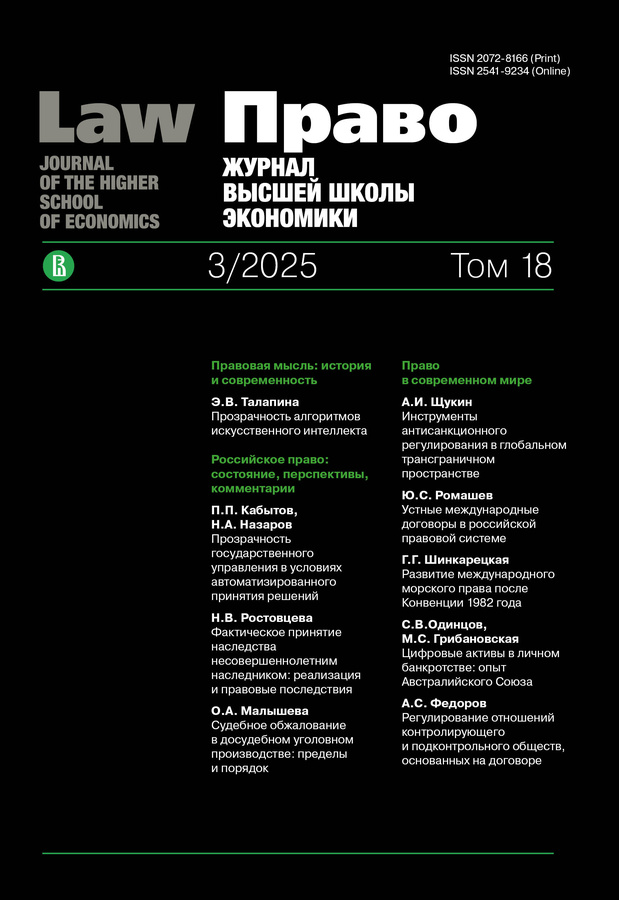
- Авторлар: Kabytov P.1, Nazarov N.1
-
Мекемелер:
- Institute of Legislation and Comparative Legal Studies under Government of the Russian Federation
- Шығарылым: Том 18, № 3 (2025)
- Беттер: 28-55
- Бөлім: Russian Law: Condition, Perspectives, Commentaries
- URL: https://journals.rcsi.science/2072-8166/article/view/318081
- DOI: https://doi.org/10.17323/2072-8166.2025.3.28.55
- ID: 318081
Дәйексөз келтіру
Толық мәтін

Аннотация
In context of active implementation of automated systems decision-making and artificial intelligence systems into activities of public authorities, a problem of maintaining an adequate level of transparency in public administration is becoming increasingly relevant. The issue is critical for upholding principles of rule of law and protecting fundamental rights of citizens. The work aims to conduct a comprehensive systematization and critical analysis of current approaches to solving the problem in Russian and foreign law, as well as in legal theory. The methodological basis of the research includes general research methods (analysis, synthesis, systematic approach) and specific scholar methods (comparative legal, formal legal). The article consistently examines the conceptual foundations and practical challenges of implementing transparency and explainability requirements for automated systems decision-making and artificial intelligence systems, including their role in increasing trust, maintaining accountability, preventing discrimination, and strengthening legitimacy of public administration. The main attention is paid to a detailed and critical analysis of a wide range of transparency mechanisms (classified, in particular, according to their focus on the system as a whole or on a specific decision, as well as by the timing of information provision — ex ante or ex post): disclosure of the procedure or logic of decision-making, the «right to explanation», counterfactual explanations, disclosure of data and program code/models, audit and public control, information about application, as well as use of explainable/interpretable models and other technical solutions. For each mechanism, advantages, disadvantages, and difficulties of practical implementation are identified like conflicts with intellectual property protection, technical complexity of implementation and interpretation, and the fundamental «black box» problem of artificial intelligence systems. The conclusion substantiates the insufficiency of applying individual tools and the necessity of developing a flexible, risk-oriented, and context-dependent comprehensive approach.
Авторлар туралы
Pavel Kabytov
Institute of Legislation and Comparative Legal Studies under Government of the Russian Federation
Email: kapavel.v@yandex.ru
ORCID iD: 0000-0001-8656-5317
Candidate of Sciences (Law), Leading Researcher. Candidate of Sciences (Law), Leading Researcher. , Russia.
34 Bolshaya Cheremushkinskaya Str., Moscow 117218, Russia.Nikita Nazarov
Institute of Legislation and Comparative Legal Studies under Government of the Russian Federation
Хат алмасуға жауапты Автор.
Email: naznikitaal@gmail.com
ORCID iD: 0000-0002-3997-0886
Junior Researcher. Junior Researcher. , Russia.
34 Bolshaya Cheremushkinskaya Str., Moscow 117218, Russia.Әдебиет тізімі
Қосымша файлдар
