



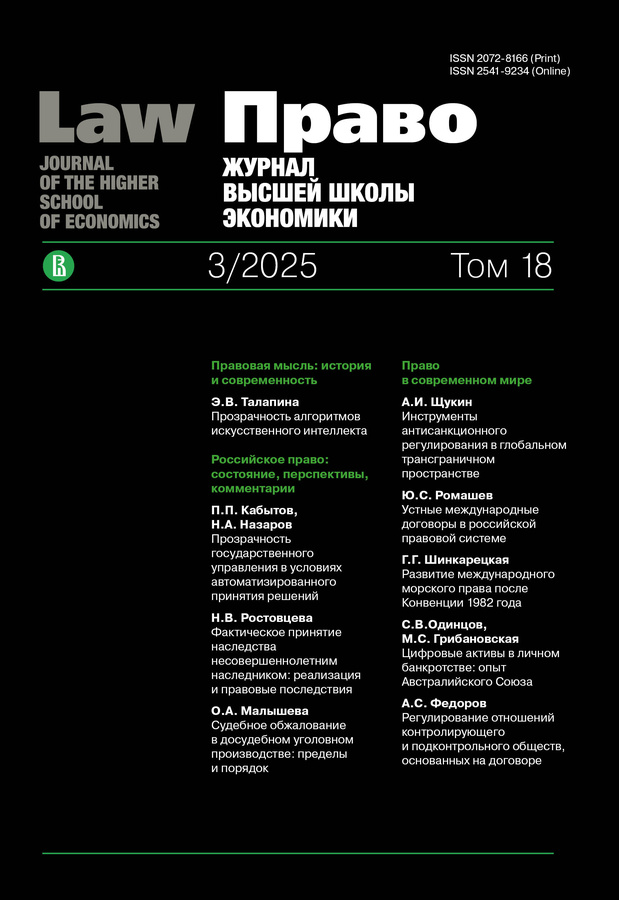
Digital Assets in Personal Bankruptcy: Experience of the Commonwealth of Australia
- Authors: Odintsov S.1, Gribanovskaya M.1
-
Affiliations:
- Peoples’ Friendship Lumumba University
- Issue: Vol 18, No 3 (2025)
- Pages: 226-251
- Section: Law in the Modern World
- URL: https://journals.rcsi.science/2072-8166/article/view/318089
- DOI: https://doi.org/10.17323/2072-8166.2025.3.226.251
- ID: 318089
Cite item
Full Text

Abstract
The article is devoted to the study of the issues that arise in process of working with digital assets in personal bankruptcy procedures based on the example of the Australian Union. The legal and practical aspects of identifying and establishing control over the digital assets of an individual debtor are being investigated in order to include them in the bankruptcy estate for sale in the interests of creditors. The dialectical method, formal legal and legal dogmatic methods, as well as methods of system analysis and legal modeling are implemented in the research. The key results of the study demonstrate that digital assets significantly complicate the bankruptcy procedure due to their decentralized nature, anonymity and cross-border nature. The authors identified the main problematic issues related to the identification of asset owners, tracking transactions, gaining control over the debtor’s crypto wallets, including and returning digital assets to the bankruptcy estate, as well as assessing their value in order to implement bankruptcy procedures applied to individuals. It has been established that in the Australian Union, digital assets are considered property in the context of bankruptcy, but there are no special rules for their regulation in bankruptcy procedures. From the point of view of Australian competition law, the legal regime of digital assets is governed by legal norms relating to the debtor’s property as a whole, which have to be adapted due to the unique intangible and decentralized nature of digital assets. The practical recommendations developed by the regulator for persons managing the debtor’s assets and administering the relevant personal bankruptcy procedures, which include various methods for identifying digital assets, recommendations for analyzing transaction evidence, and mechanisms for interacting with the debtor, do not cover the full range of potential problems that may arise in practice. The main conclusions of the study emphasize the need to create a balanced regulatory approach that would encourage voluntary disclosure of information about digital assets and discourage unfair behavior by debtors. For unscrupulous debtors, a set of existing measures should be developed to force the discovery of digital assets and their inclusion or return to the bankruptcy estate.
About the authors
Stanislav Odintsov
Peoples’ Friendship Lumumba University
Email: odintsov_sv@pfur.ru
ORCID iD: 0000-0002-3403-3519
Candidate of Sciences (Law), Associate Professor. Candidate of Sciences (Law), Associate Professor.
6 Miklukho-Maklaya Str., Moscow 117198, Russia.Maria Gribanovskaya
Peoples’ Friendship Lumumba University
Author for correspondence.
Email: gracefulmind@yandex.ru
ORCID iD: 0000-0002-3583-7033
Postgraduate Student. Postgraduate Student.
6 Miklukho-Maklaya Str., Moscow 117198, Russia.References
Supplementary files
