





 Enviar artigo por via de e-mail
 Rationale for Teaching Medical Students to Apply Humanitarian Principles in their Work Practices
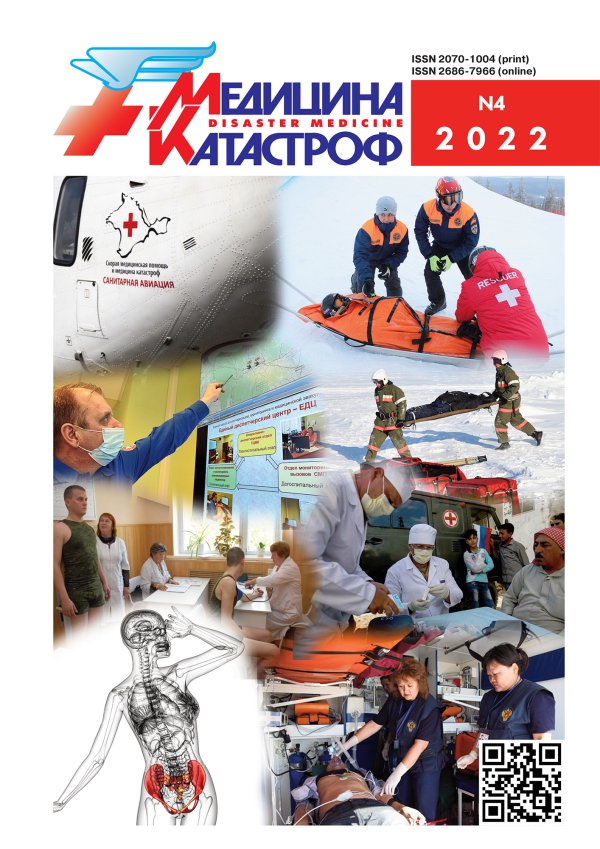
- Autores: Minyaylov N.A.1, Chizh I.M.1, Rusanov S.N.1
-
Afiliações:
- I.M. Sechenov First Moscow State Medical University of the Ministry of Healthcare of the Russian Federation
- Edição: Nº 4 (2022)
- Páginas: 29-33
- Seção: Public Health and Healthcare
- URL: https://journals.rcsi.science/2070-1004/article/view/360256
- DOI: https://doi.org/10.33266/2070-1004-2022-4-29-33
- ID: 360256
Citar
Texto integral

Resumo
Summary. It has been noted that an increasing number of people in the world are becoming victims of humanitarian crises, and the application of basic humanitarian principles can improve the quality of medical care, including medical care in emergencies. Therefore, training future physicians in the application of humanitarian principles in practice becomes a crucial task, since without this it is impossible to imagine achieving the goal of universal health care coverage, including in emergencies. The article presents the experience of teaching medical students to comply with legal obligations when providing medical care in various emergency situations.
Sobre autores
N. Minyaylov
I.M. Sechenov First Moscow State Medical University of the Ministry of Healthcare of the Russian Federation
Email: minyaylov_n_a@staff.sechenov.ru
Cand. Sc. (Med.); Associate Professor of the Department of Life Safety and Disaster Medicine of N.V.Sklifosovsky Institute of Clinical Medicine Moscow
I. Chizh
I.M. Sechenov First Moscow State Medical University of the Ministry of Healthcare of the Russian Federation
Email: minyaylov_n_a@staff.sechenov.ru
Moscow
S. Rusanov
I.M. Sechenov First Moscow State Medical University of the Ministry of Healthcare of the Russian Federation
Email: minyaylov_n_a@staff.sechenov.ru
Moscow
Bibliografia
- Основополагающие принципы Международного движения Красного Креста и Красного Полумесяца: этические основы и инструменты гуманитарной деятельности / Пер. с англ. М.: Международный Комитет Красного Креста, 2018. 108 с.
- Quality of Care in Humanitarian Settings. Global Health Cluster Quality Improvement Task Team. Geneva: World Health Organization, 2020. URL: https://www.who.int/health-cluster/about/work/task-teams/Quality-of-Care-in-Humanitarian-Settings-June-2020.pdf?ua=1 (Дата обращения: 11.04.2022).
- Сассоли М., Бувье А. Правовая защита во время войны. В 4 т. Т. 1 / Пер. с англ. М.: Международный Комитет Красного Креста, 2008. 669 с.
- Schussler L., Burkle F.M., Wren S.M. Protecting Surgeons and Patients During Wars and Armed Conflicts: Importance of Predeployment Training on the Geneva Conventions and International Humanitarian Law // JAMA Surg. 2019. V.154, No. 8. P. 683–684.
- Spiegel P.B. The Humanitarian System Is Not Justbroke, But Broken: Recommendations for Future Humanitarian Action // Lancet. 2017. doi: 10.1016/S0140-6736(17)31278-3.4.
- Van Hoving D.J., Wallis L.A., Docrat F. Haiti Disaster Tourism – a Medical Shame // Prehosp. Disaster Med. 2010. V.25, No. 3. P. 201-202.
- Attacks on Health Care: Three-Year Analysis of SSA Data (2018-2020). WHO. URL: https://www.who.int/data/stories/attacks-on-health-care-three-year-analysis-of-ssa-data-(2018-2020) (Дата обращения: 15.05.2022).
- Protecting Health Care – Key Recommendations. ICRC. 2016. URL:https://www.icrc.org/en/publication/4266-protecting-health-care-key-recommendations. (Дата обращения: 12.04.2022).
- Основополагающие принципы Международного Движения Красного Креста и Красного Полумесяца: краткие сведения. М.: Международный Комитет Красного Креста, 2015. URL: https://www.icrc.org/ru/download/file/9461/4046_fundamental-principles-ru.pdf. (Дата обращения: 12.04.2022).
- Guide for Governments: International Humanitarian Action. UNOCHA, 2017. URL: https://www.unocha.org/document-management/guide-governments-international-humanitarian-action. (Дата обращения: 12.04.2022).
- Burkle F.M., Kushner A.L., Giannou C., et al. Health Care Providers in War and Armed Conflict: Operational and Educational Challenges in International Humanitarian Law and the Geneva Conventions, Part II. Educational and Training Initiatives // Disaster Med. Public. Health. Prep. 2019. V.13, No. 3. P. 383-396.
- Simm K. Ethical Decision-Making in Humanitarian Medicine: How Best to Prepare? // Disaster Med. Public. Health Prep. 2020. V.15, No. 4. 499-503.
- Powell R.A., Schwartz L., Nouvet E., et al. Palliative Care in Humanitarian Crises: Always Something to Offer // Lancet. 2017. V.389, No. 10078. P. 1498-1499.
- Lee JS, Roberts SWP, Götsch K. Caring for critically ill patients in humanitarian settings // Am J Respir Crit Care Med. 2019. Mar 1. V.199, No. 5. P. 572-580.
Arquivos suplementares

