



No 3 (2022)
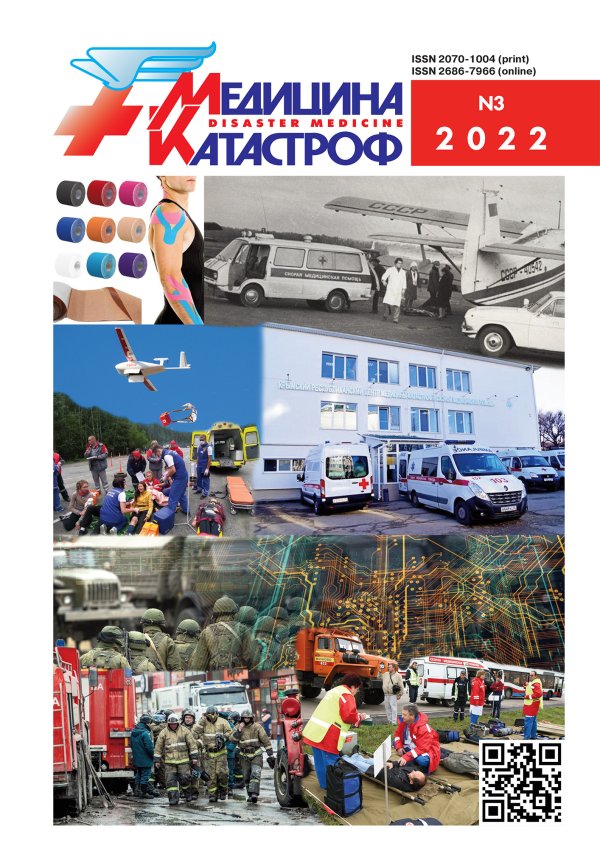

Safety in Emergency Environment
Issues of Medical Triage of the Wounded in Acts of Terrorism
Abstract
Summary. The aim of the study is to develop proposals to improve methodological approaches to the organization and performance of medical triage of the injured in terrorists attack committed with conventional means of destruction.
Materials and research methods. Normative and methodical documents regulating the order of organizing and carrying out medical triage of the wounded in emergencies, including acts of terrorism; data of expert examination maps; scientific works and publications devoted to the issues of medical triage of the wounded in extreme situations.
The following scientific methods were used while performing the research: content-analysis and expert assessment methods, statistical method, method of logical and informational modeling, analytical method.
Results of the study and their analysis. The results of the study, characterizing the state of problematic issues of medical triage of the victims of acts of terrorism, are presented.
The substantiated proposals on improvement of methodical approaches to the order of organization and performance of medical triage and allocation of sorting groups of the defeated in the terrorist act zone have been made.
 5-11
5-11


Hybrid Warfare and Medicine: from Common Understanding to Interagency Interaction
Abstract
Summary. The concept of “hybrid warfare” is analyzed. Basic provisions of the modern military-medical doctrine and the modern system of medical and evacuation support of troops are considered. The main tasks of inter-departmental interaction in the interests of medical support of troops, health care and protection of citizens’ health are presented. So are the main directions of its further development.
12-16
Analysis of the risks of death of personnel of the Federal Fire Service of EMERCOM of Russia in 2006-2020
Abstract
Summary. The aim of the study is to analyze the risks of fatalities among the personnel of the Federal Firefighting Service of the Ministry of Emergency Situations (EMERCOM) of Russia in 2006-2020 by categories of personnel, causes of fatal injuries, and types of professional activity.
Materials and research methods. Injury rates of Russian EMERCOM Federal Firefighting Service personnel were taken for 2006-2015 from the data bank on morbidity, injury, disability, and death during the performance of official duties in the Russian EMERCOM; for 2016-2020 — from the reports of the Ministry of Emergency Situations of Russia. Risks of death were calculated per 100 thousand people or ×10-5.
Results of the study and their analysis. Over 15 years (2006-2020), 224 members of the Federal Firefighting Service of the Russian EMERCOM died as a result of injuries received during the performance of their official duties, averaging (15±1) deaths per year. The average annual risk of death was (8.53±0.83)×10-5. That is statistically reliably lower, than the average risk for Russian Federation male workers — (13.23±1.12)×10-5 (p<0.01). The polynomial trends of the indicators of risk of death of Federal Firefighting service personnel and of male workers of the Russian Federation with different significance coefficients of determination show a decreasing trend in the data. The consistency of the trends is low and statistically insignificant (r=0.228; p>0.05), which may indicate the influence of different (multidirectional) leading factors on fatal injuries. The average annual risks of fatal injuries by causes of fatal injuries, types of professional activity and personnel categories were calculated.
17-22
Assessment of the Level of Preparedness of Medical Staff of Different Departments In the Non-Staff Units of the Emergency Medicine Service to Eliminate Medical and Sanitary Consequences of Emergencies
Abstract
Summary. The aim of the study was to investigate and to evaluate the readiness and job satisfaction rates of military medical specialists and civilian personnel of military medical organizations of the Russian Ministry of Defense of central and district subordination (MMO-MOD group), as well as the readiness and job satisfaction indicators of medical specialists from medical organizations of the Russian Ministry of Health and the Federal Medical and Biological Agency (MOH-FMBA group) within the non-staff units of the Disaster Medicine Service for medical and sanitary consequences of emergencies elimination activities.
Materials and research methods. Materials of the study: sociological survey questionnaires of the non-staff medical specialists divided into 2 groups (MOH-FMBA group, n = 255; MMO-MOD group, n = 227). The following was assessed: general characteristics of a medical specialist, his/her professional activity at the main place of work and in the non-staff formations when working in high readiness and emergency modes; readiness of non-staff medical specialists to eliminate medical and sanitary consequences of emergencies. Research methods: analytical, logical, statistical (descriptive statistics, correlation and factor analysis).
Results of the study and their analysis. Satisfaction with the work of all military medical specialists and civilian personnel of the Russian Ministry of Defense of central and district subordination, as well as medical specialists from medical organizations of the Ministry of Health and the Federal Medical and Biological Agency of Russia were noted. It is marked that among the factors influencing professional activity of medical specialists of different departments in non-staff formations the most important should be considered special training and provision of non-staff formations with medical and other material and technical equipment, readiness of non-staff formations when working in the mode of daily activity to perform tasks on purpose.
23-31
The Option of Organizing the Work of the Territorial Center for Disaster Medicine of the Republic of Crimea under the Threat of Several Simultaneous Terrorist Acts
Abstract
Summary. The aim of the study is to choose the optimal format of actions of the formations of the Disaster Medicine Service (DMS), Emergency Medical Service (EMS), Civil Defense (CD), Territorial Center for Disaster Medicine (TCDM) of the Republic of Crimea when responding to the threat of several terrorist acts occurring simultaneously.
Materials and research methods. The work of the emergency medical teams and disaster medicine service of the Republic of Crimea on the protection of the population in case of a threat of several terrorist acts occurring simultaneously in January-April 2022 was analyzed.
Results of the study and their analysis. Calculation of the number and composition of emergency medical service formations for primary response to the threat of several simultaneous terrorist acts at five or more differently located objects in one settlement or separate district was substantiated. The composition and tasks of the task force for prevention and elimination of medical and sanitary consequences of emergencies (terrorist acts) were defined. It is noted that the training of DMS personnel in civil defense and protection in emergencies in the system of additional professional education is the most promising form of personnel training for work under the threat (occurrence) of emergency situations.
32-35
Public Health and Healthcare
Mental Health of Medical Workers under COVID-19 Pandemic Conditions
Abstract
Summary. At different stages of its development, the world community has repeatedly faced various disasters, natural calamities and epidemics. COVID-19 pandemic was no exception, the consequences of which, one way or another, affected everyone, but mostly medical workers. It is in the conditions of the pandemic that common stress factors emerged and aggravated, many people experienced negative mental and psychological consequences of it. However, based on the accumulated experience and the rapid development of medicine, there is an opportunity to influence the preservation of mental health of any person, as well as to identify risks and to prevent negative consequences of the pandemic.
Preservation of mental health of medical workers is one of the most important tasks of public health. Factors influencing mental and psychological state of medical workers as well as possible organizational measures to support medical workers during the pandemic are considered in the article.
36-41
Disaster Medicine Service of Voronezh Region: History of Creation and Formation
Abstract
Summary. The article presents the history of foundation and formation of the Disaster Medicine Service of the Voronezh region and of the Voronezh Regional Clinical Center for Disaster Medicine. The basic directions of the Center’s and Service’s activity, the Center’s structure and equipment are examined.
42-46
Clinical Aspects of Disaster Medicine
Application of Kinesiotaping in the Rehabilitation of Employees of Power Structures Participated in Elimination of Emergency Consequences
Abstract
Summary. The aim of the study was to determine the current evidence base for the effectiveness of kinesiotaping in Russian EMERCOM employees suffering from osteoarthritis of knee joint.
Materials and research methods. The data of the Russian and foreign literature on the efficacy of the kinesiotaping method in osteoarthritis were analyzed. The research was performed using electronic databases MEDLINE, Embase, Scopus, Web of Science, eLIBRARY and PEDro for the period from 2007 till 2021. The following key words and their combinations were used: kinesioteaping, knee joint, osteoarthritis, rehabilitation.
Study results and their analysis. More than 1,000 articles were found and analyzed as a result of the search. Seven studies met the inclusion criteria.
Analysis of the results of the study led to the following conclusions:
47-50
Actual Problems of Medical Evacuation
Results of the Use of Practical Recommendations on the Organization of Internal Quality Control and Safety of Medical Activity Outside a Medical Organization
Abstract
Summary. The aim of the study was to assess the results of application of the criteria for controlling the quality and safety of medical activity in the provision of emergency, including specialized emergency, medical care and medical evacuation.
Materials and research methods. The results of treatment of 763 emergency patients admitted to the hospital from September 2021 to September 2022 were analyzed. The work of general medical teams of the hospital in rendering emergency medical aid was studied based on medical documents (case histories): 451 patients received medical care during routine activities; 312 patients received medical care within an emergency situation.
During the study, methods of expert review and comparative analysis were used. Thirty physicians with the highest medical category in the specialty “organization of health care and public health” and with work experience of not less than 5 years were involved as experts.
In order to check sufficiency of criteria for quality control of medical care, the authors developed a special questionnaire, in which experts were asked to assess on a 10-point scale the significance of each indicator and their sufficiency for a complete description of all possible clinical situations.
The results were assessed by statistical analysis using the capabilities of Microsoft Excel tables.
Study results and their analysis. The results of the study showed that the most significant criterion of quality control of field forms of work in pre-hospital and hospital periods is the timeliness of medical evacuation, as well as the need to include additional indicators to assess patients with especially dangerous infections in the practical recommendations for the organization of internal quality control and safety of medical activity outside a medical organization.
51-54
Experience Performing Respiratory Support in Victims with Severe Injuries during Air Ambulance Evacuations by Light-Class Helicopter
Abstract
Summary. The aim of the study was to determine the optimal types of respiratory support for acute respiratory failure in patients with severe trauma during medical evacuation by light-class helicopters.
Materials and research methods. The materials of the study are the data on the performance of respiratory support in patients with various types of trauma and acute respiratory failure for 2016-2021, contained in the automated information-analytical system “Disaster Medicine of Moscow” of the State Budget Institution “Moscow Territorial Scientific and Practical Center for Disaster Medicine of the Moscow City Health Department”.
When performing the study, historical, statistical and analytical methods were used.
Study results and their analysis. The results of the analysis showed:
– proportion of victims with various traumas received in the emergency situations in Moscow constitutes 31,9% of all sanitary losses in emergencies. Of them 12.9% were in an extremely severe and serious condition, including 1.1% who needed artificial lung ventilation and tracheal intubation;
– severe acute respiratory distress requiring ventilation and tracheal intubation was caused in 49.7% of cases by polytrauma, in 38.4 cases — by isolated trauma, in 8.7 cases — by thermal trauma, and in 3.2% of cases — by combined trauma.
The indications and peculiarities of artificial ventilation with tracheal intubation in patients with various traumas to be medically evacuated by a light-class ambulance helicopter have been determined.
55-59
In Order of Discussion
Improving the Organization of Medical Care for Victims of Road Accidents on the Federal Highway in a Low-Density Region of Russia
Abstract
Summary. The aim of the study is to substantiate the necessity of a set of measures to improve medical care to the victims of road traffic accidents on federal highways in Russian regions with low population density on the basis of the developed system of medical care provision.
Materials and research methods. Using the method of organizational experiment, we carried out the scientific substantiation and development of measures the implementation of which will improve the efficiency of first aid and medical care to the victims of road accidents on the federal highways in the regions of the Russian Federation with low population density.
Materials of the study — a sample of 206 medical records of patients admitted for urgent indications after an accident on the federal highway M-8 “Kholmogory” to medical organizations of the Arkhangelsk region and who received medical care in hospital conditions (form 003/u) in the periods from January 1 to December 31, 2016 and from January 1 to December 31, 2018. Record forms were selected according to the criteria of retrospective continuous documentary observation — all medical histories of accident victims who received inpatient care during the study periods were selected.
Inclusion criteria for the study were:
Exclusion criteria for the study:
Categorical variables were used for statistical analysis and presented as percentages. The Pearson Chi-square test was used to determine if there was a relationship between the categorical variables. Statistical processing of the data was performed using a package of applied statistical programs SPSS 22.
Study results and their analysis. Implementation of new approaches to the organization of medical care for victims of traffic accidents on the federal highway M-8 “Kholmogory” led to an increase by 2018 compared with 2016: of share of timely (up to 1 hour) delivery of ambulance crews to the place of the accident; of share of victims to whom specialists of ambulance crews performed anesthesia, transport immobilization, intravenous infusion of antishock drugs, as well as the creation of a regional competence center in the Level I trauma center and, consequently, an increase in the number of consultations for victims with polytrauma and in the number of medical evacuations of victims with polytrauma, performed to the Level I trauma center.
60-64
Case Study of Transporting Blood Components Using an Unmanned Aerial Vehicle
Abstract
Summary. The objectives of the study were to evaluate the effect of transportation of leucoreduced erythrocyte suspension (LES) using a rotary-type unmanned aerial vehicle (UAV) (drone); to determine its application and use in clinical practice after transportation on a drone.
Materials and research methods. Transportation of 6 doses of LES with a volume of 260 to 300 ml using a rotary-type UAV was performed. Before and after transportation suitability of blood components for clinical use was determined; the number of erythrocytes, platelets, leukocytes, free hemoglobin, and hematocrit were estimated. We evaluated the speed of blood component delivery by automobile transport during the period of minimal traffic in St. Petersburg. The speed of delivery by automobile transport was compared with the estimated speed of delivery by UAV.
Study results and their analysis. Changes in the indices of LES laboratory tests after transportation by UAV of rotor type were not statistically significant and remained within the norms. Transportation of blood components by motor transport takes more time than their delivery by drone under metropolitan conditions — (15 min 17 s ± 39,3 s) and 5 min 46 s, respectively.
The results of the pilot study demonstrated the suitability of using LES in clinical practice after its transportation by rotor-type UAV.
In addition, delivery of blood components and other medical drugs by drones in metropolitan areas can be performed much faster and will be more cost-effective than transportation by road transport.
65-69
70-72