





 Email this article
 ECOLOGICAL FACTORS ASSOCIATED WITH FLUCTUATIONS IN THE INCIDENCE OF NEOPLASMS IN CHILDREN
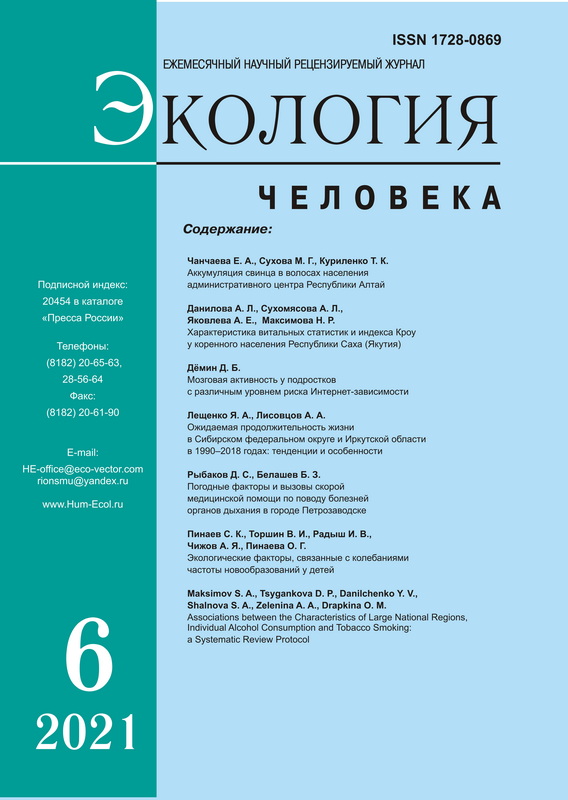
- Authors: Pinaev S.K.1, Torshin V.I.2, Radysh I.V.2, Chizhov A.Y.2, Pinaeva O.G.1
-
Affiliations:
- Far Eastern state medical university
- Peoples' friendship university of Russia
- Issue: Vol 28, No 6 (2021)
- Pages: 49-57
- Section: Articles
- URL: https://journals.rcsi.science/1728-0869/article/view/74762
- DOI: https://doi.org/10.33396/1728-0869-2021-6-49-57
- ID: 74762
Cite item
Full Text

Abstract
Full Text
##article.viewOnOriginalSite##About the authors
S. K. Pinaev
Far Eastern state medical university
Email: pinaev@mail.ru
Khabarovsk, Russia
V. I. Torshin
Peoples' friendship university of RussiaMoscow
I. V. Radysh
Peoples' friendship university of RussiaMoscow
A. Ya. Chizhov
Peoples' friendship university of RussiaMoscow
O. G. Pinaeva
Far Eastern state medical universityкандидат медицинских наук, доцент кафедры онкологии с курсом хирургии и эндоскопии Khabarovsk, Russia
References
- Агаджанян Н. А., Чижов А. Я., Ким Т. А. Болезни цивилизации // Экология человека. 2003. № 4. С. 8-11. URL: https://cyberleninka.ru/article/n/bolezni-tsivilizatsii http://www.osu.ru/img/department/bio/otherpdffiles/ part_2/05.pdf (дата обращения 06.02.2018).
- Злокачественные новообразования в России в 2018 году (заболеваемость и смертность) / под ред. А. Д. Каприна, В. В. Старинского, Г. В. Петровой. М.: МНИОИ им. П. А. Герцена - филиал ФГБУ «НМИЦ радиологии» Минздрава России. 2019. 250 с. URL: http://www.oncology. ru/service/statistics/malignant_tumors/2018.pdf (дата обращения 02.11.2019).
- Злокачественные новообразования в России в 2007 году (заболеваемость и смертность) / под ред. В. И. Чиссова, B. В. Старинского, Г. В. Петровой. М.: ФГУ «МНИОИ им. П. А. Герцена Росмедтехнологий». 2009. 244 с. URL: http:// www.oncology.ru/service/statistics/malignant_tumors/2007. pdf (дата обращения 02.1 1.2019).
- Косых Н. Э., Савин С. З., Десятов А. Ю. Модели и методы популяционных эпидемиологических исследований социально значимых заболеваний (на примере злокачественных новообразований). Владивосток: Дальнаука, 2006. 148 с.
- Лихтенштейн А. В. Генетическая и эпигенетическая составляющие канцерогенеза: Докл. 9. Всероссийской научно-практической конференции «Отечественные противоопухолевые препараты», Нижний Новгород, 18-19 мая 2010 г. // Российский биотерапевтический журнал. 2010. Т. 9, № 2. С. 54.
- Мелехова О. П. Свободнорадикальные процессы в эпигеномной регуляции развития. М.: Наука, 2010. 282 с.
- Петров Н. Н. О признаках однородности так называемых доброкачественных и злокачественных опухолей // Хирургия. 1956. № 2. С. 3-13.
- Пинаев С. К., Кустов В. И., Косых Н. Э. Подходы к изучению частоты доброкачественных опухолей в детской популяции // Вопросы онкологии. 1992. № 8. С. 969-974. URL: https://www.ncbi.nlm.nih.gov/pubmed/1300808 (дата обращения 02.11.2019).
- Хворова Л. А., Брыксин В. М., Гавриловская Н. В., Топаж А. Г. Математическое моделирование и информационные технологии в экологии и природопользовании: Барнаул: Изд-во Алт. ун-та, 2013. 277 с.
- Чижов А. Я., Пинаев С. К., Савин С. З. Экологически обусловленный оксидативный стресс как фактор онкогенеза // Технологии живых систем. 2012. № 1. С. 47-53.
- Abuetabh Y., Tiwari S., Chiu B., Sergi С. Semaphorins Biology and Their Significance in Cancer. Austin. J. Clin. Pathol. 2014, 1(2), p. 1009.
- Agaimy A., Foulkes W. D. Hereditary SWI/SNF complex deficiency syndromes. Semin. Diagn. Pathol. 2018 Feb 1. pii: S0740-2570(18)30002-9. DOI: 10.1053/j. semdp.2018.01.002.
- Breslow N. E., Langholz B. Childhood cancer incidence: geographical and temporal variations. Int. J. Cancer. 1983, 32 (6), pp. 703-716.
- Cancer in Adolescents and Young Adults: Pediatric Oncology / eds. A. Bleyer, R. Barr, L. Ries, J. Whelan, A. Ferrari; 2nd ed. Springer International Publishing AG, 2017, 825 p. doi: 10.1007/978-3-319-33679-4.
- Delloye-Bourgeois C., Bertin L., Thoinet K. et al. Microenvironment-Driven Shift of Cohesion/Detachment Balance within Tumors Induces a Switch toward Metastasis in Neuroblastoma. Cancer Cell. 2017, 32 (4), pp. 427-443. e8. doi: 10.1016/j.ccell.2017.09.006.
- Fucic A., Guszak V., Mantovani A. Transplacental exposure to environmental carcinogens: Association with childhood cancer risks and the role of modulating factors. Reprod Toxicol. 2017, 72, pp. 182-190. DOI: 10.1016/j. reprotox.2017.06.044.
- Glenn M. Marshall, Daniel R. Carter, Belamy B. Cheung, Tao Liu, Marion K. Mateos, Justin G. Meyerowitz, William A. Weiss. The prenatal origins of cancer. Nat Rev Cancer. 2014, 14 (4), pp. 277-289. doi: 10.1038/nrc3679
- Hooper M. L. Is sunlight an aetiological agent in the genesis of retinoblastoma? Br J Cancer. 1999, 79 (7-8), pp. 1273-1276.
- Howell J. M., Auer-Grzesiak I., Zhang J., Andrews С. N., Stewart D., Urbanski S. J. Increasing incidence rates, distribution and histological characteristics of primary gastrointestinal non-Hodgkin lymphoma in a North American population. Can. J. Gastroenterol. 2012, 26 (7), pp. 452-456. Available at: https://www.ncbi.nlm.nih.gov/ pubmed/22803021 (accessed: 02.1 1.2019).
- Ito D., Nojima S., Nishide M. et al. mTOR Complex Signaling through the SEMA4A-Plexin B2 Axis Is Required for Optimal Activation and Differentiation of CD8+ T Cells. J Immunol. 2015, 195(3), pp. 934-943. DOI: 10.4049/ jimmunol.1403038.
- Lombardi C., Heck J. E., Cockburn M., Ritz B. Solar UV radiation and cancer in young children. Cancer Epidemiol Biomarkers Prev. 2013, 22 (6), pp. 1118-1128. DOI: 10.1 158/1055-9965.EPI-12-1316.
- Modonesi C., Oddone E., Panizza C., Gatta G. Childhood cancer and environmental integrity: a commentary and a proposal. Rev Saude Publica. 2017, 10 (51), p. 29. doi: 10.1590/S1518-8787.2017051006744.
- Nasarre P., Gemmill R., Drabkin H. The emerging role of class-3 semaphorins and their neuropilin receptors in oncology. OncoTargets and Therapy. 2014, 7, pp. 1663-1687. DOI: https://doi.org/10.2147/OTT.S37744.
- Neufeld G., Mumblat Y., Smolkin T. et al. The role of the semaphorins in cancer. Cell Adh Migr. 2016, 10 (6), pp. 652-674.
- Neufeld G., Mumblat Y., Smolkin T. et al. The semaphorins and their receptors as modulators of tumor progression. Drug Resist Updat. 2016, 29, pp. 1-12. doi: 10.1016/j.drup.2016.08.001.
- Shim K. S., Kim M. H., Shim C. N. et al. Seasonal trends of diagnosis of childhood malignant diseases and viral prevalence in South Korea. Cancer Epidemiol. 2017, 51, pp. 118-124. doi: 10.1016/j.canep.2017.1 1.003.
- Steliarova-Foucher E., Colombet M., Ries A. G. L. et al. International incidence of childhood cancer, 2001-10: a population-based registry study. The Lancet Oncology. 2017, 18 (6), pp. 719-731. Available at: http:// dx.doi.org/10.1016/S1470-2045( 17)30186-9 (accessed: 02.1 1.2019).
- Villeneuve P. J., Agnew D. A., Miller A. B., Corey P. N. Non-Hodgkin’s lymphoma among electric utility workers in Ontario: the evaluation of alternate indices of exposure to 60 Hz electric and magnetic fields. Occup. Environ. Med. 2000, 57 (4), pp. 249-257. Available at: https://www.ncbi. nlm.nih.gov/pubmed/10810111. (accessed: 02.1 1.2019).
- Vitte J., Gao F., Coppola G., Judkins A. R., Giovannini M. Timing of Smarcb1 and Nf2 inactivation determines schwannoma versus rhabdoid tumor development. Nat. Commun. 2017, 8 (1), p. 300. doi: 10.1038/s41467-017-00346-5.
- WHO/IARC Classification of Tumours, 4th Edition. Available at: http://publications.iarc.fr/Book-And-Report-Series/Who-Iarc-Classification-Of-Tumours. (accessed: 02.1 1.2019).
Supplementary files

