
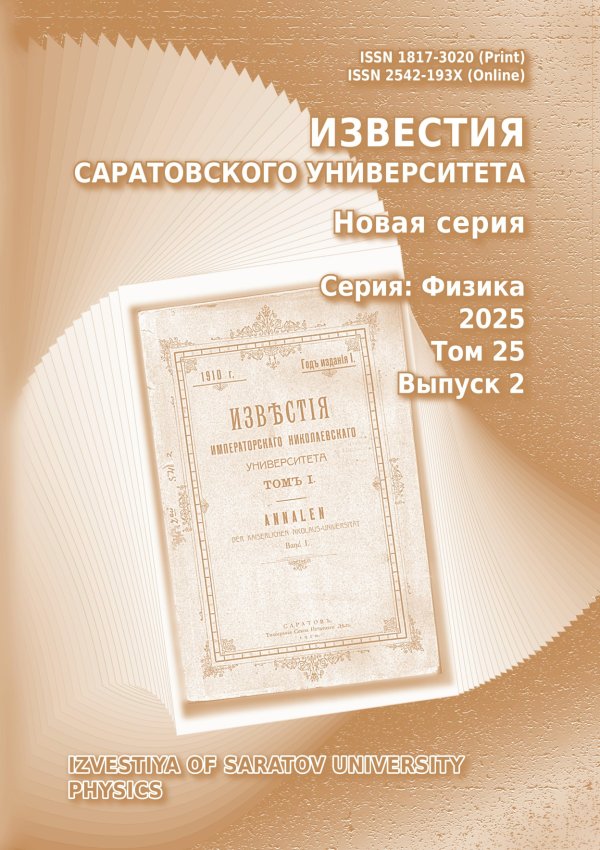
卷 25, 编号 2 (2025)

Radiophysics, Electronics, Acoustics

Ensembles of four discrete phase oscillators

Kuznetsov A., Sedova Y.

摘要

Background and Objectives: Ensembles of four discrete phase oscillators are considered. The aim of the research is to study and compare ensembles with different topologies of coupling: chains, rings and stars. Materials and Methods: We carry out the analysis using three-dimensional discrete maps for the relative phases of oscillators. We use the method of Lyapunov exponent chart, which identifies periodic regimes, quasi-periodic regimes with a different number of incommensurable frequencies and chaos. The various modes are illustrated using phase portraits. Results: We have found the regions of different regimes in the frequency detuning space of oscillators for different topologies of coupling. Resonances are indicated and illustrated both for pairs and for triples of synchronized oscillators, which corresponds to three- and two-frequency quasi-periodicity. We observe Arnold resonance web based on four frequency as well as on chaotic regimes. Conclusion: The ensemble of four discrete phase oscillators demonstrates a variety of quasi-periodic regimes with a different number of incommensurable frequencies, which are caused by possible resonances depending on the topology of coupling.
Izvestiya of Saratov University. Physics. 2025;25(2):134-146
pages 134-146 views

Recovery of compartment model parameters of dynamical systems for the epidemiological SIR model

Korobko M., Bukh A.

摘要

Background and Objectives: In problems where the model of dynamical system is known and the parameters need to be determined, researchers most often encounter the problem of ”getting stuck” in local minima of the cost function. Most known methods do not guarantee finding the global minimum, although they increase the probability of finding it. A known method of avoiding local maxima, which consists of simultaneously using several cost functions that behave differently in the vicinity of local minima, detecting the minimum as local, in some cases does not find a way to leave the region of the local minimum of the cost function. In this paper, we propose an improvement in the latter method, which allows finding the global minimum with a higher probability. Materials and Methods: In this paper, 4 different error values were calculated at each iteration of the parameter selection algorithm. The parameter values were saved when at least one of the cost functions reaches a new minimum value. Both the parameters were varied, and the random choice between the saved sets of parameters corresponding to the smallest value of at least one of the cost functions was made, when the procedure is “getting stuck” in local minima. Results: An improved algorithm for estimating the values of control parameters of ordinary differential equation models has been presented. The method demonstrates good results in restoring the parameters of the considered dynamical system both in the case of steady-state solutions different from the equilibrium state and in the case of transient processes. Conclusion: As the results of numerical modeling using the described algorithm have shown, preserving several sets of parameters that correspond to the best values of error values allows us to avoid local minima of cost functions with a higher probability in the presence of noise.
Izvestiya of Saratov University. Physics. 2025;25(2):147-156
pages 147-156 views

Optics and Spectroscopy. Laser Physics

Application of Au10 gold nanoclusters to block the formation of DNA from non-canonical forms

Ten G., Plaksin M.

摘要

Background and Objectives: The objects of this study are gold nanoclusters and nucleic acid bases. The aim of the work is to study the interaction of gold plates, for which gold neutral flat 2D clusters (n = 10) were selected, with canonical and rare tautomeric forms of nucleic acid bases (BNA), as well as complementary pairs of Ade-Thy and Gua-Cyt. Materials and Methods: Calculations of the structure and vibrational spectra have been performed by the DFT method using the Gaussian-09 program. Results: The different character of interaction of gold Au10 nanoclusters with rare forms of nucleic acid bases has been observed. Conclusion: This feature leads to the formation of covalent bonds between them, which makes it possible to block or limit the uncontrolled process of DNA formation from non-canonical forms.
Izvestiya of Saratov University. Physics. 2025;25(2):157-166
pages 157-166 views

Physics of Condensed Matter

Quantum shims in a strong magnetic field – carriers of electronic states with controllable quantum numbers

Mandel A., Oshurko V., Karpova E., Solomakho K.

摘要

Background and Objectives: One of the most promising properties of thin quantum rings – their selective properties for localized electrons in a magnetic field – is practically not discussed in the modern literature. Meanwhile, the spectrum of such rings can be reduced to a single stable level, all quantum numbers of which (including spin number) are controlled by the magnetic field. The electronic states of flat thin quantum rings of rectangular cross section, whose thickness h, inner radius Rin and outer radius Rex are related by the relations h ≪ Rex − Rin ≪ Rin, are considered; hereinafter we will call them “quantum shims”. This paper is devoted to select the parameters of a quantum shim so that it holds an electron only in a particular spin state. Materials and Methods: The equations for the radial function, which are of primary physical interest, are obtained by analytically solving the Schrödinger equation for this structure. Results: It has turned out that narrow-gap quantum shims in a wide-gap matrix have the most pronounced and fully controllable selection properties. To keep an electron in such a shim at a single stable level, an external homogeneous magnetic field of strictly defined strength is required. Each set of quantum numbers – radial, orbital and spin – corresponds to a unique value of field strength stabilizing this level. Conclusion: It has been found that this type of narrow-gap heterostructures in a wide-gap matrix can become basic elements for spintronic systems. Their spectrum in an external magnetic field can be reduced to a single stable level, all quantum numbers of which (spin including) are controlled by the external field. We have considered variants of changing the spin state of an electron localized on a shim by a longitudinal magnetic field.
Izvestiya of Saratov University. Physics. 2025;25(2):167-177
pages 167-177 views

Simulation the response of graphene to far-infrared pulses

Panferov A., Novikov N.

摘要

Background and Objectives: The emergence of sources of ultrashort high-intensity laser pulses has made it possible to subject various materials to a strong electric field without the risk of irreversible damage. Nonlinear effects observed under these conditions, such as the generation of high-frequency harmonics, have great potential for practical application. Graphene is considered one of the most promising materials due to the specificity of its band structure. The aim of the work is to demonstrate the applicability of the model based on the quantum kinetic equation in describing the results of the action of an external electric field with frequencies close to the lower limit of the IR range on the electronic subsystem of a material. Comparison of the model behavior at different values of temperature, relaxation time of nonequilibrium population and decoherence time with experimental data will allow us to estimate possible values of these parameters. Materials and Method: The work uses a quantum kinetic equation for the charge carrier distribution function in the state space. It allows one to reproduce the behavior of the electron subsystem of the material in an external classical electric field with an arbitrary time dependence. The spectrum of single-electron states is determined using the tight-binding approximation of nearest neighbors. The model parameters are the sample temperature, which determines the initial equilibrium distribution, the relaxation time of the nonequilibrium population of excited states, and the decoherence time. The implemented efficient computational procedure allows one to reproduce the characteristics of radiation induced by the action of an external field and analyze its spectral composition. The subject of comparison was the published results of experiments on the generation of high-frequency harmonics by far-infrared pulses at the TELBE facility. Results: The results presented in the work confirm the applicability of the used model for the frequency range near the lower boundary of the IR. It has been shown that under such conditions the external electric field forms a strongly anisotropic distribution in the conduction band with the population of states with high, up to several eV, energy values. In this case, the initial population of the conduction band, determined by the temperature of the sample at zero chemical potential, is much smaller than that created by the external field and does not significantly affect the observed results of the external field action. On the contrary, the relaxation time of the nonequilibrium population turns out to be the most important parameter determining the achieved values of the carrier density and conduction current. This is due to the fact that its value is small compared to the duration of the half-period of the external field. The estimate of this parameter made on the basis of the comparison with the experimental data is in good agreement with the expected values. Due to the insignificant role of the polarization current reflecting the dynamics of interband transitions, a comparison of the model behavior with the available experimental data does not provide criteria for estimating the decoherence time. Conclusion: The results of the work have shown the promise of new tools for modeling, studying, and qualitatively and quantitatively reproducing the characteristics of nonlinear effects under the action of an external electric field on graphene with frequencies close to the lower limit of the IR range. It has been shown that the distinguished role of the conduction current in this frequency range allows one to obtain an independent estimate of the relaxation time of the nonequilibrium population of excited states by comparing the behavior of the model with the experimental results.
Izvestiya of Saratov University. Physics. 2025;25(2):178-188
pages 178-188 views

Biophysics and Medical Physics

Sensing using SERS-substrate and machine learning approaches

Bakal V., Gusliakova O., Prikhozhdenko E.

摘要

Background and Objectives: Accurate and duly determination of glucose levels is critical for the diagnosis and control of diabetes. Recently, optical methods for glucose determination have become the subject of increased interest due to their potential cost-effectiveness, portability, and low invasiveness. Raman spectroscopy coupled with surface-enhanced Raman scattering (SERS) substrates demonstrates outstanding sensitivity through signal amplification and high specificity due to the unique vibrational spectra of target molecules. However, direct detection of glucose using SERS is complicated by the weak adsorption of glucose on metal surfaces and its low scattering cross section. Materials and Methods: Glucose sensors were constructed on the basis of polycaprolactone(PCL) scaffolds which have been modified using vaterite microparticles or filter paper (FP), both of which were then decorated with silver nanoparticle aggregates. The surface of the created substrates was assessed using scanning electron microscopy (SEM) on a MIRA II (Tescan, Czech Republic). To make the sensors specific for glucose detection, they were coated with a layer of glucose oxidase (GOx). To analyze the SERS spectra obtained as a result of measurements of aqueous solutions of glucose with various concentrations on sensors, classification models developed using the ensemble method RandomForestClassifier were used. Confusion matrices were obtained to assess the ratio of truly classified spectra. Results: Carrying out three cycles of modifying the surface of PCL fibers with microparticles of calcium carbonate leads to uniform overgrowth of the entire treated area. Additional immobilization of glucose oxidase (GOx) onto the surface of a matrix of PCL fibers with grown vaterite particles and a reduced layer of silver aggregates has provided selectivity for glucose detection when examining samples using SERS spectroscopy. The highest sensitivity in determining low glucose concentrations (1 mM) has been obtained for substrates with three sequential modifications of PCL fibers with vaterite and the reduction of aggregates of Ag nanoparticles from 5 M solutions of silver nitrate and ammonia hydrate with overall accuracy of 92.2%. Filter paper was considered as an alternative to using PCL-based scaffold. The reduction of silver was carried out without vaterite particles growth by varying the concentration of the reagents used (AgNO3, NH3·H2O). Sensors based on filter paper after the reduction of silver on the surface from salt solutions with concentrations of 2 M have shown overall accuracy of 90.2% and the ratio of truly classified 1 mM glucose solution of 88%. Conclusion: Increasing the number of cycles of sequential modification of the polycaprolactone surface with vaterite microparticles makes it possible to obtain a more uniform overgrowth, which was observed in SEM images, and, as a consequence, greater ratio of truly classified spectra at lower glucose concentrations. The PCL-based sensor (PCL/(CaCO3)3/Ag (5 M)) have outperformed FP/Ag (2 M) both with overall accuracy of classification (92.2% versus 90.2%) and 100% of truly classified spectra of 1 mM glucose solution.
Izvestiya of Saratov University. Physics. 2025;25(2):189-200
pages 189-200 views

Differences in the kinetics of optical clearing of healthy and diabetic head tissues

Shanshool A., Lazareva E., Surkov Y., Ziaee S., Timoshina P., Serebryakova I., Tuchina D., Genina E., Tuchin V.

摘要

Background and Objectives: Optical differentiation of pathologies is a promising tool for biomedical diagnostics, primarily due to its non-invasiveness and ease of implementation. The values of optical parameters andthe kinetics oftheir changes differ in healthy and pathological tissues due to changes in the tissue structure. In diabetes mellitus, such changes are especially noticeable. This requires detailed studies and the development of quantitative criteria for differentiating pathological (glycated) tissues. Materials and Methods: This paper presents an ex vivo experimental study of the optical and geometric parameters of rat head tissue samples under the action of an immersion liquid in the form of an aqueous 70% glycerol solution. Results: Optical and volumetric-weight characteristics were measured for rat head tissue samples (scalp skin, skull bone, dura mater, gray and white matter of the brain) in health and in model diabetes mellitus. Collimated transmission spectra of tissue samples were measured in the wavelength range of 450–900 nm. Conclusion: Analysis of optical transmittance kinetics over time up to 60 minutes has shown that all types of head tissue in diabetic rats exhibited impaired diffusion of test glycerol molecules compared to healthy rats.
Izvestiya of Saratov University. Physics. 2025;25(2):201-210
pages 201-210 views

Solid-State Electronics, Micro- and Nanoelectronics

Developed ternary processor units based on analog models of ternary logic elements

Semenov A., Venig S., Dronkin A.

摘要

Background and Objectives: The transition of digital technology from a binary base to a ternary number system, that is, the use of three possible states within one digit – false/uncertain/true – allows one to obtain a number of advantages and, in general, provides a real opportunity to increase the performance of microprocessor technology, all other things being equal. The presence of functional analog models of basic and additional combinational ternary logical elements in CAD systems allows the correct modeling of complex devices of digital ternary technology. So, the goal of the work is to develop the main combinational units of the ternary processor, which are main parts of its arithmetic logic unit. Materials and Methods: The software package for analysis and automatic design of electronic circuits was used to develop analog models of ternary logic elements. This program made it possible to analyze transient processes, parameters and interaction features of the developed logical elements and ternary digit units, based on such elements. Results: Based on analog models of basic and additional ternary logic elements, a controlled inverter, a single-bit ternary adder modulo 3, half-carry and full-carry circuits, a ternary half adder and a full ternary single-bit adder have been designed. Conclusion: The developed nodes, along with the previously presented basic ternary combinational logical elements, have allowed to further implement on their basis the heart of the ternary processor – the arithmetic logic unit.
Izvestiya of Saratov University. Physics. 2025;25(2):211-221
pages 211-221 views

Nanotechnologies, Nanomaterials and Metamaterials

Characterization of imprinted albumin by molecular modelling and spectroscopy

Ilicheva P., Reshetnik I., Drozd D., Pidenko P., Burmistrova N.

摘要

Background and Objectives: Imprinted proteins are promising alternatives to natural recognition systems, such as biological receptors or antibodies. However, the knowledge available on the theoretical study of imprinted proteins as recognition systems is limited. In this study, bovine serum albumin (BSA) is imprinted in the presence of 4-hydroxycoumarin. Change in protein structure is studied by molecular modelling and spectroscopy. Materials and Methods: To evaluate the effect of pH on the structural properties of BSA during imprinting, fluorescence 2D and 3D spectroscopy and dynamic light scattering (DLS) combined with molecular dynamics and metadynamics simulations were carried out to monitor the conformational change of the protein matrix. Results: Analysis of molecular dynamics simulation has shown that the mechanism of BSA conformational state changes is associated with displacements of molecular domains relative to each other. Based on molecular dynamics data, the values of collective variables have been selected for mapping the free energy of the system. The distance and angle between the centers of mass of domains D1 and D3 have been specified as collective variables. Simulations using themetadynamics method have been performed for 100 ns. As a result, slices of the potential energy surface have been obtained. Analysis of the free energy surface shows that 3.05 nm and 1.53 radian correspond to the minimum energy (ΔG = –6.14 kJ·mol–1). BSA have been studied by fluorescence and DLS. DLS analysis has shown that BSA exists predominantly in monomeric form in solution. In acidic media (pH 3.0) the significant changes of fluorescence properties of BSA have been observed. The results of molecular modelling are consistent with the experimental results. Conclusion: An important practical result of this study is that the theoretical study of such molecular systems combined with fluorescence characterization during synthesis can be applied to control imprinting process and to create new imprinted proteins with a wide range of applications.

Izvestiya of Saratov University. Physics. 2025;25(2):222-229
pages 222-229 views

The effectiveness of the effect of microwave radiation and convection heating on the relaxation of internal stresses in cured polymer composite materials

Zlobina I., Bekrenev N., Churikov D.

摘要

Background and Objectives: The relaxation of internal stresses in pressed carbon and fiberglass plastics under the action of bending loads after modification by heating in a thermal chamber and exposure to a microwave electromagnetic field has been studied. It is shown that for pressed carbon and fiberglass plastics under the influence of bending loads, relaxation processes of internal stresses are characteristic, the intensity of which is determined by the initial state of the material. Materials and Methods: In the experiment, three groups of carbon and fiberglass samples produced by Eurocomplant LLC in Kaluga were used in the form of plane-parallel plates with dimensions of 75x10x5 mm, cut from a panel with dimensions of 500x500x5 mm in the state of delivery. Experiments with the first group of samples were carried out using a special microwave technological installation assembled on the basis of the Zhuk-2–02 radiator (NPP Agroecotech LLC, Obninsk, Kaluga region, Russia) with a horn-type radiator. The time of microwave exposure was recorded upon reaching the set surface temperature determined by the Flir E-40 thermal imager (FLIR, USA). The second group of samples was heated in an artificial light-weather chamber Solarbox 522 model 1500e RH (COFOMEGRA SRL, Italy). The study of internal stress relaxation was carried out according to the three-point bending scheme on a laboratory computer installation with LabVIEW software (IP Mayorov, Orel, Russia). Results: Microwave exposure to carbon and fiberglass contributes to stress relaxation by (5.1–7.2)% and (6.5–9.8)%, respectively, depending on the magnitude of the external load. After heating in the thermal chamber, stress relaxation was noted by(4.4–6.8)% and (5.2–9.0)%. For control samples, the degree of relaxation is(4.3–6.5)% and (4.9–8.55)%, the process stops almost 3 times earlier than for experimental samples. On average, the degree of stress relaxation in samples after exposure to a microwave electromagnetic field is 18.5% and 12.8% higher for carbon fiber and fiberglass, respectively, compared with heating in a thermal chamber. Conclusion: Тhis indicates a greater effectiveness of the microwave method of heat treatment in order to stabilize the properties of PCM.
Izvestiya of Saratov University. Physics. 2025;25(2):230-241
pages 230-241 views

Methodological Part

About the envelope of the wave packet (pulse)

Davidovich M.

摘要

Background and Objectives: The methodological work considers the issues of the velocities and times of propagation of wave packets (pulses) through a medium layer of thickness d with dispersion. Methods: The spectral method of numerical calculation of the wave packet is used, taking into account the dispersion of the dielectric constant. Results: It has been shown that the output pulse appears no earlier than after time d/c, while it weakens and expands with the formation of a tail. Tunneling through a plasma layer has been numerically investigated, while no Hartmann-type tunneling paradoxes have been observed.
Izvestiya of Saratov University. Physics. 2025;25(2):242-254
pages 242-254 views

From the History of Physics

To the History of the Physical and Mathematical Research Institute of Saratov State University

Anikin V.

摘要

Background and Objectives: We provide information about the foundation of the Research Institute of Mathematics, Mechanics and Physics at Saratov State University in 1937, its structure, topics and first director Viktor V. Wagner. Materials and Methods: The organizational and vital details that accompanied the process of foundation and work of the Institute are clarified using data from the State Archives of the Saratov Region and the archives of Saratov National Research State University. Results: The article presents basic information about the activities of the Institute in 1937–1941. The structure of the Institute reflected the areas of scientific research (in the field of physics, mathematics and mechanics) that were formed at SSU in the 1920–1930s and were recognized by the domestic and foreign scientific communities, including at the congresses of the Russian Association of Physicists in 1924–1928. The analysis is conducted in the context of the historical conditions of the 1930s. (in particular, the emergence of a personnel “hunger” at the University). The Head of the University, Gavriil K. Khvorostin, appointed Viktor V. Wagner as the director of the Institute, since he had witnessed the defense of his doctoral dissertation at the Council of the Research Institute of Mathematics and Mechanics of Moscow State University (April 1935). At the same time, Khvorostin invited a number of mathematicians and physicists from the capital to take up professorships at the University. In 1939, Professor Georgy P. Boev became the director of the Institute. The work of the Institute was interrupted in the autumn of 1941. In 1945, the staff of the former Institute continued their work at the revived Research Institute of Mechanics and Physics of Saratov University under the leadership of Professor Petr V. Golubkov. Conclusion: The use of archival materials and newspaper publications from the 1930s made it possible to present not only reliable facts from the history of Saratov State University, but also to reflect the color and characteristics of that time.
Izvestiya of Saratov University. Physics. 2025;25(2):255-261
pages 255-261 views

Согласие на обработку персональных данных с помощью сервиса «Яндекс.Метрика»

1. Я (далее – «Пользователь» или «Субъект персональных данных»), осуществляя использование сайта https://journals.rcsi.science/ (далее – «Сайт»), подтверждая свою полную дееспособность даю согласие на обработку персональных данных с использованием средств автоматизации Оператору - федеральному государственному бюджетному учреждению «Российский центр научной информации» (РЦНИ), далее – «Оператор», расположенному по адресу: 119991, г. Москва, Ленинский просп., д.32А, со следующими условиями.

2. Категории обрабатываемых данных: файлы «cookies» (куки-файлы). Файлы «cookie» – это небольшой текстовый файл, который веб-сервер может хранить в браузере Пользователя. Данные файлы веб-сервер загружает на устройство Пользователя при посещении им Сайта. При каждом следующем посещении Пользователем Сайта «cookie» файлы отправляются на Сайт Оператора. Данные файлы позволяют Сайту распознавать устройство Пользователя. Содержимое такого файла может как относиться, так и не относиться к персональным данным, в зависимости от того, содержит ли такой файл персональные данные или содержит обезличенные технические данные.

3. Цель обработки персональных данных: анализ пользовательской активности с помощью сервиса «Яндекс.Метрика».

4. Категории субъектов персональных данных: все Пользователи Сайта, которые дали согласие на обработку файлов «cookie».

5. Способы обработки: сбор, запись, систематизация, накопление, хранение, уточнение (обновление, изменение), извлечение, использование, передача (доступ, предоставление), блокирование, удаление, уничтожение персональных данных.

6. Срок обработки и хранения: до получения от Субъекта персональных данных требования о прекращении обработки/отзыва согласия.

7. Способ отзыва: заявление об отзыве в письменном виде путём его направления на адрес электронной почты Оператора: info@rcsi.science или путем письменного обращения по юридическому адресу: 119991, г. Москва, Ленинский просп., д.32А

8. Субъект персональных данных вправе запретить своему оборудованию прием этих данных или ограничить прием этих данных. При отказе от получения таких данных или при ограничении приема данных некоторые функции Сайта могут работать некорректно. Субъект персональных данных обязуется сам настроить свое оборудование таким способом, чтобы оно обеспечивало адекватный его желаниям режим работы и уровень защиты данных файлов «cookie», Оператор не предоставляет технологических и правовых консультаций на темы подобного характера.

9. Порядок уничтожения персональных данных при достижении цели их обработки или при наступлении иных законных оснований определяется Оператором в соответствии с законодательством Российской Федерации.

10. Я согласен/согласна квалифицировать в качестве своей простой электронной подписи под настоящим Согласием и под Политикой обработки персональных данных выполнение мною следующего действия на сайте: https://journals.rcsi.science/ нажатие мною на интерфейсе с текстом: «Сайт использует сервис «Яндекс.Метрика» (который использует файлы «cookie») на элемент с текстом «Принять и продолжить».